Affichage des articles dont le libellé est AG. Afficher tous les articles

24 mars 2013

Paris expérimental (Lebrat)

Regarder Paris tel qu’il a été filmé par le cinéma expérimental, c’est se plonger dans une «contre-histoire du cinéma». Une conférence de Christian Lebrat, cinéaste et responsable des éditions Paris-Expérimental, illustrée d’extraits de films de cinéastes du monde entier, pour qui cette ville a été une inspiration, une référence ou une terre d’accueil.
Cette conférence a eu lieu le 5 mars 2013 au Forum des images, à Paris.


07 mars 2013

Perpetual Mash-up (Cyriak)

Bonobo : Cirrus (video by Cyriak; 4 Feb 2013) 3'23"

17 octobre 2006

DR9 - part quatre

Sorry for staling on this one, I'm not good at holding together this kind of wide study, it takes me time to re-focus on it. I will eventually get to the bottom of my notes, if there are still readers who care about it.

An art critic on a radio show about Art Brut, brought up an insightful taxonomy of art movements paralleled with certain mental disorder tendencies. The artist is always the lunatic among us... And it was interesting in correlation to Matthew Barney's Avant Garde, and the obsessions in his work we could easily qualify of symptoms.

History of Arts & Psychiatry
  • Mannerism (XVIth c.) <=> Obsessive Neurosis
  • Baroque <=> Hallucination
  • Siècle des Lumières Utopia <=> Rational Delirium
  • Symbolism <=> Melancholy
  • Art Nouveau <=> Hysteria
  • Cubism <=> Schizophrenia
  • Surrealism <=> Paranoia
  • Body Art <=> Perversion
  • Suicide Aesthetics (XXIst c.) <=> Death Pulsion
Matthew Barney's work could correspond to the last three, Surrealism (symbolism, free-association, subconscious inspiration), Body Art (physical performance, body choreography, prosthetics, mutation) and Suicide Aesthetics (fascination of death, decomposition, decay, destruction, mutilation)

Back to DR9, I wanted to describe the time line of the choreographed presence in the film of the Field Emblem sculpture, from beginning to end. Barney documents almost every state of its fabrication, because the making is part of the performance, and probably more important than the finished sculpture, which is in fact destroyed. Although the collapsed sculpture, solidified, is the artwork Barney sells as a "collectible" from a one-time performance. Thus perverting the idea of sculpture that means to produce the perfect replica from the mould, here Barney dismisses imitation and lets chance design the shape of his artwork. The artist only controls the process but cannot direct the final aspect. Actually he's more interested in the aesthetic of decomposition, a state when the object loses its contour. Like the compression of a Chrysler car in Cremaster 5. And the advantage of the petroleum jelly is it "petrifies" a semi-liquid state for ever once solidified. This petroleum cast is called Cetacea, and is obviously a metaphor of the live whale that is absent from the film. And the strange choreography around the mould, almost like a bee dance, contains all the significant subtext of the film. This symbolic message can be decoded however quite intuitively because the visual language is very simple. Actually I wonder what the crew of the Nishin-Maru thought of this "mascarade" and why they agreed to be part of it...


Phases of the Cetacea (Field Emblem)
The sculpture goes through a cycle of the 3 states of matter (gas, liquid, solid), from chemical/artificial (petroleum by-product, which is the result of decomposition of fossil organism) to organic (incorporation of ambergris, shrimp), almost symmetrical, rhythmically composed and marking the evolution/mutation at work on the lower deck between the Occidental Hosts (Barney and Björk), to mirror their "alchemical transmutation". The whole process could remind the slow and sophisticated operations necessary for alchemists to change lead into gold (the secret of the Philosopher's stone).
  1. AIR (empty) : Mould assemblage.
  2. LIQUID (chemical) : Fill up with hot petrolatum
  3. AMORPH (chemical) : Solidification of the petrolatum
  4. SOLID (chemical) : Bisection of the jelly block in 3 parts, insertion of the mid walls
  5. SOLID (chemical) : Removal of the petrolatum midsection, retrieval of the white spine
  6. SOLID (chemical) : Rotation 90° of the mould across the axis of the ship
  7. SOLID (organic) : Dragging of the ambergris log to fit in the gap
  8. SOLID (organic) : Rotation 90° back to initial position parallel to the ship axis
  9. SOLID (organic) : Reconstitution of the midsection around the ambergris log with shrimp and cement (allegory of the digestive restraint in the whale stomach leading to the formation of ambergris) by white clothed children.
  10. SOLID (organic) : Removal of the ambergris log, which melts down and infiltrates the ship, only remains the black spine
  11. SOLID (organic) : Midsection filled with more liquid petrolatum
  12. AMORPH (organic) : Disassemblage of the mould and collapse of the petrolatum into a shapeless cream
Read the rest of this analysis:

12 août 2006

DR9 - part trois

Whaling Imagery - The Absent Whale

"No whales are captured or slaughtered in the story; on the contrary, after a series of rituals and transformations, two new whalelike animals are created and released into the ocean." (from press release)

The iconic water blow or tail flukes so popularly associated with the whales didn't find their place in the film. The presence of a real live whale would probably invite impassioned identification with the victim of the food chain process documented in the film. The only whale appearing in the entire film is a CGI model in the title sequence. Although blood is shed, ripped apart, the whale swims across the screen steadily, like a spaceship. A stylized torture where the whale doesn't suffer.

Barney will describe every step of the ancestral tradition of whaling from hunt, roaming for weeks out at sea, to retrieval of the blubber oil on the factory ship. Only that the entire process is not filmed with real whales and blood, but in a clean abstracted way, each sailor performing a dramatized act as if on a theatrical stage, every professional gesture applied to a symbolic model instead of the animal. And that's why we could speak of an "Avant Garde documentary" of sort. We can sense a de-personification of the whale there, turning it into an object, an idea, a concept. Whale is food. Hunt is a need. Tradition is noble. Such is the surfacing message of this "stylized propaganda commercial" for the Nisshin-Maru, but we'll see the subtlety of a multi-layered meaning later in detail. A latent critique of whaling and a critique of human relationship to natural resources springs from the subtext and this artistic (read : cryptic) posturing.


Throughout the rest of the film, the whale appears symbolized by other (lifeless) objects. Its evocative shape incarnated by foreign matter, or whale by-products standing in for a whale.

  • Initially only evoked orally in the prologue song. A fisherman sent a letter to General Macarthur in 1946 to thank the occupying powers for the removal of whaling moratorium to provide the starving post-war Japanese population with whale meat. The choice to feature this letter introduces upfront an ambivalent political situation involving both the USA and Japan around whaling policies and also setting a tricky historical context of this diplomatic relationship around WW2. 1946 is also when the International Whaling Commission was founded.
  • Whaling factory ship, Nisshin-Maru, is a steel allegory of the whale itself. The story of Jonas (Bible) or Pinocchio, trapped in the belly of the whale, like the Occidental Guests are inside the belly of the massive ship. It could be seen as well for a metaphor of the Japan island, alone in the middle of the ocean.
  • The mould of the Field Emblem is designed/carved as to show the characteristic tail flukes shape on one end of the petrolatum pool and the throat grooves (ventral pleats) at the other end, once the solidified jelly is unmolded. We get a brief glimpse of these features, a black outerskin (rubber?) with flukes and grooves, before it collapses.
    The outer envelope of the petrolatum slab is made of a different material, black and more resistant, which signifies the hard skin of the whale (epidermis/rubber) protecting the white flesh inside (blubber/petrolatum). Although Barney didn't show this special preparation in the film, nor does he show when the plastic spine is installed in the mid-section (before solidification) that will allow it to be pulled out by a crane without collapsing.
    Coincidentally the 3D Field Emblem extruded in a whale-sized pool of petrolatum roughly looks like the sea mammal in its general shape, with a long fat body and small flippers on each side.
  • This representation of the whale skin (blubber and epidermis) is again used in the ship kitchen where the cook prepares a dish made of a white jelly with a black and solid top crush, in the shape of the Field Emblem.
  • An oversized ambergris log drifts on the ocean. It is first discovered by the Japanese oyster fisherwomen to emphasize its connection with seashells and oysters (it looks made out of a conglomerate of shrimp casing and cement, which are the material later used on deck by the kids), and then captured with harpoon, to emphasize its reality of being an actual whale within this setting.
    Note : Ambergris is a fatty substance produced by the whale's stomach to facilitate evacuation of squid beaks and krill casing that are indigestible.
  • An astute connection (that I had missed) with pearl oyster is explained on the SFMoMA website :
    Like ambergris, the production of a pearl in oysters results as a defence mechanism against the presence of a foreign (indigestible) object inside the host living organism. A grain of sand in the case of the oyster. Both are digestive leftovers turning out to be a luxury asset, in perfume industry for ambergris, in jewellery for pearl. The digestive allegory of The Path (mouth-stomach-anus) suggested something creative can result from restraint in the stomach (productive state). What best evidence can you get than creating luxury from excrements? Barney finds in nature a proof of his theory initially developed around artistic restraint and human digestion.
  • In the dressing room, a Japanese screen separates Barney and Bjork, displaying an old ink painting of a traditional whale hunt. Reference to the artistic rendition of a noble tradition (village whaling opposed to industrial hunt) when the battle actually required courage to face the sea monster on a tiny boat. Maybe an adventurous era reminding us westerners of the fantastic story by Herman Melville, Moby Dick, when the relationship between man and whale wasn't depersonified.
  • Before the ambergris log is captured and dragged on-board, the crew seems to play a game on the upper deck to pass time... Sailors pull by a rope a huge black garbage bag across the deck and other men train to hit it on the move with traditional hand-propelled harpoons (again reference to ancient times when whaling was noble). Once the game is over they rip open the bag, and a small model of a ship is found in this symbolized stomach full of shrimp (krill is the food of whales), like if this "whale" had swallowed a whaling ship. Back to the Jonas/Pinocchio myth.
  • Blubber, fat matter of the whale skin, is symbolized by Barney's trademarked petroleum jelly, in the mould. Incidentally, when processed into oil, blubber can be burned in lamps and used in paints, soaps, cosmetics, and other products. So Barney's association of his familiar petroleum jelly element, with whale is not inappropriate. It issues a meaningful substitute and hints at the correlation with fossil organic fuel (exploitation of natural resources by the oil industry). His obsession with petroleum jelly thus makes sense and constitutes a valid critique/apologia (within his artistic research) of human dependence on oil by-products.
  • A dispassionate whale slaughter is symbolically performed by the ship crew on this lifeless ambergris log, once hauled on the top deck, with stylized, choreographed gestures. They first honor it by pouring sake all over it in a formal ceremony, and drinking a toast to its well respected sacrifice, because according to Shinto religion, all creatures are sacred and life can only be taken with the utter most deference. The old, sculptural, traditional flensing blades are used to bisect the solidified petrolatum, and extract the plastic spine from the crossbar (which really gives materiality/animality to this abstract chemical pool).
  • Meanwhile the proper slaughter is enacted by Bjork and Barney in the tea room, with graphic close-ups of flesh slicing by flensing knives. Like if man turned this violence onto himself. The whale is after all a mammal like us, and some believe an intelligent creature with complex social behaviour. To me this scene really holds the key to Barney's position on the whaling debate, as this S&M display of mutual mutilation bears a violent symbolic significance. We really get a disturbing feeling of (literally) hurting ourselves when whaling is translated this way.
  • Regarding whaling ban (IWC moratorium since 1986) : Industrial whaling only continues in Iceland, Japan and Norway today.
    USA (represented by Barney). The discovery of petroleum in Pennsylvania in the late 19th century was the beginning of the end of commercial whaling in the United States as kerosene, distilled from crude oil, replaced whale oil in lamps. Later, electricity gradually replaced oil lamps, and by the 1920's, the demand for whale oil had disappeared entirely. Only native population of Alaska exercise whaling rights, although only until 1996.
    Iceland (represented by Björk) left the IWC in 1991 and rejoined in 2002 to exploit the loophole allowing industrial whaling for scientific researches.
    Japan (host of the film). Whaling is an ancestral tradition as far as 12th century. Whale meat was a primary source of food in the couple decades of WW2 aftermath. Japan continues to exploit the IWC loophole for scientific researches, and kills over 500 whales per year.
  • The Nisshin-Maru factory ship bumped a Greenpeace boat in 1999, which is the event recalled by the ship host during the tea ceremony, with elliptical words. The ship collided with a Greenpeace boat again in 2005 and 2006 (after completion of the film, and after the captain's speech about how profoundly shocked his conscience was).
  • The oil leak from the boiler filling the tea room could be interpreted as an ironic overflow (of sea water) inside the ship (without actually sinking). It is also an allegory for gastric acid in the whale stomach that decomposes meat and transform it into nutriment (here into sea mammal hybrids).

Read also previous posts :

1 (Introduction)
2 (Drawing Restraint series)
4 (Field Emblem sequence choreography)

11 août 2006

DR9 - part deux

The Cremaster Cycle was more complex symbolically, dealing with gender, morphology, mythology, psychology.
By contrast, DR9 is rather simple. It develops a simple idea, under multiple approaches and various forms, the allegory of the muscle regeneration. The whaling tradition in Japan is only an excuse to illustrate this theory. Barney's commentary on the whaling controversy is minimal and the borrowing from Shinto traditions is incidental (yet pertinent to his concept), almost indifferent.

The artist is not an accurate historian and resorts to provocation using somebody else's social taboos. This performance functions like a surrealist collage, displacing objects from their usual place, or meanings from their usual subjects. Inversion of objects to cause confusion of senses, to generate a language free of ready-made prejudices. The action disguised with new clothes looks new and we can perceive it differently, where the essence devoid of sense takes precedence on the container. It's a simultaneous clash of concepts rather than an apparent linear history.

DR9 is not about what we see, but going beyond appearances, engages an abstract reflection on the creative condition of humanity. To create implies to destroy. Destruction implies starting over anew with a stronger base, a deeper experience.


Few notes on the directing concepts of the DR series from drawingrestraint.net :

  • 1 - Hypertrophy : The Athlete is the alchemist
  • 2 - The Athlete is the artist
  • 3 - Houdini and the body intelligence, The artist is the athlete
  • 4 - Formal Perversion and Autoerotica. Three phases of the Path : Situation, condition, production. The artist/Athlete is the masochist in the margin

The Path :

  • Situation (mouth) :
    Raw drive, undifferentiated sexual energy without discipline or direction. undifferentiated foetus sex organ. Hunger, indiscriminate consumption.
  • Condition (stomach) :
    visceral funnel. Condition disciplines the oral intake of Situation. Undifferentiated field of energy begins to take form. Condition functions like the stomach, systematically breaking down the bolus ingested by Situation, nourishing it and encouraging growth.
  • Production (anus) :
    Anal output of the path. Two-headed dumbbell (unit BOLUS). Potential to close the three-phase PATH, joining the mouth (Situation) with anus (Production), enabling a mediation on an endless loop between desire and discipline.


DR Project
Resistance as a prerequisite for development and vehicle for creativity. Barney understands that when you work against resistance, muscular growth takes place in the body. The creation of obstacles that would make the act of drawing a physical challenge.

  • DR1(1987) - artiste strapped to the thighs with an elastic band to restrain mobility during drawing
  • DR2 (1988) - variation on DR1
    meditation on the desire to make a mark, and the discipline imposed on that.
  • DR3 (1988) - Weightlifter : Olympic barbell cast in petroleum wax/jelly. First piece in the series that rendered a character of refusal. Beginning of a more narrative approach to the DR project.
  • DR4 (1988) - Blocking sled (trains the legs and the explosive strength of an athlete) and petroleum wax plates pushed through a corridor in attempt to draw a linear drawing on the floor.
  • DR5 (1989) - Only piece in the series performed for an audience.
    Ceramic skeet thrower making marks on the wall. Drawing on the wall around the marks strapped to an elastic band.
  • DR6 (1989) - Self portrait drawn on the ceiling by jumping on a trampoline.
  • DR7 (1993) - video
    Render the character of refusal that emerged in DR3. Satyrs (ram & ewe) wrestle while attempting to draw a ram horn in the condensation of the moon roof with the tip of the ram's horn. Presumption punished by flaying.
  • DR8 (2003)
    Field emblem: "pill-shaped body with a superimposed rectilinear bar positioned over its central axis. The field represents self-imposed resistance placed upon an organic body."
    Inversion of the proposal, the metaphorical bar was removed temporarily from the body, allowing for an eroticism that the system hadn't granted itself before. stored energy is sacrificed for eroticism and the body begins to atrophy.
  • DR9 (2005) "begins with a procession at a Japanese oil refinery, where a tanker truck loaded with hot petroleum jelly is paraded from the factory gates down to the local harbour. The tanker is led by oxen, horses, deer, and a wild boar and is flanked by hundreds of Japanese revellers as it arrives abreast an enormous factory ship. The hot petroleum jelly has been delivered to the ship in port, where it is pumped into a massive, open mold on the aft deck. The ship departs for the Antarctic, and over weeks the mass of petroleum jelly cools. The cured surface of the jelly casting becomes a provocative reflection of the changing conditions of the seas. Whale processing methods and tools are used to facilitate the creation of this sculpture. The story culminates with the de-moulding of the sculpture as the ship reaches the Southern Ocean, with backdrop of luminous icebergs.The evolution of the petroleum jelly sculpture on the processing deck is mirrored by a love story which is unfolding on the second deck of the factory ship. The strict choreography of a traditional Japanese tea ceremony is the backdrop for a courtship of two western guests who are falling in love as they are served green tea by the ship's host. As the voyage ensues, the tea room itself becomes the tea bowl, as it slowly fills up with warm fluid. The western guests become enveloped in the fluid and undergo a mysterious transformation." (press notes from the website)
  • DR10 (2005) - variation of DR6 - performed in Japan.
    Additional marks added with a bamboo pole while climbing on a column. Drawing : visualization of the DR9 narrative, superimposed over the bodies of two whales.
  • DR11 (2005) - climbing on three walls at the exhibition gallery (Japan) to draw the three phases of the PATH.
  • DR12 (2005) - site specific performance in Seoul Korea.
    climbing of the wall of the gallery while drawing the 3 phases of the PATH.
  • DR13 (?) n/a
  • DR14 (2006) - site specific performance at SFMoMA. Climbing and drawing dressed as General MacArthur.

Read also the other posts on DR9 :
- 1 (Introduction)
- 3 (Whaling Imagery)
- 4 (Field Emblem sequence choreography)

03 août 2006

Drawing Restraint 9 (2005/Barney)

DR9 : Drawing Restraint 9 (2005/Matthew Barney/USA/Japan) +++

Opening Sequence
(pre-credit prolog) : Fade from black. Shape of an eye in a melon-sized fossile rock. The rock is shaking, a transparent fluid leaks out to the floor. Frame widens showing the stone stored under layers of papers. This is an abstract symbolic reminder of the subterranean elevating tracking shot through layers of earth in the opening of Cremaster 3.
-- Giftwarpping sequence, to send a prehistoric krill fossile to General MacArthur to thank his decision to end the anti-whaling moratorium, accompanied by the sung letter wrote on 13 july 1946.

(CGI Credits) : a CGI whale is sliced in the sea in a stylized fashion. Flensing knife-shapped letters assemble the words : Drawing Restraint 9.
-- Cut to a flyover shot over Nagasaki waterfront. Then a construction site on the beach where the mold for a petroleum jelly pier (holographic entry point) is built to the image of a land flensing ramp of ancestral whaling tradition.

Avant Garde cinema
Avant Garde cinema is less accessible immediately, but takes us closer to the unspoiled essence of an artist's mind.
AG cinema is less "movies" than Conceptual Arts, channeling a certain reflexion on art, form and metaphisics. Which could be terribly alienating to the casual observer. This level of freedom of expression is never achieved within mainstream cinema, where the artistic vision of the auteur is always encumbered by plot points, continuity, plausibility and commercial interests.
Matthew Barney claims his formative inspiration from Chris Burden, Vito Acconci, Bruce Nauman, Joseph Beuys, Marina Abramovic who influenced the emergence of the Performance Art movement in the 60ies and 70ies.
Body-art developped in the 70ies, the artist and his own motion is the work of art itself, video serving as an objective recording of reality. These happenings are spontaneous events with a physiological mise-en-scene. The body might be pushed to the limit of physical tolerance or subjected to a trivial/repetitive routine.

Drawing Restraint series (1987-2005)
A comprehensive survey of Drawing Restraint projects is currently exhibited at the San Fransisco MoMA. June 23rd - September 17th, 2006. Before it has been exhibited at Kanazawa, Japan (2005) and Seoul, South Korea (2006)

The organizing principle of this Drawing Restraint series comes from Barney's original combination of sport, medicine and art. To build stronger the athlete shall constrain his muscles, they would grow bigger. Thus the athlete is a masochistic alchemist who creates matter with self-imposed discipline and exercise. The cycle of muscular regeneration is compared to the digestive process in a ternary Path :
Situation (mouth) - Condition (stomach) - Production (anus)
The complex process of ingestion-digestion-assimilation becomes allegorical of the creative existence of the artist.
After looking closer at the other (non-filmic) installments of the series, the deeper subtext of DR9 came to light for me, making sense of the visceral and cluless admiration I initially experienced. Barney's aesthetics is definitely the coherent vision of an auteur, it is also founded on an intelligent reflexion which could be analyzed more carefully by an art critic, to sort out his positioning in the history of Contemporean Arts. I'm merely interested here in the elaboration of his universe and its resulting filmic instance.

DR9 : Matthew Barney's Cinema
As odd as it sounds, there is no fundamental difference between the installments he performs alone in his studio, strapped to an elastic band (DR1 to 6), and the making of this grandiloquent movie, only the scale differs. And it's impressive to see an artist develop his one idea through many different ways, indifferently. Here adaptated or transposed to the japanese tradition of whaling, the Drawing Restraint concept develops along the same "Path".
DR9 is the most narrative and explicit piece in the series, yet is hardly a narrative movie by cinema standards. This is mainly the cinematic recording of one of his sophisticated performances. Unlike narrative directors, Barney fully enjoys the multimedia potential of cinema. His use of cinema is free of prejudice and conventions, opening a fresh field of experimentation because he's not beholden to professionalism. Cinema isn't his only medium of expression, so his films aren't formated by distribution necessity or audience expectations.
Dialogue delivery and familiar body language are excluded. Barney's films are usually wordless, because his work develops the expressive physicality of the human body. He's a self-conscious athlete (football, wrestling, climbing) exploring the significance of intense muscular efforts. Therefore his mise-en-scene is mainly focused on choreography, gesture and apprehention of space. Compared to traditional cinema, this posture vis-à-vis acting performance is particularly interesting. Although the magic of cinema special effects and editing allow him to materialize life-threatening Body-Art fantasies like mutilation and amputation, for the audience to see, without the artist's real pain (which used to be determinant in traditional Body-Art).

Structure
Like in every experimental work, it's important to understand what is going on, and to pay attention to the forms that convey the directing concept, before flat out rejecting the "megalomaniac superficiality" of it all. Here the form is almost too simple, looking like an overextanded music video with funky production design. From my uneducated opinion, I'd assume Barney doesn't care too much to personalize the cinematic form itself, appropriating a ready-made medium quite naively and humbly, with very conventional use of editing and mise-en-scène, unlike most Avant Garde directors who usually strive to pervert the function and experience of cinema by altering it's traditional perception (eg. Brakhage, Kubelka, Tscherkassky, Martin Arnold, Mekas...). But maybe I'm underestimating this aspect. His true experimental work is in the very performance, and the elaboration of a coherent neological mythology.
There is a great description of the narrative story on Bjork's website
Two parallel events unwind simultaneously on the same ship without direct interaction but symbollical, mirroring allegories in contactless dialogue. The Occidental Guests never take notice of what is happening on the top deck.
The first event, articulating the rhythm of the entire film, is the processing of a Field Emblem sculpture made of petroleum jelly on the aft deck.
The other event is a wedding between two Occidental Guests inspired by Shinto ceremonial protocols. The petrolatum mold is the pulse of this happening, regulating at the slow pace of chemical solidification the protocol of everybody on this ship (and on the shore).
The bookend elements, Holographic Entry Points, that enclose the two events after the prolog, symbolize the Ise Shrine tradition of perpetual life recycling through (identical) reproduction. These flensing decks are ramps used to haul a harpooned whale on the beach in traditional whaling (before the industrial ships age). One is old, made of concrete, the next one is new, made of petroleum jelly, under construction during the duration of the film. Echoing the ancestral ceremony that rebuilds every 20 years the Ise Shrine anew to the side of the old one, which is burnt down in celebration of continuation. The ashes are kept in a box aside the new shrine.
Likewise the brand new ramp is cast out and revealed at the end of the film, and the concrete ramp is destroyed after a metallic box is hauled from the sea. So the fact the events take place during the shrine renewal process imprint this cycle of renovation to the film, which is at the heart of the Drawing Restraint concept of creative regeneration under constraining discipline.

The Occidental Guests seem to come to this peculiar ceremony without knowing eachother, like an arranged marriage. Their first encounter is anti-climactic, as it takes place in a quiet waiting corridor. Meeting wasn't a purpose of theirs apparently, unless their inner emotion is measured by the overwhelming etiquette. Then finaly unite after an erotical anthropophagic ritual.

The linear timeline goes: separation, transfiguration, union, mutation
  • Separation. Barney and Bjork are isolated, they are two dissociated halves (like in Plato's soulmate myth)
  • The petrolatum filling the two halves of the Field Emblem mold allows their reunion (chemical reaction)
  • Transformation with ablution and new costumes
  • The tea ceremony is a social restraint preventing contact
  • A storm breaks out when the cross bar (restraint) of the Field Emblem is removed at night
  • Chaos releases sexual energy drawing Barney and Bjork together
  • This is the opportunity for creativity and production. Like the blubber from the symbolic whale is flensed out and burnt in the boiler, the flesh of humans is mutilated and consumed, to give birth to a new hybrid.

Official Website
(s) ++ (w) +++ (m) +++ (i) ++++ (c) +++

* * *

Following up in the next post(s) :

* * *

This post is a contribution to the Avant Garde blogathon organised by Girish, check out the other participants:

13 octobre 2005

Secondary Currents (1983/Peter Rose)

More From the retrospective "La Pellicule du Chaos"

Secondary Currents (1983/Peter Rose/USA) 16' +++

"I'm an escape artist. I aspire to travel in the fifth dimension, to speak
unknown languages, to discover the next stage in the evolution of thought. I
construct structural parables that allude to the possibility of there being more
to the universe than is permitted by our explanations." Peter Rose

A strange narrator speaks an imaginary language, an unidentified voiceover subtitled in English on a black screen. Several voices overheard staging the verbal exchanges between a few characters, exposing with lyrical vocabulary the alienation of a foreigner arriving in a conservative community. The absence of images shifts the attention on the sonority of language, a sort of Esperanto sounding like Finnish or Native American Indian, sometimes Chinese or just freestyle gibberish, reminiscent of Dada poetry. Abandonned in the dark and missing the meaning of this language, the auditory experience focuses us on the intonations, the accentuations, the mood of the protagonists from their voice only. The subtitles, only graphic element shown on screen, become the center of the action. The traditional lower line of text translating the dialogue in a very neutral manner, takes liberties progressively, playing on the text format, alignment, verse composition, punctuation... As the quirky verbalisation we are listening to is futher complicated, soon the letters occupy the full space of the screen, and form disturbing mathematical equations where numbers are replaced by letters. Using all possible variation of a typeface, exponent, indice... When the furious cacophony is barely discernible the letters make a blinking canvas of textual matrix and words of a bigger scale appear against the background noise : "I destroy the language" "non-sense"...
An interesting reflexion on the operational mode of the soundtrack and our ambiguous relation to the onscreen information dephased or not with the audio content. It challenges the visual concentration and perverts the logic of language in our brains connections. It's mental sport!
Watching a lot of subtitled movies myself, I thought this little style exercice was particularly thought provocative and ironic. An experimentation related to the lettrist movement of Maurice Lemaître who used to distract annoyingly his audience with such visual mind-games in the 60ies.

Sample The other video clips on the site look great!

(s) ++ (w) +++ (m) 0 (i) +++ (c) ++

06 octobre 2005

Martin Arnold's cinematic stutter

From the retrospective "La Pellicule du Chaos" at the Centre Pompidou MoMA, a handful of Avant-Garde shorts under the theme of Deconstruction.

Pièce Touché (1989/Martin Arnold/Austria) 15' ++++

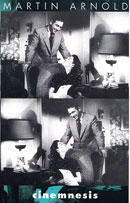
Everybody likes to play around with the backward/forward slo-mo wheel on a video editing table, but Martin Arnold, genius of the Austrian experimental scene, takes it to sublimation on a custom optical printer of his own making. He works with foundfootage in B&W, here it's a clip of 18 seconds from Joseph Newman's The Human Jungle (1954), decomposed in a back and forth stop motion increments, stretched out to 15 minutes. Unlike his later masterpiece Alone. Life Wastes Andy Hardy (1998), this first experiment doesn't distort the original voices of the onscreen characters, the soundtrack emits a locomotive beat resulting from the sequential interspreced frames. Thus the manipulation is purely visual in this piece, dealing with the fluidity of motions, either existing in the original continuity or created by means of mirroring, loops, reverse and any combination of all three.

The base material is a classic plan of an american middle class family: a woman sits in an armchair back to the door and reads a magazine as her husband comes home, kisses her and walks across the room in one pan. With his scientific system of frame duplication, "one step back / two steps forward", Arnold slightly animates a freeze frame with impersceptible movement. The woman starts to tremble in an epileptic convulsion as the door freneticaly opens and closes by itself. The slow motion decomposes every little expressions on her face, and the delayed loops trap the husband between doors unable to stop from banging the door like an obsessive-compulsive disorder. By a clever manipulation of adjacent frames that are the secret of the motion picture illusion, Arnold preserves the continuity of the moves originally filmed, therefore insuring the credibility and coherence of the seamless alterations. The two characters immortalized on film in a given scene become the helpless puppets of a machiavellian demiurge controlling the normal flow of time. Like for the door episode, the kiss is the center of attention and the mouths repeat an approach that seems bound to be repulsed until it explodes into a strobing flurry of electric shocks. Taking advantage of a certain symetry in the plan composition, a mirrored footage, horizontally then vertically, is also interlaced in the cataractous loops, which cleverly allows to double an apparent motion, started on one side, and pursued by a mirrored copy in reverse. This manipulation of pure motion reaches abstraction according to the duration of the loop. On a brief loop with a double mirror on a one-character medium shot, the kaleidoscope deceptively makes coexist alternate realities in one place, at a 24 frames per second rate, in the form of a 4-faced, 8-armed monster.

What is just a fun game of editor explores the microcosme of repressed possibilities contained in a banal plan and its 400 frames, ridiculing cinema conventions through a critique of the classic narrative form. The editing manipulation opens a whole potential of subverted meanings from the same footage, altering the impressions we get from images we are subjected to. It's like an extrapolation of the Soviet Montage theory adaptated to micro motion continuity, where the juxtaposition of frames with a common internal dynamic issue a different action according to the order of association: linear or alternative, successive or discontinued, backward or forward, confrontation of reflective directions. This little style exercice proves how easy it is to generate a language from any given footage, creating new shots, new camerawork, new stories without filming new material. Somehow negating the role of performances overwhelmed by a dominating montage.

(s) ++ (w) 0 (m) +++ (i) ++++ (c) ++++

15 septembre 2005

L'Ange (1982/Bokanowski)

Report from L'Etrange Festival (Paris -Sept 2005)


L'Ange (1976-82/Patrick Bokanowski/France) ++++

Words are helpless to describe the visual impressions of cinema, moreso when no reference to wellknown conventions and clichés can be made. This Avant Garde piece is an hypnotic trip constructed on a light/darkness stacatto, precautious frame by frame decomposition, recurrent action, repetition and variation. A wonderful work on lighting texture in a sepia hue and a precise editing assemblage. This one hour long montage is roughly divided into a 5 fold installment, examining 5 different scenes with the same technical experiments. Entirely silent with an added score composed by his wife Michèle Bokanowski, for a concrete music string quartet.

Patrick Bokanowski, an artist born in 1943, painter, photographer and filmmaker, lives and work in Paris. Experimenting optical effects of reflective surfaces, diffraction, liquid mirrors, distorted perspectives, motion and stillness with 2 feature length films and 5 short films in 16 mm.Probably the inspiration of the work of todays austrian Avant Garde (Tscherkawski, Widrich, Müller, Fruhauf)

A man with a japanese katana stabs on and on a porcelaine doll hanging from the ceiling at eye level on a wire. The first shot opens on a freeze-frame, the doll hit at the end of a dark corridor, paralyzed in a motion-blur, unrecognizable. Suddenly motion gives sense to this abstract image. This short sequence is played over and over, identical from various angles, backward and forward, step-by-step, superimposition of a delayed motion, homage to the chronographic studies of Eadweard Muybridge at the origin of cinema. (video sample)

Down in a librairy archive, glasses wearing book-rats patrol the shelves and stack piles of books on the scribe's desk who record them on the registry. This routine goes on faster with more clerks and more books each time, like a studious anthill. The precipitation of chain workers and the overwhelming accumulation of books is administered with fatalistic resignation.

In the style of an archaic silent comedy, a man with a melon hat and a big moustache takes his bubble bath with a dog. The many takes are interspreced in a cataractous editing. Many surrealist visions emerging from darkness, flashed by aesthetical spotlights. Strobe-lit staircase reminiscent of the etchings of Piranese's prisons. A naked woman in a giant cube.

(s) ++ (w) + (m) +++ (i) +++ (c) ++++

11 septembre 2005

Dali's surrealist documentary (1976)

Festival report : From L'Etrange Festival (Paris - Septembre 2005)

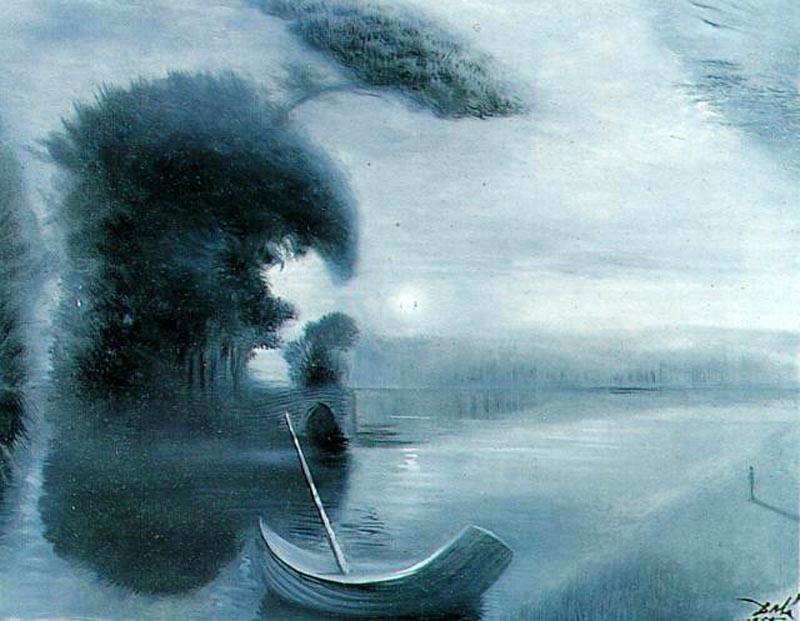
Metamorphosis of Hitler's Face into a Moonlit Landscape with Accompaniment, 1958

Impressions de la haute Mongolie (1976/Salvador Dali/José Montes-Baquer/Germany)

Homage to Impressions d'Afrique (1909), a free-associative poem written by Raymond Roussel (1877-1933), even though he never visited Africa. The film is dedicated to this french author, forefather of the Surrealists, who developped a formal constraint system to generate inspiration from dislocative puns.
Dali does the very same thing with this chimerical pseudocumentary leading us to the mysterious realm of High Mongolia where a gigantic, soft, white mushroom grows, many times more hallucinogenic than LSD! From his studio-museum in Cadacès (Spain), he proceeds to report with fake newspaper clips and newsreel on the alleged scientific expedition sent out by himself to retrieve this precious treasure. Childhood memories (like the picture above) are the opportunity to explain throughoutly the source of his inspiration. This bucolic landscape is in fact a close up of Hitler's portrait (his nose and moustache) turned to the side!
Wholly daliesque, this film experiment pieces together astonishing combinations on superimposed images, fading in and out, switching scale with odd perspectives. Dali invents a filmmaking process and applies his very language to cinematic purposes, bending the rules to serve his desperate need for originality. Travelling through a microscopic close up of paintings or the rough surface of a pen, his voiceover commentary gives sense to the landscapes taking form under his eyes. We get the chance to see some of his art, and watch the artist being his egotico-paranoid self (in French). A delirious experience, beautifully crafted. The backdoor to Salvador Dali's twisted mind.

This brought back fond memories of spending time staring at abstract motifs on tacky wallpapers, marble tiles or on geometrical rugs, discovering unmistakable faces and curious monsters or animals, that would later stand out everytime I'd lay my eyes in this area. The mind always tries to rationalize in an anthropomorphical way an image devoid of meaning, lacking recognizable features. The same game as discriminating shapes in the cumulonimbus. And suddenly we blink for a second and it's all gone, impossible to spot it again like it was before, even though we know it's right there before our eyes. I used to trace them over, as it was a rich generator of original shapes, but it never looks as real when the hand "improves" by filling the blanks on paper, adding a missing eye, or connecting dots. The creature emerging from a stain appears genuine and evident in its alien context only. Dali operates the same doctoring by overlapping his drawings on the footage to hint us how to read his vision. Then he takes it away and let our imagination build the rest, like a collective visual palimpseste.

(s)++ (w)+++ (m)++ (i)++++ (c)+++