Affichage des articles dont le libellé est Ozu. Afficher tous les articles

05 mai 2026

Ozu In Color (TCM/Every Frame a Painting)


Ozu in Color (Clip) | TCM Originals | TCM (YouTube) 10'26"
(Turner Classic Movies & Every Frame a Painting) 5 may 2026


"The cinema of Japanese filmmaker Yasujiro Ozu is explored in this new exclusive TCM Original.  

The creators Tony Zhou and Taylor Ramos are the duo behind the celebrated YouTube channel “Every Frame a Painting”, a collection of visual essays on matters of movies.

With Tony narrating, the duo reveal new insight and a richer appreciation of Ozu’s use of color in his films."


04 mars 2007

I Graduated But... (1929/Ozu)

Daigaku wa deta keredo / I graduated, but... (1929/Ozu Yasujiro/Japan)

10th B&W silent film made (Shochiku Kamata studio), 3rd surviving film (incomplete). Only 12 minutes remain from this feature length film, completed by intertitles. But it's not too difficult to follow the plot. Original screenplay by Hiroshi Shimizu, friend of Ozu. Filmed and released in the summer before the NY stock market crash (October 1929). The economic crisis is perceptible, young graduates struggle to find a job.


Tetsuo, the protagonist, is proud and turns down a receptionist job offer because it is not good enough for his level of qualification. When his mother visits him and his young wife, afraid to lose face, he lies about having found a great job. The japanese social status is identified through the work position held. It is primordial never to lose face in society. This distance between the fantasized role expected by the parents, the significant other, the neighbors, the colleagues... and a more modest reality is the root of many dramatical situations in japanese films. Saving appearances in the present is prioritized over the planning of a comfortable future. Thus extravagant expenses are made to impress visitors even if the family cannot afford it. Likewise the poor couple in The Only Son (1936), will sacrifice savings to honor the visiting mother.


Nevertheless he's happy to take out his mother for Tokyo sightseeings, but she's worried taking a day off from his new job would be impolite. So he's forced to live up to the condition of his lie, to wake up early and not spend time with his family like he'd want to.

After his mother left, he confesses to his wife through a visual cue, an interesting interplay between the silent image and the written intertitle. We see the cover of a "Sunday" newspaper, and the carton says "For me, everyday is like this". A discreet allusion, an euphemism, helping to communicate a shameful truth without the obligation of spelling it all out.


A wall-sized poster of Harold Lloyd's movie Speedy (1928/Ted Wild) takes a prominent place in the interior scenes, sometimes filling the entire background of a medium shot. I haven't seen this film, so I don't know what comparison we could thread from this citation. Although it's fascinating to see a contemporary foreign movie exposed this way, which is frequent in early Ozu silent films. The release of Speedy is only a few months earlier than I graduated, but...
We couldn't imagine this type of honor in today's cinema, with movies citing each other or showing the poster of last year's movie (except for intentional parodies), let alone the copyrights infringement and studio competition issues!


Ultimately, Tetsuo takes down his personal pride and lowers his expectations in order to find the smallest job at all costs, when he finds out the temporary job his wife has found to support the household was of a bar hostess, in a bar he visited with one of his student friend. We find this socially degrading situation in Brothers and Sisters of the Today Family (1941), where the unmarried daugther of a rich family is lectured by her older sister(-in-law?) about family humiliation. She's opposed to her project to take a job as a shop clerk, in the case she would face the humiliation to be served by her own relative.
The job of a bar hostess, who lights the cigarettes of customers, is also highly connoted sexualy.


Tetsuo comes back to the first company to accept the receptionist job. The moral lesson is well stated: His boss, who had a smirk and complicite looks with a colleague to emphasize the pressure in the first scene. Since Tetsuo has matured since their last interview, he concedes to give him a decent position in the company. It was only a test of modesty and submission to channel his young ego.

03 mars 2007

What Did the Lady Forget? (1937/Ozu)

Shukujo wa nani o wasureta ka / What Did the Lady Forget? (1937/Ozu Yasujiro/Japan) ++

37th B&W film made (Shochiku studio), 19th surviving film. 2nd Talky fiction.

Opening Sequence : Camera onboard a car, looking into the reflection of the back of a chrome spherical headlight. The car is driving across the rich neighborhood of a Tokyo suburb (Kojimachi). An odd shot we see in The Lady and The Beard (1931) and Dragnet Girl (1933), or in Epstein's La Glace à trois faces (1927).

Wealthy wives are established as castrating dominators in the house, controlling their husbands' timetable and activities, sharing gossips on neighbors and concerned by fashion and beauty. In an hilarious scene, the older lady tells the others how she muffles her laughter to avoid aging lines around the eyes. This ravishing comedy departs from Ozu's usual filmography (student films, mafia films, family drama) with an upperclass setting and a world essentialy dominated by powerful women.

Komiya, the husband, is a respected doctor at the university, cheerful and relaxed. We meet him his eyes into a binocular, answering the phone without looking away, and comfirming abruptly to the caller his sterilty from what he sees. Whereas at home he's bland and submissive. He lies and hides away to pass the compulsary golf weekend imposed by his ruling wife, Tokio.

The arrival of their liberated niece from Osaka, Setsuko, will expose the contradictions of their sustained routine. Setsuko, 16 yold, came to Tokyo for its modern life, and feels sorry for what she finds in this backward household. She wears western clothes, drives, smokes, drinks sake, and goes to the Geisha house. The spoiled brat of a rich provincial family, but so cute and high-spirited. Unexpectedly, as open-minded as she may be, she lectures her uncle for his passive attitude, and begs him to take control of the house back like a real man, even suggesting to beat his wife!


"I drink upon occasion, sometimes upon no occasion." Don Quixote

Ozu films twice this citation written in big letters above the bar counter, in a slow Close Up shot revealing word after word. We also see this citation in the bar of the film The Munekata Sisters (1950).
There is a scene in a Kabuki theatre where we see the faces of the audience, but never the stage, only music and voices are heard off screen.
Again Ozu repeats the trick at the Geisha house, until he finally films the dance number of 2 geishas in a long uninterrupted take!

Many comical situations punctuate the little household until the secret is discovered. Notably another hilarious scene where Komiya is supposed to lecture the undisciplined niece, but was asking her a favor instead, as his wife enters and they fake the argument.
Finally, Komiya explains to the young girl that sometimes a man should take the "opposite approach" : to let the wife believe she's in control. And she automatically notices this gimmick in the behavior of her boyfriend because he seems to approve whatever she says too often. A great comedic treatment of a critique of the conversational phrases and the mundane etiquette, just like in Ohayo (1959).

The ending is beautiful! After telling her (admirative) friends she got slapped in the face, almost proud, Tokio is transformed, in love again, as if she had lost hope in the virility of her husband. Back home she's all sweet and treats her husband with a late coffee, even though he's afraid to be unable to sleep if he takes a cup. Precisely it's what she has in mind. And he understands her unspoken desire while she's away, with a smile on his face. In one ultimate stationary shot : the lights go down in the house, one by one. All excited he walks in circle, backlit in the bedroom. And his wife comes back with the coffee at the end of the corridor. Black. The End. Isn't it a more subtle and amusing allegory for marital sex than Hitchcock's train/tunnel or fireworks metaphors? ;)


(s) + (w) ++ (m) ++ (i) ++ (c) +

26 février 2007

The Lady and the Beard (1931/Ozu)

Shukujo to hige / The Lady and the Beard (1931/Ozu Yasujiro/Japan) ++

19th silent film made at the Shochiku Kamata studio, shot in 8 days. 7th surviving film.
Comedy of manners confronting a poor misogynist bachelor, Kiichi, with 3 cute women : the street thug, the innocent low-class clerk and an aristocrat.

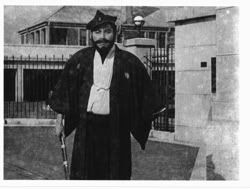
Kiichi is a Kendo champion, brave and honest, with a childish and asocial behavior, lives alone in a dirty appartment. His beard and repaired clothes ridiculize him in society. Ozu portrays here a stereotypical world opposing the ancient regime incarnated by the martial art tradition, kimono and facial hair, to the modern Japan of the westernized fashion, suits, office work. We can sense the inspiration of Chaplin humor in this negligent tramp causing etiquette troubles in public because he doesn't fit in.

The film opens at a Kendo tournament showing Kiichi hidden under his Kendo helmet, delaying the revelation of the face of the popular actor, Okada Tokihiko, and his notorious beard. During his domination of all opponents, only body language conveys the visual gags. His purely physical performance already identifies a peculiar personality, like Mifune Toshiro with his famous shoulder shake. It's an interesting establishing scene for a silent movie, where the audience cannot identify to the voice nor the face of the lead actor. And we have to contemplate the spectacle of this choreography of lookalike "puppets" battling together until we understand who is who.
In the street his confident saber skills help him to rescue a lone woman racketed by a street gang, conducted by a female thug. Invited at the fancy birthday party of an aristocrat heiress he scares away all the girls but leaves a strong impression with his traditional dance. Once convinced to shave his antic beard to become a modern gentleman, women will fall for him and he'll be embarassed by marriage proposals. The coincidence of three women from different social classes running after him creates a series of humorous misunderstandings. From unpleasant and clumsy he tries hard to seduce his chosen sweetheart.
Pure entertainment routine (one of the last ones) from Ozu's early period. The visual running gags are quite funny and staged with originality. Very amusing. There is an exterior travelling with the camera looking into a spherical chrome headlight of a driving car, which reflects the city streets, deformed. A shot Ozu used in other early films as well.
(s) 0 (w) + (m) ++ (i) ++ (c) +