Affichage des articles dont le libellé est Documentary. Afficher tous les articles

09 février 2026

Terry Gilliam (documentaire ARTE)


Le cinéma de Terry Gilliam | Documentaire | ARTE Cinema (YouTube) 52'38"
(ARTE Cinéma) 7 Février 2026


"Des Monty Python à "Brazil" et "L'armée des 12 singes", plongée dans l'univers baroque du réalisateur Terry Gilliam, au croisement de la satire, de la poésie, du cauchemar et de la comédie. Le parcours chaotique d'une véritable manufacture à rêves.

D'où vient l'imaginaire foisonnant de Terry Gilliam ? De son enfance à la Tom Sawyer, dans les forêts du Minnesota ? Des phénomènes de foire qu'il côtoya durant l'adolescence ? Ou de sa passion dévorante pour le magazine satirique Mad, qui dynamitait alors un pays corseté dans les clichés de l'American way of life ? Lorsqu'il débarque en Angleterre à la fin des années 1960, celui qui n'est encore que dessinateur s'illustre à la télévision, où il développe un style reconnaissable entre tous : l'animation, image par image, de collages déjantés. Il intègre au passage une joyeuse bande d’acolytes sur le point de changer la face de l’humour, les Monty Python. Après leurs sketches à la BBC, le succès fulgurant du film Monty Python : sacré Graal, que Gilliam coréalise, le propulse au rang de réalisateur demandé. Jabberwocky, son premier film en solo, adapté du poème de Lewis Carroll, affirme sa singularité visuelle et ses thèmes de prédilection : la misère et le merveilleux, au filtre d'un humour absurde, toujours sombre. 

À hauteur d'enfant

Le documentaire de Benjamin Clavel revient en archives et entretiens sur le style unique du réalisateur, son appétit pour le merveilleux et la poésie, contrebalancés par un regard satirique et cauchemardesque sur l'état du monde. La carrière de Terry Gilliam aura connu son lot de succès (L'armée des 12 singes) et d'échecs (les millions engloutis du Baron de Munchausen, les fiascos successifs de Don Quichotte avant, enfin, un film en 2021), ainsi que ses relations houleuses avec les grands studios américains et leur obsession pour le happy end. Que serait devenu son chef-d'œuvre Brazil, charge désespérée (et prophétique) contre le néolibéralisme et la bureaucratie, si Universal Pictures avait eu le dernier mot ? Une plongée spectaculaire au cœur de la manufacture à rêves baroques de Terry Gilliam, qui aura toute sa carrière rejeté l'imaginaire étriqué des adultes pour créer à hauteur d'enfant."

Le cinéma de Terry Gilliam, L'imagination au pouvoir 

Documentaire de Benjamin Clavel (France, 2022, 53mn)

22 juin 2012

Canadian indie distribution (KinoSmith)


The Seventh Art: Issue 4 (May 2012)
A profile of the Canadian film distributor, KinoSmith, where we talk to founder Robin Smith.
KinoSmith is an independent Canadian film distribution and marketing company that works closely with domestic and international producers, distributors and sales agents in presenting diverse works to the Canadian market.
Notable releases include the box office hit documentary Up the Yangtze, Werner Herzog's 3D documentary Cave of Forgotten Dreams, Academy Award winning foreign language feature Departures and Mark Cousins' epic The Story of Film: An Odyssey.
We sat down with founder Robin Smith in the newly renovated Bloor Hot Docs Cinema, where he is the new Cinema Programmer, to discuss the realities of distribution in Canada.
The Seventh Art is an independently produced video magazine about cinema featuring profiles on interesting aspects of the film industry, video essays and in-depth interviews with filmmakers.
View full issues and additional features on our site: http://www.theseventhart.org

Related:

08 mars 2012

KONY 2012

KONY 2012 (5 March 2012/Jason Russel/USA) DOC 30' YouTube [FR] / Vimeo / Official websiteWikipedia
KONY 2012 is a film and campaign by Invisible Children that aims to make Joseph Kony famous, not to celebrate him, but to raise support for his arrest and set a precedent for international justice.

HOW TO HELP:
Donate to Invisible Children: causes.com/donatekony2012 Purchase KONY 2012 products: invisiblechildrenstore.myshopify.com/Sign the Pledge: causes.com/konypledge
For members of the PRESS and celebrity REPRESENTATION ONLY: Monica Vigo pr@invisiblechildren.com


Related:

03 février 2012

La guerre d'Algérie (Manceron)

Conférence de Gilles Manceron, historien et vice-président de la Ligue des droits de l’Homme
Coauteur avec Fatima Benaci-Lancou de plusieurs ouvrages sur les harkis (notamment “Les harkis, histoire, mémoire et transmission” – Éd. de l’Atelier, 2010), Gilles Manceron a publié “La triple occultation d’un massacre” (Éd. La Découverte, 2010) sur le 17 octobre 1961. Extraits de films à l’appui, il évoque l’image et la représentation des Algériens et leur évolution.
Cette conférence a eu lieu le 1er février 2012, dans le cadre du programme "La guerre d'Algérie : images et représentations", au Forum des images, Paris. 
Films cités

Algériens (immigrés) invisibles ou sous-représentés :
  • Pépé le moko (1936/Duvivier/France)
  • El Djazair (le port d'Alger) (1948/Jean Leherissey/France) DOC
  • La corniche d'amour (1955/Jean Francoux/France)
  • Képi bleu (1957/Alain Pol/France) 
  • 58 2/B (1958/Guy Challon/France) CM 31'
  • Secteur postal 89098 (1959/Philippe Durand) CM 
  • Parfois le dimanche (1959/Ado Kyrou/Raoul Sangla/France)
  • Adieu Philippine (1960/Jacques Rozier/France-Italie)
  • Cléo de 5 à 7 (1961/Agnès Varda/France)
  • Les oliviers de la justice (1961/James Blue/France)
  • Demain l'amour (1962/Paul Carpita/France)
  • La quille (1962/Jean Herman/France)
  • Muriel ou le temps d'un retour (1962/Alain Resnais/France-Italie)
  • La belle vie (1962/Enrico Robert/France)
  • Les parapluies de Cherbourg (1963/Jacques Demy/France)
  • Elise ou la vraie vie (1970/Michel Drach/France)
  • Avoir vingt ans dans les Aurès (1971/René Vautier/France) 
  • Cher Frangin (1982/Gérard Mordillat/France-Canada-Belgique)
  • Liberté la nuit (1983/Philippe Garrel/France)
  • La guerre sans nom (1992/Bertrand Tavernier/Patrick Rotman/France) DOC
  • Méditerrannées (2011/Olivier Py/France) CM 32'
Véritable représentation des Algériens :
  • Octobre à Paris (1961-62/Jacques Panijel/France) censuré, sorti en 2011
  • La bataille d'Alger (1966/Gillo Pontecorvo/Italie-Algérie)
  • Les sacrifiés (1982/Okacha Touita/France)
  • Outremer (1989/Brigitte Roüan/France)
  • La Trahison (2005/Philippe Faucon/France)
  • Hors la loi (2010/Bouchareb/France-Algérie-Belgique)
  • Ici on noie les Algériens (2010/Yasmina Adi/France) DOC
Autres films de la rétrospective du Forum des Images (22 janvier - 2 février 2012) :

  • R.A.S. (1972/Yves Boisset/France)
  • La bataille d'Alger (2006/Yves Boisset/France) DOC
  • Chronique des années de braise (Mohammed Lakhdar-Hamina
  • Les Distractions  (Jacques Dupont)
  • Une si jeune paix  (Jacques Charby)
  • Algérie année zéro  (Marceline Loridan-Ivens et Jean-Pierre Sergent)
  • Patrouille à l'est  (Amar Laskri)
  • Les Folles Années du twist  (Mahmoud Zemmouri)
  • Pacification en Algérie  (André Gazut)
  • Le Petit Soldat  (Jean-Luc Godard)
  • A mon inconnu que j'aime  (Rémy Collignon)
  • Les Frères des frères  (Richard Copans)
  • L'Opium et le baton  (Ahmed Rachedi)
  • Rester là-bas  (Dominique Cabrera)
  • Algérie tours / détours  (Oriane Brun-Moschetti et Leïla Morouche)
  • Le Vent des Aurès  (Mohammed Lakhdar-Hamina)
  • Le Coup de sirocco  (Alexandre Arcady)
  • La Blessure, la tragédie des harkis  (Isabelle Clarke et Daniel Costelle)
  • La Question  (Laurent Heynnemann)
  • Algérie, histoires à ne pas dire  (Jean-Pierre Lledo)
  • Peuple en marche  (René Vautier)
  • Cartouches gauloises  (Mehdi Charef)
  • En finir avec la guerre  (Mehdi Lallaoui)
  • L’Ennemi intime  (Florent-Emilio Siri)
  • Gamila l'Algérienne  (Youssef Chahine)
  • Mon colonel  (Laurent Herbiet)
  • Paroles d'un prisonnier de l'ALN  (Salim Aggar)
  • La Chine est encore loin  (Malek Bensmaïl)


* * *
Autres conférences du cycle :

* * *

Révolutions
EST-CE AINSI QUE LES HOMMES VIVENT ? (12èmes journées cinématographiques dionysiennes)
Programmation de films issus du Printemps Arabe, à l'Ecran de Saint-Denis (Paris) du 1er au 7 février 2012. [PDF]

Tables rondes : 
  • Le 89 Arabe (avec Edwy Plenel, Benjamin Stora, Nouri Bouzid et Thomas Heise)
  • Table ronde "Les révolutions arabes, et après?" (avec Farah Khadhar, Khadija al-Salami, Charif Kiwan, Ridha Tlili, Tamer Ezzat, Hala Alabdalla, Karin Albou)
  • Carte blanche à AFLAM (diffusion des cinémas arabes)
  • Carte blanche à l’ACEA (Association du Cinéma Euro-Arabe) : « Faire du cinéma en contexte révolutionnaire » ; courts métrages inédits de Tunisie, d’Egypte, de Syrie et du Yémen, en présence de cinéastes. [PDF]
Films projetés :
  • TAHRIR 2011 : THE GOOD, THE BAD AND THE POLITICIAN de Tamer Ezzat, Ayten Amin et Amr Salama (Égypte, 2011, 90')
  • REVOLUTION UNDER 5’ de Ridha Tlili (Tunisie, 2011, 75’)
  • LE CINEMA SOUS LA DICTATURE EN SYRIE de Hala Alabdalla
  • BRÛLURES (work in progress) de Farah Khadhar (Tunisie, 2011, 10’)
  • LA BATAILLE DE DHIBAT de Salma Baccar (Tunisie, 2011, 12’)
  • LE MUR de Nabil Saouabi, Aymen Omrani et Rafik Omrani (Tunisie, 2011, 5’)
  • YASMINE ET LA RÉVOLUTION de Karin Albou (France, 2011, 9’)
  • REMARKING JANUARY 25 : A SERIES OF SIX de Philip Rizk et Jasmina Metwali (Égypte, 2011, 34’)
  • POURCHASSÉ d’Imed Aissaoui (Tunisie, 2011, 3’)
  • REGUEB d’Emilie Flamand (Tunisie, 2011, 2’)
  • L’INCUBATEUR DU SOLEIL d’Ammar al-Beik (Syrie, 2011, 12’)
  • YEMEN : LA REVOLUTION AU FEMININ (work in progress) de Khadija al-Salami (Yémen, 2012, 10’)
  • Films du collectif syrien Abounaddara
* * *
Comment filmer la révolution ? (La Grande Table; France Culture; 25 janvier 2012) [MP3] 85'

* * *

 Voir aussi :

14 décembre 2011

Doc filmmakers vs. Doc critics (CIFF)


Shamans · Animals

A response to the Film Symposium "Ethics and Documentary Cinema" (31st October 2011) held at the China Independent Film Festival Documentary (Nanjin)
Signed by several documentary filmmakers who participated and also who did not participate in the festival
  1. Demand that film critics buy their own DVDs (Xue Jianqiang)
    Reject how film critics have become the definers and arbiters of the morals and ethics of documentary film. Rather than simply passing judgement on documentary ethics, film critics should foster a film critique based on artistic intuition that, rooted in intrinsic film language itself, inquires into ethics.
    Reject a film critical perspective that is remote from common people, one that abuses a concept like “the lower strata of society.” Do you like this concept because you feel that you are in a position of superiority?
    Can an intellectual-style round table discussion have any possible constructive nature?
  2. Reject the way intellectuals use conventional concepts and actions to turn fresh and lively documentary experience into something uninteresting. (Cong Feng)
  3. If we see cinema as a private garden, is the critic the owner of the garden or only the gardener? (Zhang Chacha)
  4. The rigid theorizing of intellectuals turns the flow of discussion into something oppressive and boring. (Gui Shuzhong)
  5. For the past few years, it seems that we’ve abandoned discussing film language. It’s more fun discussing the ethics of social differentiation. (Jin Jie)
  6. Shoot films like an animal.
    Criticize (films) like an animal.
    Animals of a different species. (Qiu Jiongjiong)
  7. Critics cannot dictate history.
    Critics should learn from filmmakers, and not pretend to be their mentors.
    Artists teach themselves in the course of shooting their films; they establish their own ethical principles.(Cong Feng)
  8. Making documentary cinema reproduces the feeling of making love. The climaxes can’t be judged by the critics.(Song Chuan)
  9. Respect the diversity of and multiple approaches to creative artistic research.
  10. We’re not trying to start a revolution. We’re trying to shake people awake (while we get drunk).(Ji Dan)
  11. Revolutions are caused by arrogance, nothing more.(Ji Dan)
  12. Fortunately documentary filmmakers pay no heed to unreliable theory.(Gui Shuzhong)
  13. Theory is inflexible.
    Documentary
    Jealousy
    Excitement
    Are fresh and lively. (Gui Shuzhong)
  14. Filmmakers speak through their works
    Viewers ponder what’s on the screen
    Here come the critics, squawking and quacking a language of their own. (Jin Jie, Zhang Chacha)
  15. If theorists are the ones who can speak, and critics are the ones who can write, then the real thinkers are precisely those who neither speak nor write. (Bai Budan)
  16. When ethics are at issue, law is the criterion. (Feng Yu)
  17. Where is the moral introspection of certain critics and scholars? Enough with leaders’ speeches, already. (Cong Feng)
  18. Theory is related to reality. Theory also must keep up with the times. If critics stray from the works of art themselves while discussing theory, then their discussion will become like fog in the wind, vapid and uninteresting. (Gui Shuzhong)
  19. [missing]
  20. Talk too much about theory, and you sound pretentious. Overemphasize theory and you sound authoritarian. Life is not a two-sided coin: you have no right to force it to be either one way or the other. Of course, you can use theory to impress the kids. The motivation for documentary comes from a shame of one’s own ignorance. There’s no place for any talk of an avant garde or of theory. (Hu Xinyu)
  21. At present, the critics tend to a kind of literary writing style. Documentary films are treated as literature, as works of art. The critics seem to think they alone have the right to define a rational discursive interpretation of society. But this is in fact an act of cultural despotism, an act that is neither rational with respect to social reality nor with respect to art. Because of this, the rational discourse of the critics is a kind of observation at one remove. (Mao Chenyu)
  22. So-called theory is all for self-gratification. Independent film should not be restricted to the society’s lowest classes telling stories about each other. It should be diverse and multiple.
    Uninteresting, boring, useless.
    When you say you’re aligned with the lowest levels of society, you are in fact looking with disdain and contempt at the low from on high.
    Please use the word “intellectual” correctly and carefully. And please don’t use that word at this kind of independent film festival. It is not a term of praise, but rather a pretext to occupy a position high above the ordinary people. Is it really so hard to be modest and put yourself in someone else’s position? (Wang Shu)
  23. If possible, watch more movies. If you ever have the opportunity, then try to shoot a film. If you’ve never shot a gun yourself, how can you teach someone else to shoot? (Gui Shuzhong, Cong Feng)
  24. Yesterday’s forum took place at the Nanjing University’s News and Media Institute. Is it the job of our professors and scholars to teach students how make false statements sound like true ones? If those who teach students to lie boast that they are intellectuals, can there still be any filmmakers willing to label themselves “intellectuals?” (Beifang Lao =web alias)
Translated by Shelly Kraicer. Co-translator: Isabella Ho. With thanks to Yang Yishu, J.P. Sniadecki, Zhang Xianmin, and Cong Feng (cinemascope; 25 Nov 2011)

* * *

Some comments :

This is very sad actually to see that the new generation of Chinese indie filmmakers could not MEET eye-to-eye with the Chinese film scholars... it's like if an important rendez-vous of History was missed. I don't know which side was the most self-indulgent, which one was wrong... but surely, given the difficult state of cinema in China, being dominated by Hollywood blockbusters on one side, and by State-approved conformity on the other side, there must have been a strategic move to support the independent scene (critically acclaimed around the world), regardless for any shortcomings, in a country where artistic freedom has been repressed for so long! If filmmakers come to your table to discuss their artistic creation, the basic curtsy would be to LISTEN to them, and to walk half-way through to a neutral middle ground. For the sake of cinema!

I would usually take the defense of the Film Criticism profession, against the anti-intellectual sentiment that denies critics the right to scrutinize, with complete independence and no pressure, the production of art. Because it is easy to blame critics when they don't like your film, and reject film criticism altogether just because you're in denial about the shortcomings of your own work... That's not how it works. We have to accept and protect the existence of Criticism, no matter what, in times of praise like in times of harsh judgement. This said, critics ought to be held to the highest standards of evaluation as well! Too many reviewers pass judgements they aren't qualified to emit in the first place. This is why individual reviewers should be held accountable for the sustainability of the whole profession. And in this case, even though I'm not very familiar with the Chinese indie scene, I tend to agree with the plaintifs (for the most part). But some details need to be clarified...

  1. I agree. But this is a thorny subject.
    Free access to ALL production for critics is the only guarantee for an independent opinion. Charging critics to watch films put them in a position to reconsider whether certain film is WORTH paying BEFORE they even got to see it, thus establishing an a priori rating based on assumptions (not to mention segregating the number of possible reviews a critic can publish based on how many DVDs they can afford). One way to circumvent this issue, is to charge the media company employing the critics (they surely can afford to buy the DVDs).
    The reason I agree, even though it is against the fundamental liberty of criticism, is because the situation has changed with the digital age, especially for the smallest niches of art cinema. There are more people than ever reviewing films in the world, while the gap between the hegemony of blockbusters and the slim niche of artfilms widens. And, considering that the main demographic interested in artfilms today are active cinephiles who happen to be also festival-goers and film reviewers... not charging the critics community amputates a sizeable chunk of expected revenue from their potential audience! This is one reason why the artfilm niche shrunks... most people who would watch these films, have already seen advance screenings, festival screenings or DVD screeners.
  2. I've seen a couple of Chinese indie documentaries, and they haven't been as masterful as Wang Bing's West of Track or Jia Zhangke's Dong. They pride themselves in being amateurs and don't care about formalist correctness or political correctness. So it is very hard to compare them to "academic documentaries". But this is where the critic should use fairness and understand where this particular production comes from. Sometimes a new film form emerges from the destruction of certain established standards and conventions (1920's Avant Garde, Surrealism, German Expressionism, Film Noir, Soviet Montage, Cinéma Vérité, Direct Cinema, New American Cinema (1970's NYC experimental scene), New Hollywood...) When they arose they were dismissed for looking "rough", "failed", "imperfect", "unfinished", "amateurish"... but the test of time proved otherwise. So critics need a long term perspective and bet on the future potentials. Maybe they shouldn't be judged on the form, but on the content, the slice of life (and the era) they are witness of, the experience. It's hard to convince the critical establishment that celebrates the photo-realist formalism of the XIXth century to welcome the arrival of a new "unprofessional" style such as Impressionism... but in this case, the establishment was wrong.
  3. Good image to keep critics in their place and remind them to be humble in front of ART. Too often critics believe they have a say in deciding what the future of art should look like, while they are merely there to attest the current production, and make sure to not miss anything. The future of the art form itself is for artists to give it a go (and sometimes fail too).
  4. Here I cannot support the use of polarizing, anti-intellectual and subjective clashes such as "rigid", "oppressive" and "boring". You already lost the argument there. That's what criticism appears to people being criticized unfavorably... but criticism is judgmental, conceptual, intellectual, theoretician and "arrogant", by definition, because it implies the authority to value the work of someone else. Criticism is not evil, there are only faulty film writers. Demand highest rigor from people who practice criticism, yes. But don't direct your anger and frustration toward the critical institution itself. Film Criticism is there to help artists, not to battle against them.
  5. I don't know the background of this controversy around the question of "social ethics" that seems to be the main issue against this group of documentarists. 
  6. Probably the language barrier doesn't translate the full innuendo of this analogy. There is animality in the artist indeed. But critics should never think of themselves as equal to the artist in this domain. I get the point that critics are asked to put themselves in the artist's shoes to understand the condition of an "animal-creator", and produce a more organic, tolerant, adaptable, empathetic judgement. Yes, definitely. But the critic doesn't have the privilege, prerogative, excuse to resort to animality. 
  7. Exactly. See my comment #2 and 3. 
  8. Agreed. Funny way to put it, but that's the spirit, as far as passing moral judgement on how other people make love, or I would rather say how other people choose their significant other. Being in love is an inter-personal affair, with idiosyncratic taste and expectations. Nobody can judge what is somebody else's object of election, desire, life partner. But that doesn't mean the critic is forbidden to judge at all. The critic has no say in WHAT the artist wants to do, but it's the critics job to investigate where the artist is coming from and what (s)he is trying to achieve, and judge the results given the process.
  9. Definitely.
Then there are unfair comments against criticism and against the liberty for critics to do their job, which I cannot condone. Call the "critical establishment" incompetent, antiquated, outdated, out of touch with reality, tell them they are missing the point, that they focus on the wrong aspects if you think that the NEW Chinese cinema needs a NEW generation of critics updated to the new paradigm. But don't reject criticism altogether, or the right for a scholar to judge your work. It's not the critical principles that are faulty, but the individual persons who misuse them. It is possible, even for scholars, to be wrong. It happens regularly throughout Art History. In this, I agree with the point #18, 21, 22, 24 of their manifesto.

I feel bad that the current vital scene of Chinese digital cinema cannot walk hand-in-hand with the current generation of critics and scholars... their (respective) loss, but so be it. The art scene may strive in the margin of the establishment, no worries. The Academe will catch up later (hopefully sooner than later), because what matters above all is the artist community producing art TODAY! Every art lover would agree. We are glad that artists in the past stubbornly pursued their researches and experiments all the while being mocked, caricatured, dismissed and repressed by scholars, critics and society of their times, often to the point of never profiting of the value their art reached in today's market, dying poor and neglected. Art survives all hardship, and that's the beauty of the selfless faith of artists in their persistent inspiration. That's why we should admire and respect the dedication of artists.

(23) I understand the frustration of filmmakers being misjudged by "critics" who never tried to make a film in their life, and don't understand the amount of efforts and commitments it involves, while they click a number of stars on their computer to evaluate a film after sitting on their ass for 90 minutes. The fact is there are lazy reviewers out there, who think of their job as a factory job, rating the most films per day as possible to show off to their peers, to publish-or-perish...
However, Cinema cannot be judged only by people who make films... it would be a self-serving, corporatist enclosure patting itself on the back, or rivaling with eachothers for personal interests. The purpose of art criticism is to offer an independent point of view. The point I agree with is that critics are REQUIRED to know about the filmmaking technique, almost as well as a filmmaker, to be able to evaluate and maybe to be more understanding of the efforts put into a given shot before dismissing it.


Related:

24 octobre 2011

Life in a Day (Macdonald)

Watch Life in a Day on YouTube (channel translated in 22 languages), 28 October 2011 (official website / FAQ)


Life In A Day is a historic global experiment to create a user-generated feature film shot in a single day. On July 24, you have 24 hours to capture a glimpse of your life on camera. The most compelling and distinctive footage will be edited into a feature film by Joe Walker, produced by Ridley Scott and directed by Kevin Macdonald.
On July 24, 2010, thousands of people around the world uploaded videos of their lives to YouTube (86000 videos; 5000 hours of footage) to take part in Life in a Day, a historic cinematic experiment to create a documentary film about a single day on earth. Now, it's time to watch their story unfold on the big screen. Directed by Kevin Macdonald, Life in a Day wowed audiences at the Sundance (27 January 2011), Berlinale, Panorama (16 Feb 2011) [PDF] and SXSW (16 March 2011) film festivals and during its YouTube world premiere in January.

Commercial theatre releases : Internet, Russia, Kazakhstan, Germany, UK, USA (35000 spectators, 19 screens), Serbia, Canada, Hong Kong, Japan

User-generated contributors (Shoot location)
  • Massoud Hossaini (Kabul, Afghanistan)
  • Cristina Bocchialini / Ayman El Sayed Hassan (Cairo, Egypt)
  • Soma Helmi (Bali, Indonesia)
  • Hiroaki Aikawa / Taiji Aikawa (Tokyo, Japan)
  • Marek Mackovic / Okhwan Yoon (Kathmandu, Nepal)
  • Alberto Rauizo Gonzalez / Cain Abel Tapia Chavez / Aveliro Tapia (Arequipa, Peru)
  • Renat Ardilanov / Alexander Bayturin  (Moscow, Russia)
  • Patricia Marinez del Hoyo / Toniu Xou / Virginia Salvado Segu / Araceli Segu Muste (Barcelona, Spain)
  • Boris Grishkevich (Zakarpatska, Ukraine)
  • Harvey Glen (Dubai, United Arab Emirates)
  • Caryn Waechter (New York, NY - USA)
  • Christoper Brian Heerdt (Naperville, IL - USA)
  • David Jacques (Woonsocket, RI - USA)
  • Betsy DelValley (Urbana, IL - USA)
  • Bob Liginski, Jr. / Bobby Liginski III / Catherine Anne Liginsky (Grayslake, IL - USA)


Also featuring here : Berlin: Die Sinfonie der Großstadt / Berlin, symphony of a great city (1927/Walther Ruttmann/Germany) FULL FILM 1h02'


Related:

18 octobre 2011

Cambodge : culture exterminée

-Cultural Diversity Awareness-

Cambodge : mémoires contemporaines, du documentaire à la fiction 

Bibliothèque Publique d'Information, Centre Georges Pompidou, Paris. 10 Octobre 2011 [PDF]
2h18' video + MP3
Comment témoigner à chaud de guerres civiles ou de conflits? Le silence et l’oubli sont souvent considérés comme les conditions du retour à la paix. Mais lorsque l’apaisement repose sur la dénégation, on sait malheureusement que le retour de la violence est probable.
Écrivains, artistes, cinéastes prennent donc la parole et s’engagent à rendre compte en inventant de nouvelles formes de récit telles que la bande dessinée documentaire ou les films mêlant documentaire et fiction. Comment la fiction – dans le roman, le théâtre, la bande dessinée ou le cinéma – parvient-elle à toucher au plus près cette mémoire immédiate? La création artistique, l’imaginaire, peuvent-ils désamorcer le retour de la violence ? Pourquoi faire appel à de nouvelles formes de récit ? Quelles particularités chaque conflit présente-t-il qui appelle à ce renouvellement? Quels liens se tissent entre la fiction et le travail documentaire basé sur le recours critique aux archives, aux témoignages ?
avec :
  • James Burnet (remplaçant Rithy Panh à la conférence): ancient journaliste, collaborateur de Rithy Panh, centre de ressources audiovisuelles Bophana
  • Jean-Baptiste Pouh : Auteur, metteur en scène et comédien
  • Séra : auteur de bande dessinée historique, peintre, graveur, chargé de cours aux universités Paris I Paris 8. (Il est également connu comme peintre sous le nom de Phoussera)
  • Ariane Matthieu : Journaliste au magazine "L'Histoire"

Vann Nath (décédé le 5 Septembre 2011), 1 des 7 survivants des 17000 prisonniers du camp d'extermination S21, face à ses tortionnaires
Filmographie et bibliographie sélectives

Rithy Panh
  • Les Gens de la rizière, 1994
  • La Terre des âmes errantes, 1999
  • S21, la machine de mort Khmère rouge, 2003
  • Le papier ne peut pas envelopper la braise, 2009
  • Un barrage contre le Pacifique, 2009
Lire aussi : Cahiers du cinéma, n°487, février 2004 (consacré à Rithy Panh et S21)

Séra
  • BD Ciné, 2004
  • L’Eau et la Terre, 2005
  • H.K.O.1997, Impasse et rouge en 1995
  • Lady Mage Kane en 1986
  • Lendemains de cendres en 2007
  • Mon frère, le fou en 2009
  • Les Processionnaires de 2001 à 2003
  • Secteur 7, 2005
  • Sortie de route, 2000
  • Le Tour du monde en bande dessinée, 2009


Related:

11 octobre 2011

World Cruise 2010 (Eikawa Yuki)

-Cultural Diversity Awareness-

director : 永川 優樹 EIKAWA Yuki (born in Nagasaki in 1978) released a Blu-ray/DVD (official website)
"Cruising 17 cities in ten countries, everyday people's lives from dawn to midnight are captured with one DSLR with handheld stabilizer. No narration or background music clutter this film - instead, natural sounds recorded in each locale present a true-to-life environment. Amazing perspective opens before your eyes, and the bustle of the cities fills the air. Now you can travel the world right from your armchair."
  1. NEW YORK / USA 04:31
  2. TOKYO / JAPAN 05:35
  3. LONDON / UK 04:00
  4. CHEFCHAOUEN / MOROCCO 05:08
  5. AMALFI / ITALY 03:03
  6. KYOTO / JAPAN 05:15
  7. VARANASI / INDIA 03:50
  8. CUZCO / PERU 04:26
  9. VENICE / ITALY 04:03
  10. OLD DELHI / INDIA 01:59
  11. ISTANBUL / TURKEY 04:18
  12. XITANG / CHINA 03:18
  13. ROME / ITALY 03:18
  14. SHANGHAI / CHINA 03:09
  15. FES / MOROCCO 03:06
  16. BANGKOK / THAI 03:07
  17. UCHISAR / TURKEY 03:06
  18. WORLD - CRUISE 28:07


Cruise 2010 by 永川 優樹 EIKAWA Yuki (egawauemon; 36 videos)

Amalfi - Italy (28 April 2010) 15'27"
Walking in Tokyo by 永川 優樹 EIKAWA Yuki (egawauemon; 22 videos)
Originally posted at Unspoken Cinema

More on the YouTube channel here


Related :

07 octobre 2011

Global Lives

-Cultural Diversity Awareness-

Global Lives Project (website [EDIT: server back on]) Wikipedia 
Berkeley, USA. 2004-2010
Our mission is to collaboratively build a video library of human life experience that reshapes how we as both producers and viewers conceive of cultures, nations and people outside of our own communities.
Framed by the arc of the day and conveyed through the intimacy of video, we have slowly and faithfully captured 24 continuous hours in the lives of 10 people from around the world [China, India, Indonesia, Japan, Kazakhstan, Lebanon, Malawi, Serbia, Brazil, USA]. They are screened here in their own right, but also in relation to one another.
There is no narrative other than that which is found in the composition of everyday life, no overt interpretations other than that which you may bring to it.
By extending the long take to a certain extreme and infusing it with the spirit of cinema verité, we invite audiences to confer close attention onto other worlds, and simultaneously reflect upon their own. The force and depth of human difference and similarity are revealed in this process. Gaps which mark cultural divides feel, at once, both wider and narrower. This sense - that we, as humans, are both knowable and unknowable, fundamentally different as well as the same - opens a space for dialogue.
24h unedited video footage (plan sequences) available online on their website; here are the trailers:


James Bullock - San Francisco, USA (November 17, 2004) offline [10' excerpt] [YT trailer]


Israel Feliciano - São Paulo, Brazil (May 21, 2006)  [YT trailer]


Edith Kapuka - Ngwale Village, Malawi (May 2007)  [YT trailer]

  • Rumi Nagashima - Tokyo, Japan (July 2007)  [trailer offline]


Kai Liu - Anren, China (September 2008) [YT trailer]


Dadah - Sarimukti Village, Indonesia (October 2008) [YT trailer]

  • Muttu Kumar - Hampi, India (March 7, 2009)  [trailer offline]


Dusan Lazic - Vojka, Serbia (April, 2009) [YT trailer]


Jamila Jad - Beirut, Lebanon (May 15, 2009) [YT trailer]


02 décembre 2008

Les Statues Meurent Aussi (Resnais/Marker)

Watch part 1/3 (other parts on YouTube):

10 février 2007

Directors Lounge

For the 3rd time the Directors Lounge (8 - 18 february 2007) offers a place to showcase experimental videoartists from around the world, in the margin of the Berlin International Festival. Video installation, exhibitions, slideshow, animation, conference.

Organized by Marina Foxley (among others), don't miss her beautiful short films called Still Life, Errance and Scrap Metal (can be viewed online here and here with some of the other works).

Follow the news on the official program and the blog.
  • Special screening : Chinese Independent Documentaries
    China Doc in coperation with Fanhall Studios, Beijing Curated by Marina Foxley and Zhu Rikun, founder of Fanhall Studios. This special focus comprises of several long features and short videos and illustrates the singularity and the richness of independent Chinese documentary in a concise manner.

09 janvier 2007

Over There : documenting contemplation

2nd post for the Contemplative Cinema Blogathon at Unspoken Cinema.

Continuation from Là-bas (2006/Chantal Akerman/Belgium/France)

In February 2005, Chantal Akerman is asked to make a documentary on Israel. Taking position, shaping a vision is complicated. She's afraid to picture this difficult nation too lightly, to give an uneducated judgment of the conflict, to oversimplify politics at work. Not belonging to Israel is also a worry. She doesn't feel at home and she can't identify her peers either. These are the dilemmas Akerman contemplates hampered by the inhibition of her neurotic denial. Although reluctant to confront a caricatural banality of long-lived clichés, she installs a camera in her rented appartment nonetheless and lets it capture life through the windows.

The reflexion about the conception thus becomes part of the documentary itself, like a very personal meta-film, which turns out to be a creative justification on the impossibility to produce satisfying images. The limitations of cinema, as a regard, in descriptive explanations. What Akerman can't bring herself to say, the strict formality of her montage reveals it. This contemplative aesthetic takes a long pause to ponder, through the physicality of wait and silences (in place of intellectualized polemics), over the state of being in Israel, the resentment of exil, the uprooting of dispora. The ambivalent Jewish fate.

The cinematic space and the auteur's scope, in a symbiotic analogy, are both divided in four constructs layered in depth: Inside, Frontier, Outside, Away.

Her spontaneous, neurotic seclusion, takes a political dimension in the context of her own double exil. She's first exiled from motherland, Israel, because her family lives in Europe, and she's exiled again, as a foreigner, once in Tel Aviv because she can't pretend to be Israeli. A feeling of being elsewhere, always out of place.

She's a child of the second generation. Her mother bears the wounds of the death camps in her flesh, Chantal does in her subconscious. She says if she had been raised in Israel she would have ran around with the other kids in the street, but in Bruxelles, going out was forbidden and she watched the kids from her window. In this film, again, she assumes the childhood conditioning and watches from behind closed windows.

INSIDE (Exil) : Bunker-appartment, safe hideout, passive observation, centrality, immobility. She is in Tel Aviv, but the closed doors make her appartment an alien territory, away from Israel, which only shows out of the windows. A microcosm in truncated details, out of context. All screens pulled down on the windows create a camera obscura, the reality from outside filters in through the gaps. We're in Plato's myth of the cave : the silhouettes at the windows are the only reality she knows of Israel.

FRONTIER (Curtain) : Initial distanciation from her environment, ambiguity conceal/reveal, overframing. The large bay-window filling the screen, replaces the cinema screen, stands for a TV screen to display movies or the News. Relating her experience to the theatre audience.

OUTSIDE (Street) : Homeland, heartland, motherland, Tel Aviv, Israel. The first layer is the invisible street down below that emits a muffled ambient noise (sound without visual). The second layer across the void, is the facade of the building, replicating/mirroring her "inside", only as seen from outside, behind their walls and curtains (partial visual without sound). Each window is a TV screen to contemplate, with its own "soap opera" with recurrant characters.

AWAY (The world) : Ideal hope. Immense, global, invisible macrocosm, out of reach, impossible to grasp. Represented by 3 elements. The planes in the sky, going to another exil. The sea, open on all sides, the polar opposite of her cealed bunker. The phone line connecting to friendly voices, breaking the exil, folding space, canceling the distances.

* * *

Sous le ciel lumineux de son pays natal (2001/Franssou Prenant/France)
A companion film to Akerman's documentary would be a similar work by Franssou Prenant who tells her return to Beyrout in Lebbanon (on the other side of the Israeli border). She interviews her friends, off-screen, who stayed there and recall her memories from before the war, her impressions of the changes, against a handheld reportage through the streets.

La-bas (2006/Akerman)

This post is my contribution to the Contemplative Cinema Blogathon. Check Unspoken Cinema for all the updated contributions and the roundtable discussions with other participants.


Là-bas / Over There (2006/Chantal Akerman/Belgium/France) ***

The film starts and ends inside someone's empty living room, respecting the rules of dramatic unity (one space, one time, one action). A precautionary look at what's happening outside. The shots are always static and patiently pursued in long takes. If the framing is artisticaly composed, it lets however the audience's gaze wander around and select our own acumen. Little action animates this quiet scrutiny of the neighborhood, from various angles, through the straw-screens. A textured curtain of proximity and disconnection. Lacking any hint of a narrative subject, these silent images denounce the passivity and voyeurism of a cinema viewer, which strangely echos the filmmaker's own state of mind in Israel.

After a while, mundane noises announce a presence we'll never see. As we imagine her making coffee in the kitchen, eating fruits, walking around, typing on her laptop, Akerman invites us to share a slice of her dailylife and witness her self-imposed seclusion. Thus the camera isn't Akerman's own eye, but a supervisor planted next to her. It rolls, nonchalant, as she stays off-screen doing other things.
Her voiceover commentary will come later to incorporate her developping ideas. She talks about triviality (food, traveling, mood, work, family memories) in a diary fashion. It could be an essay film in-progress, observing itself being made. From the notes, to denial, to idle shooting, to making of, to meta-documentary, to film. All in one.
A phonecall in French, with her mother or a friend, explicits her situation : she's fine, a little tired, her stomach was sick, she has work to do. Another phonecall in Hebrew and English, with a local friend, says she'd rather stay home. Three interlaced idioms remind us the communication barrier in a foreign land. From this remote sanctuary, the phone links to the world, literaly, all the way to Belgium, and right outside in the city. It's her only human contact. Our only context to the film. And an opportunity for a diegetic monolog.

Shortage of food imposes a leap to the shops. Not the israeli salads! they made her sick... This upset stomach could be a psychosomatic symptom due to her resistance to go out, or a subconscious incompatibility. Everything seems to approve her self-imprisonment. Her vocal introspection shares with us the irony of these coincidences.

All the while the digital camera peeks views of the buildings across the narrow street of her only landscape, over-framed by the curtains. Her neighbors become the involuntary protagonists. Through recurring shots of extensive length, we get to familiarize with some of them appearing now and then at the windows. There is an old retired couple up there, watering the plants every day. Noises of cars driving in and out. An old lady smoking on a tiny balcony. Children shouting nearby. A group of people in the street.
We can only imagine the words of their conversation. We listen what we can't see off-screen, we see what we can't hear. Our senses are dissociated. The mind will reconstitute the puzzle of a larger reality. Our voyeurism projects a judgement on them as we profile their supposed personality. These shots unroll silently, patiently, waiting for something to show up, or not.

And the montage cuts from this window to that balcony, like if skipping channel on a TV. They are like small silent films, from a surveillance camera. The almost-real-time contemplation translates the apprehension of dailylife rhythm in this quarter. We are there. We live there.
The sun drags the shadows across the facade, from underexposed to overexposed. The intensity of daylight evolves and creates a new environment, more or less oppressive. Texture, color, depth constantly vary.
The images fabricate a de-facto narration, in the absence of a stated plot, because they contain their own fragmented stories, those of real-life people, an intimate microcosm. The scarcity of sightings makes the observation riveting and the wait rewarding. At the antipode of Rear Window, Akerman recreates a dramatic tension out of nothing (what's already there) with her frame.
Them on one side, and her on the other end, and us. The narrow field of the tele-lens, the minimalism of details, transcend the archetypal features of a neighborhood, so we can relate to this confrontation to the "Other" painted in universal tableaux.

Là-basOn her exceptional visit to the beach, we can at last breath the open air. Same contemplative static shots observing from the distance the stroll in the sand of an orthodox family and tourists alike. Both the people and the filmmaker face the horizon. Over there. One always dreams of a hopeful elsewhere. The titular "Over There" that meant Israel from a european perspective, here, in turn, names the world beyond the sea : Europe, home, USA.
Just when she returns from the shop, she learns about a bomb attack on the beach, around the corner. Akerman is under shock in her appartment, and doesn't stigmatize the incident in spectacular pictures like the Israeli news. This bomb hides in words to us.
The phone rings again and she lies about her fear to appease her friends. The shot angles are the same routine but the atmosphere is more severe and the tone more serious. She notes her aunt Ruth in Bruxelles and her friend's mother in Tel Aviv both commited suicide around the same time. Why suicide in Israel just like everywhere else? Isn't it the promised Land?

The film is making itself in the camera magazine, overcoming her initial reticence. The intuition of the filmmaker succeeds where her intellect backpedalled.

Berlin Festival 2006 - Forum
(s) +++ (w) +++ (m) +++ (i) ++ (c) ++

03 mai 2006

Los Angeles Plays Itself (2003/Andersen)

Los Angeles Plays Itself (2003/Thom Andersen/USA) ++

During nearly 3h, this documentary reviews movies shot on location in Los Angeles in a long series of clips to figure how the city hosting the cinema industry Meccha is represented by Hollywood fiction films. And of course this collection is ripe for goofs, discontinuities, inconsistencies and outrageous shorthands. The irony towards a notoriously superficial popular culture is lacking however... I didn't understand why the narrator took such a pompous tone and dramatized every geographical misinformation as if anyone would expect fiction drama (especially pop flicks whiches are the bulk of the films cited) to be educational, and pay attention to map accuracy, and buildings real-life functions... Everybody knows that cinema uses reconstructed sets or squatt actual locations to refurbish them with a new set design to suit the script requirements and material constraints. Shutting down a public street for a day of shooting is very expensive and much difficult to pull off, so geographical continuities are the least worry of movie producers. Let alone the audience who couldn't tell the difference anyway.

This ends up being a refined trivia factoid for IMDb geeks, which is amusing from a cinephile point of view, as thematic or geographical parallels are drawn between movies made years apart, across a diverse array of genres and situations. But it hardly justifies the intellectual pamphlet suggesting a scholarly study of social and political contexts should be at the heart of every bad movie production. How utopic and naive. Thom Andersen, who speaks through his narrator, introduces himself as a bitter native inhabitant from Los Angeles who blames Hollywood for failing to document a faithful rendition of the city he loves.
For instance, Hollywood initiated the use of the acronym shorthand "L.A.", he concludes : only a city with an inferiority complex could tolerate such offense... I guess same goes for NYC and DC then.

Hollywood movies are dubious and unreliable? What's new? Like if it mattered... That's why they shouldn't be taken at face value.
I mean the geography angle is probably not the first in mind to scrutinize the relevance of popular cinema culture. These people can't even get a plot straight. Deceiving screenwriting in mainstream entertainment is a global issue that affects not only the very place where a cinema industry has implanted itself (Roma-Cinecitta, Bombay-Bollywood. Moscow-Mosfilm, Paris...), but whichever lookalike location is the cheapest to respect the budget. Is there any city in the world that could claim an acute rendition by the movies? It's always postcards, stereotypes and embellishment...

I've never been to LA, and I don't think I got a more comprehensive picture of the city afterward than I had acquired through movies and TV... The documentary essentially cites fiction footage evidence, and too rarely compares with newsreel or reportage images. I wish Thom Andersen had been out in the street with his camera and offered his own travelogue of the genuine city life, to confront fiction to reality in the educational way that would correct the misconceptions propagated by Hollywood.

Andersen speaks of high-brow tourist filmmakers like Antonioni, Hitchcock, Polanski, Jacques Deray, Jacques Demy (incidentally all non-american and auteurs) who give a better representation of the city than low-brow tourist directors who make inconsequential plot-driven, cliché-cluttered flicks... who would have guessed? The name-dropping is a little facile just to make cheap cinema look cheaper with such a manichaean contrast.

I don't mean to defend mainstream flicks, but that's the least flaw, most superficial issue, one could reproach them... And LA doesn't need an onscreen presence to exist. Andersen seems concerned by a "literal" neorealist depiction of the city. Paradoxally, his grief takes the movies too literally. The utopic/dystopic idealization/stylization of the city, its artistic interpretation, high-brow (art-film) or low-brow (TV series or commercial), are what convey the strongest mythology in popular culture. The raison d'être of pop culture isn't to document but to translate and extrapolate the people's secret fantasy.

It's an easy game to pick random scenes and perform a reality check. The whole documentary is set up to illustrate a these established beforehand, and the biased selection of clips tells. Is it fair to Hollywood trends? Is it even fair to Los Angeles? There is truth in there, nothing that we didn't know already though, but a different series of counter-examples could as easily make a cheerful apologia of the affective relation between Hollywood and Los Angeles' real-life locations.

The project sounds excellent in a book form, with pictures, because the commentary is quite literary, written with solemn and emphatic tone. Unfortunately, the narrator's grave discourse and the funny zapping-images seem to run after two separate goals. If it's an homage to LA in movies the documentary shouldn't take itself so seriously, if it's meant to restore the true face of LA then the documentary shouldn't rely so much on the poorest pop culture.

It's a really interesting overview of the role of a location in fiction movies, to study social environment, political implications, cultural evolution in visual media. This historical patchwork through cultural and economical generations explores the representation of clichés such as policemen (LAPD), cop killers (bad cops, dead cops), social segregation (flatlands, hilltops, downtown), transportation (streetcar, bus, taxi, traffic jam, highway interchange, gas station, train station, airport, walk...), architectural styles (Modernism, Frank Lloyd Wright, Richard Neutra, revival...), tourists, clubs, landmarks...
The second half gets more investigative. It's full of food for thoughts regarding social and urban studies (demolition of some areas, racial segregation, cultural communities, public housing, public space), as well as it's historical developments (water supply, beach and hills constructions, land speculation).

Finally the last half-hour becomes a loving cinephile homage to a very specific quarter of LA cinema, the black independant filmmakers. With longer clips of Kent MacKenzie, Charles Burnett, Haile Gerima and Bill Woodberry, a neo-realist contemplative B&W cinematography, portraying the struggle of ghetto communities. An aesthetics reminding early Jarmusch that I would like to watch now. The Exiles (1961/MacKenzie), Bush Mama (1976/Gerima), Killer of Sheep (1978/Burnett), Bless Their Little Hearts (1984/Woodbury). These are the only titles the documentary made me want to track down.

The documentaristic research in Hollywood archive is impressive and certainly worthwhile. There is enough material for 2 films, and I would have prefered them treated separately for coherence. Each with their own due tone and angle, the first humorous for derision, zapping through clips and cinephile trivia (with a more appropriate commentary) and the second more serious and indepth, historical and political (with the same sententious commentary).

The film received excellent ratings so I expect vociferous disagreement, and it's ok. I just hope it wasn't offending for me to express a somehow dissenting opinion for relativisation of the general praise.

(s) ++ (w) +++ (m) + (i) ++ (c) ++

Recommended related articles (more positive review than mine):

09 décembre 2005

Grizzly Man (2005/Herzog)

Grizzly Man (2005/Werner Herzog/USA) DOC +++

Herzog watches lovingly the footage filmed by this self-made actor-director, Timothy Treadwell, ecolo-activist who felt invested in the mission to protect Grizzly bears against the evil of civilisation in the remote wilderness of Alaska. A captivating posthumous biopic documentary put together with the video remains of a reckless solitary adventure.
Citing his diary and interviewing his relatives isn't as powerful as watching the video segments he himself directed and dramatized a few feets away from fierce animals on their very territory. Stitching together all the takes of his reportage, that were made for the editing table, is like assembling a puzzle with missing pieces. A one-man-made TV reality show.

The man is a frustrated actor showing off not a scientist, he's naive or maybe just nuts. The exploration of his upbringing and addiction background comfirms. Nobody could dispute however his passion for nature, his sincere interest and understanding of animals behavior, and most of all his confident bravery! I say this man is a hero, even if a reasonable society thinks he's out of his mind. He's one of these lunatic pioneers on the edge of charted maps who are always criticized for going too far. There are more stupid ways to die than that. And he knew exactly the risks. which he repeats on and on in his videos to educate children. The crude details of a violent death were endlessly running through his head as he spells out the words decapitation, disembowelment, slashes...
One could argue there is no obvious redeeming value to get in arm's way as such, unlike a war reporter for example, but that would be overlooking the existential dimension of this life lived fully to the limits as an art.

Herzog's narrator voiceover sounds a little judgemental, as he seeks to parallel with his relationship with Klaus Kinski on Aguirre. But he doesn't make the mistake to postpone the revelation of Treadwell's death for a final climax. He also makes obvious we're not going to ear the soundtrack of his death. At the same time he merely conceals the manipulation to get his interviewees to say what he wants: the travelling backward interrupting the coroner's speech, the staging of Timmy's watch handed out to Gizzly People president, the scene when Herzog appears on screen while listening to the death tape. This might be a conscious critique of how far TV/Cinema can exploit the desir of people to be filmed.

I didn't like when Herzog silence Timmy's curse words with a moralizing speech that misses the spark of truth revealed right there by this outburst of rage. Herzog wastes his time on the "what" instead of analyzing the "why". We don't care if Treadwell is right or not in insulting the National Park guards... What's taking place here is a genuine "moment" of symbolic pride.
This is the end of the summer, his expedition is over, he is unarmed and alive for the twelveth or thirteenth time in an everyday life-threatening journey. It's not a one-strike fluke, he challenged and proved it every year.This intensity of survival instinct drains a lot of energy to constantly prevent an imminent hazard. Imagine the level of controlled fear when he frequently glances back at the bear standing right behind him as he talks to the camera. His eyes and mind are always on watch. Thus when the season is done, and the danger is gone, the adrenaline rush falls dramatically, and lets out of his chest this puerile ressentment towards people who didn't believe in him and underestimated his challenge.
Treadwell acts out in front of his own camera, speaks to the world for the record, and shares his frightening promiscuity with death, be it clumsy or misplaced. In another take he say it out loud, nobody has ever faced human predators this close and for so long. I believe he has the right to brag about it.

Treadwell is not an isolated case. Dian Fossey with gorillas, Sigfried & Roy with tigers, people living with wolves, people who mingle with sharks or alligators, snake charmers... Wild life is a fascinating attraction to humans and some want to cross the safety fences.
There was this freaky video on the net where a guy jumped into the lions compound at the zoo to tell them to accept Jesus as a savior. The guy was clearly deranged, so totally fearless, he didn't even back off when the claws hit his leg. He kept an authoritative voice and a finger pointing dominant posture, just like Treadwell with his teasing bears. This is probably what made the lion think twice before eating him up.
So Treadwell was onto something with his "kind warrior" theory. The mind confidence replaces the physical superiority in a territorial face-off. That's how the little mongoose defy the mighty cobra. As long as there is no provocation fierce animals prefer to avoid contact especially if the opponent shows no fear to intimidative postures. Maybe animals sense the intellectual ascendant of humans even though they are no match to their jaws. But it takes serious guts to believe in this theory with a bear growling in your face.

In the light of his personal history, I see this reportage as a setup for an exit with panache.
He fancies himself a public enemy, victim of an fantasized manhunt, pursued by friendly tourists who leave smiley faces on his campsite. I wonder what was the detterence of his presence among the grizzlies if he hid away as soon as people came in and threw stones at his bears. He did nothing to stop them just to preserve the mystery of his legend. Real people afraid him more than bears! The clash of titans sequence between two males competing for a female and the aftermath debriefed by Timmy full of empathy for the defeated bear is quite telling.
He refused the mediocre death of an everyday-man, or to be caught and condemned by the justice of humans. The frustrated actor who almost passed out on O.D., and watched in the eye the criminals sentenced to death at the courthouse had a repressed ego-trip that couldn't express itself and found the most tragic way to claim his need for fame and grandeur. It's most unusual for a biologist to share intimate love-life issues during a field study. Maybe he was afraid to leave life, and truly enjoyed this sympathetic indifference of animals, for the liberty civilisation didn't allow him.

I think Timothy Treadwell wanted to stage his own death, to pick his executioner, an adversary of his stature. When the Ripper came to take him he made sure the camera was recording, and we know he met his expected fate with honor and courage like he always lived in this inhospitable environment. Meanwhile the secret role of his last girlfriend, Amie Huguenard, who was crazy enough to follow him to the heart of danger, gives a truly romantic, passionate ending to this tragedy, almost creating a universal myth bigger than fiction.

(s) +++ (w) ++ (m) +++ (i) +++ (c) ++

http://www.grizzlymanmovie.com/

11 septembre 2005

Dali's surrealist documentary (1976)

Festival report : From L'Etrange Festival (Paris - Septembre 2005)

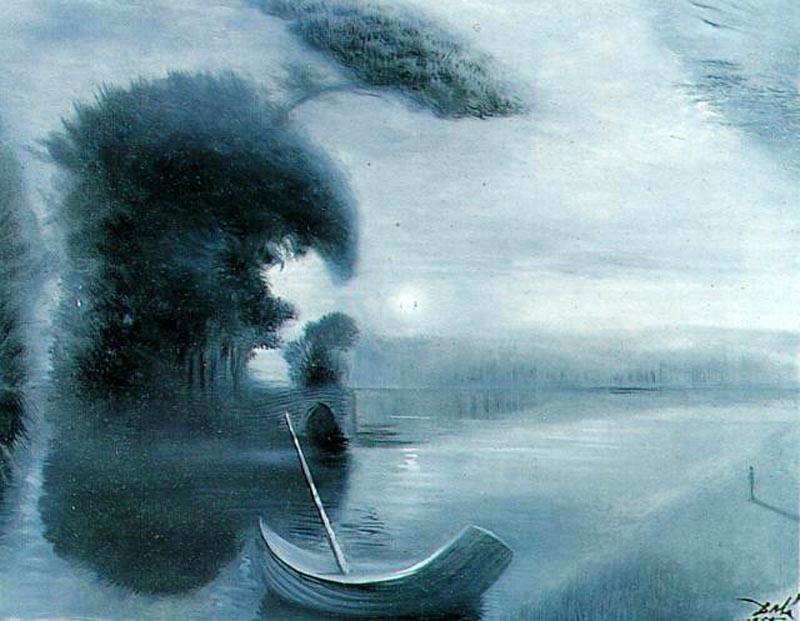
Metamorphosis of Hitler's Face into a Moonlit Landscape with Accompaniment, 1958

Impressions de la haute Mongolie (1976/Salvador Dali/José Montes-Baquer/Germany)

Homage to Impressions d'Afrique (1909), a free-associative poem written by Raymond Roussel (1877-1933), even though he never visited Africa. The film is dedicated to this french author, forefather of the Surrealists, who developped a formal constraint system to generate inspiration from dislocative puns.
Dali does the very same thing with this chimerical pseudocumentary leading us to the mysterious realm of High Mongolia where a gigantic, soft, white mushroom grows, many times more hallucinogenic than LSD! From his studio-museum in Cadacès (Spain), he proceeds to report with fake newspaper clips and newsreel on the alleged scientific expedition sent out by himself to retrieve this precious treasure. Childhood memories (like the picture above) are the opportunity to explain throughoutly the source of his inspiration. This bucolic landscape is in fact a close up of Hitler's portrait (his nose and moustache) turned to the side!
Wholly daliesque, this film experiment pieces together astonishing combinations on superimposed images, fading in and out, switching scale with odd perspectives. Dali invents a filmmaking process and applies his very language to cinematic purposes, bending the rules to serve his desperate need for originality. Travelling through a microscopic close up of paintings or the rough surface of a pen, his voiceover commentary gives sense to the landscapes taking form under his eyes. We get the chance to see some of his art, and watch the artist being his egotico-paranoid self (in French). A delirious experience, beautifully crafted. The backdoor to Salvador Dali's twisted mind.

This brought back fond memories of spending time staring at abstract motifs on tacky wallpapers, marble tiles or on geometrical rugs, discovering unmistakable faces and curious monsters or animals, that would later stand out everytime I'd lay my eyes in this area. The mind always tries to rationalize in an anthropomorphical way an image devoid of meaning, lacking recognizable features. The same game as discriminating shapes in the cumulonimbus. And suddenly we blink for a second and it's all gone, impossible to spot it again like it was before, even though we know it's right there before our eyes. I used to trace them over, as it was a rich generator of original shapes, but it never looks as real when the hand "improves" by filling the blanks on paper, adding a missing eye, or connecting dots. The creature emerging from a stain appears genuine and evident in its alien context only. Dali operates the same doctoring by overlapping his drawings on the footage to hint us how to read his vision. Then he takes it away and let our imagination build the rest, like a collective visual palimpseste.

(s)++ (w)+++ (m)++ (i)++++ (c)+++