28 mars 2006

Mary (2005/Abel Ferrara)

Contribution to the Ferrara-thon
Mary (2005/Ferrara/Italy/France/USA) +
Opening sequence : Black. From inside the Holy Sepulchre (cave in Jerusalem where Jesus was buried and ressurected), a ray of light gradually tear open the screen as the rock is rolled aside. Mary Magdalene and other women came to embalm the body of their Lord, three days after his crucifixion, and can't find it. They weep in despair. An angel (with prop wings) asks : "Why do you search for the living among the dead?"
(film within the film) This was a scene from the film "This is my blood" adapted from the controversial life of Mary Magdalene. Shot in handheld close ups in a cinéma-vérité-like style, without clean establishing shot. Just a stolen moment, confusing, hard to grasp, we are submerged by the surprise and the sudden emotions.
Cutaway to : Marie Palesi (Juliette Binoche) wearing her costume wakes up from a nightmare, sweating, and rushes to the film set, showing in a long vertical tracking shot across the hill all the backstage forgery of the cinema industry. The lightweight fake-stones, the lighting, cables, everyone is packing, only there she's reminded the film is warpped. She refuses to go back to NYC with the film director Tony Childress (Matthew Modine) and moved by a call of faith she heads off to Jerusalem.

Prompted by an adaptation of the life of Mary Magdalene, Ferrara explores the inner spiritual quest of very different personalities coming from the media industry, not quite the most religious milieu. Sin, forgiveness, redemption, recurrant themes in Ferrara's oeuvre, in a script more feminist than ever. Contrary to Mel Gibson (who is caricatured in Tony Childress for his last controversial religious movie The Passion of The Christ), the biblical epic is only a segment cited in discontinuous flashes along the story set in a contemporean NewYork city. So in fact we learn very little about the titular historical character, and not more about Marie Palesi, the actress lost, out of reach for a year, somewhere in Israel. After the opening sequence, she turns into a distant mythical figure, the illuminated pilgrim touched by grace. Brief glimpses of her, a vanishing silhouette in the crowd of tourists visiting the 2 milleniums old holy sites.

The actual protagonist is Theodore Younger (Forest Whitaker), a famous TV talk show host running an improbable week-long primetime serie of religious debates on the life of Christ. This is not the traditional image of the mainly protestant America, the Bible-belt heartland, mega-churches and preachers shows. Ferrara, is a "catholic who lost his faith" from his own words, catholic in a pure italian tradition. Ted is the link between Marie and Tony, opposite examples of the practice of religion.

3 stereotypes of christian faith, 3 different motives for self-sacrifice:

Marie (Faith of the heart) : naive, emotional, compassionate, empathic, altruistic love. She left everything behind, quit her friends, possessions and milieu. She meets the roots of religion in the Holy Land, just like her inspirational character went on the roads to spread the Good Word by teaching an exemplary life of total devotion, humility, poverty and selflessnes. Quite a change from the traditional way of life of a famous movie star. Her conversion is almost a parable from the Bible. She doesn't intellectualize the religious dogma but can't do no wrong because she believes, without prejudices, fears nor worries, a figure of blissful confidence.
Tony (Faith of the action) : He's a proud unbeliever who believes the end justifies the means thus anything goes, demogoguery, trickery, manipulation, bribes, betrayal. Egotic and ambitious, he believes to be something of a messiah (casting himself in the role of Jesus), to be a martyr of the media boycott and the integrist intolerance, just because the subject of his film is controversial. He overlooks and despises the incredible conversion of his lead actress.
Ted (Faith of the mind) : A skeptical believer who argues great religious questions with clerics and theology experts on his show, while all this intellectual debate has little bearing on his own private life. To him religion is only rhetorics, ideology, a matter of verbal concepts and sound arguments. God is only a source of revenue and fame to him. The strange unexplained faith of Marie will lead his doubts to repentance.

The apocrypha scrolls found in Egypt in 1945, The Gospel of Mary Magdalene, questions the establishment of the Catholic Church and the truncated testimonial of the New Testament. Generally considered a prostitute and a sinner saved from stoning by Jesus, Mary Magdalene would be in fact the favorite apostole of Jesus, above Saint Peter, who is the traditional founding father of the exclusive patriarchal, mysoginist Church. In a clip of Childress' film, This is my Blood, Peter and the other apostoles, after the death of Christ, contest that Mary Magdalene received a secret knowledge that the rest of them ignored, initiating the discrediting campaign against her version of the Gospels. A short dialogue, fight for succession and authority, conflict of egos, traducing the longliving institution of the catholic Church to keep absolute control and priviledges of the messages of God.
According to Mary Magdalene, the true meaning of Jesus teaching was to connect spiritual and physical, to found faith on a creative imagination. The real life scholars who studied these controversial documents denied by the Vatican, are the guests featured in Ted's theological debates: Jean-Yves Leloup, who translated the Gospel of Mary in french, and was the religious advisor for the historical portions of Ferrara's film. As well as Elaine Pagels and Amos Luzzatto.

Ferrara determines 3 constructs : Icons, reality and communications.
The iconic images carried out by the film medium, TV news, documentaries, live interviews or computer database. So video, film footage and computer screens are regularly inserted within the film, to formally abstract its content from real life, the main referential construct, where a handful of characters are observed in various places of the globe.
Reality is identified and characterised by its location in the world.
Matera in Italy is the location where Pasolini's The Gospel According to St. Matthew and Gibson's The Passion of the Christ were shot, before Tony Childress shoots This is my Blood. Italy is also the homeland of the Catholic Church at the Vatican. Ironically this location is meant to represent a Jerusalem scenery, forged for the studio trickery.
That's why Marie Palesi runs away from a cinematic fantasy for the real thing in Jerusalem. Israel being the place of everyday bomb terrorism now, a reality check clashing with the poetical allegories of period movies.
And New York city, the base of Ferrara's universe, the home of his characters from where they are partially affected by what is going on at the other side of the world.
The third construct is the telephone/TV communications that create a virtual space of reunion, putting in contact dissociated people like Marie who could only be reach through mobile phone from an undetermined location. The phone also plays a mediator role in mundane lives of close people, like between Ted and his wife, allowing lies, pretense and mystery. Ferrara uses voiceover, parallel montage to show the disconnection induced by this deceiving means of communication.

Now, filming erudit talking heads and showing portions of what could have been a period biopic of Mary Magdalene do not give a moral caution to the rest of the film... The religious statements are merely an excuse to paint human characters with pseudo-existential doubts seeking for a remotely spiritual redemption. All this theatralized in a melodramatic confusion of incidentally collided situations. Despite an ambitious subject and interesting formal ideas, Ferrara's drama is messy and stereotyped.
The core of the film revolves around the adultarous life of Ted, and the coincidental premature delivery of his wife's baby, suggesting all sin carries dreadful repercussions in one's life, like a demonstration to sell faith with the fear of punishment (which is precisely the conservative conception of the Catholic Church opposed to the humanist approach to religion proposed by Mary Magdalene's inheritance).
"Stop cheating on your wife or your baby dies" suggests heavily the plot without bringing answers to the moral test.
"Go to Hell!" shouts Elizabeth (Heather Graham) on the phone to his unfaithful (in both meanings) husband because he can't excuse him neglecting her since she's pregnant. This interracial couple is another cheap way for Ferrara to aggravate a scandalous polemic.
The baby's fate is connected in a parallel montage with an explosion in Israel and a bomb alert in the NYC theatre where Childress premiered his new film, confronting the existential crisis of the 3 characters simultaneously as if provoked by the wrath of God. Under such drastic circumstances, blaming past wrongdoings, last-chance introspection and self-sacrifice sound more like convenient superstition than a genuine leap of faith.
Theodore Younger sleeps with Gretchen Mol (Marion Cotillard), actress friend of Mary Palesi, just to get the phone number to get her on his show the very same week!
In a ridicule "thrilling" scene, Ted and Tony, dealing a pact of mutual mediatic profit at the back of a limo, are violently assaulted by a gang of integrist thugs (awkward mix of black gangstas, hasidic jews and conservative christians) and Ted walks out like a hero and puts his TV celebrity person in harm's way to save Tony from this unjust hatred with his bare hands... The stones thrown at the limo to kill Tony are an obvious reference to the mob sentence of Mary Magdalene in the Bible, placing Theodore in the role of Jesus who saves the victim ("He who never sinned shall cast the first stone")
This much melodrama just doesn't solidify an already dubious empiricist religious demonstration.

Few more notes on the allegory of cinema in Ferrara's vision of the world:
  • The opening sequence plays on the possible confusion between a dream and a film, right before reminding us that it's all an illusion by filming the technical backstage of a movie set.
  • The arguable commitment of an actress for her role having physical impacts on her sanity (Method acting, identification, schizophrenia...), especially with spiritual roles, refering to other famous cases (like Maria Falconetti in Dreyer's La Passion de Jeanne d'Arc). Exagerrated/false involvement of megalomaniac actors who wind up believing they can become the character they play. Difficulties to differentiate fiction and reality.
  • The role of media images in our society, cited as hard evidences. Forgery and manipulation of images for marketing purposes. Dichotomy of the meaning of the image created by the artist and the understanding of the received image by the public, leading to vain controversy. Limits of the freedom of expression (1st Amendment shield for moral provocations). Arguable honesty/integrity of the auteur in his/her work.
  • A powerful scene of Tony Childress who locks himself in the projection booth while the theatre is evacuated because of the bomb alert, because he believes in his film and wants his premiere to carry on, he launch the projection himself in an empty auditorium. Maybe an grim symbol of the ultimate solitude endured by a filmmaker once the film is done, a sentiment of isolation from the audience and from the mediatic buzz...

In a cinema era without creativity should we acclaim a film for the unusual ambition of its content while its making is so lame? A good script full of interesting concepts pre-exists the film but doesn't guarantee it's achievement. Using cheap melodrama tricks and push-button emotions to enact a powerful story undermines its reception and lead us to question the original quality of the ideas that couldn't come across in a more honest way. Melodrama is a great form of entertainment as long as it doesn't take itself too seriously by trying to deal with or solve bigger-than-life moral issues... Either Ferrara wants to move us with the daily lives of characters in conflicts with themselves and failing to relate to others, or he wants to take on major concerns such as a critique of The Bible, the history of faith or the Israel-Palestine conflict... loaded underdevelopped issues that encumber his plot.
Grand Special Jury Prize - Venice 2005
(s) ++ (w) + (m) ++ (i) + (c) ++
.
Also check out about this film :

23 mars 2006

The Wayward Cloud (4/4)

EPILOG

Previously:

Why Tsai meant to conclude his film by this infamous porn scene?

Over one year already since The Wayward Cloud premiered at Berlin 2005, and that the guys at Rouge (Helen Bandis, Adrian Martin, Grant McDonald) produced a great shot-by-shot analysis (with screen captures) of the last sequence that caused so much controversy and perplexity.
Check it out there, and come back here for my own additional notes on their close reading, as I will not repeat everything they say (which is very pertinent). So the parallel reading of both interpretations is required.

Shot-by-shot spoiler analysis. MATURE content.
(the two lead protagonists are named HE and SHE for clarity)


Shot 1

The composition of the image, high angle slightly slanted, isolates HE and the japanese actress in different squares (frame within the frame) traced by the grate.
Symbolism of the grate (The Hole/Vagina/TV)
I'd add another grate occurance in the shape of the net hung in the stairwell where HE sleeps in a fetal position. This is a transitory shift of the grate symbol, horizontal in The Hole: the erotized peephole between HE (voyeur) upstairs and SHE, naked, downstairs, until they can connect physically through the enlarged hole. The upstairs/downstairs junction is also affirmed earlier in The Wayward Cloud when SHE contemplates the blue sky painted on her bedroom ceiling, where a round cloud stands for a symbolic hole through which descend orgasmic noises from the porn movie shot above.
Same motif in Vive L'Amour, Lee Kang-Sheng was under the bed, looking up and listening to the couple making love right over his head.
In The Wayward Cloud the peephole is vertical, between SHE (voyeur) in the lobby, and HE, naked, in the bedroom performing porno. The vagina symbol will become more obvious later.

Shot 2

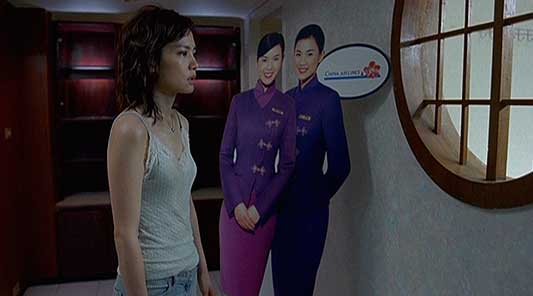
The cardboard girls standing in the lobby with SHE are a lifeless observer from an indifferent outside world. This society that never interacts with the stylized world of these protagonists (the whole film is rather deserted). Their smile is fake and contrasts with HER distress as if mocking her about-to-happen scene of adultary/jealousy (reminding the hysterical laughters imagined at the church by the paranoid protagonist in Buñuel's El).
Maybe these cardboard silhouettes represent the laughing audience we are with the prescience of what SHE refuses to believe until she'll see it for real happening before her very eyes.

Shot 3

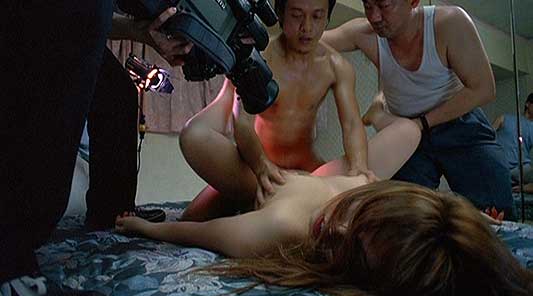
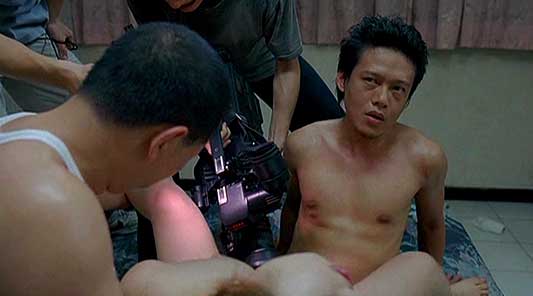
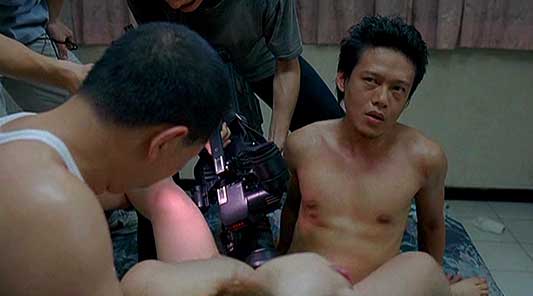
The most graphic sequence of the film couldn't be de-erotized more. The girl is numb, like a blow-up doll animated by a grip. A direct reference to an extreme form of pornography and urban myth: snuff-movies. The girl could be dead or raped under a sleep-drug. Although the cameraman shoots up close to pretend she's active (and alive) in the porno movie they make.
Tsai stands out, differenciating himself from the porn crew and making his film more disgusting than theirs. In the first nurse scene with the watermelon, there is only one camera, Tsai was the porn director, we saw onscreen exactly what the porn cameraman shoots. Later in the shower, Tsai steps back like a documentarian to show onscreen the crew working on the porno set. Then he places his camera inside the action (scene when the japanese girl lost the bottle cap). Ultimately Tsai shoots his own X-rated movie staging a voyeur girl on a shooting set.

Shot 4

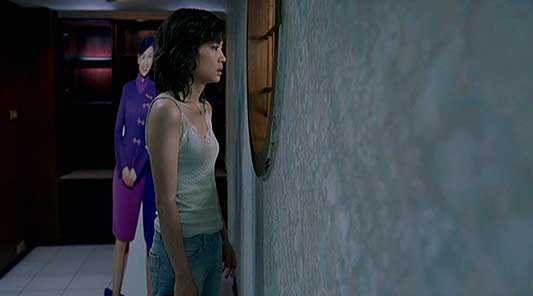
The judgemental social witness incarnated by the cardboard girls (China Airlines) gradually disappear behind SHE, who literally upstages them, as HER onscreen size outgrows theirs.
SHE positions herself near the peephole, which from her side is a symbolic TV screen. The very TV set SHE was riveted to in the previous sequence when SHE discovered the japanese girl and HE performed porn on a DVD.
The political backdrop reunites here in the same room the two empires (China and Japan) claiming Taiwan, the little dragon. Like for Hou Hsiao-hsien in Three Times, love is impossible for the taiwanese couple throughout ages because of the political oppression. An island where people are sexual products.

Shot 5

SHE discovers live porn for the first time (she might be virgin too). HE is off-screen, so this composition tells us she only looks at the girl for the moment. A porn actress represented from a very feminist perspective : woman turned into sexual object, without consent, subdued, manipulated by pervert men. An extreme characterization of a freaky porno set, surreal, symbolized, like only would happen in a bad dream.

Shot 6

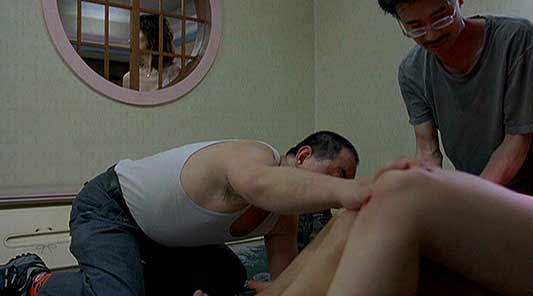
A key shot that formalizes the partition of their universe, innocence v. brutality, female v. male. Again the characterization of both gender is extreme, totally stereotyped. Although without feeling a self-conscious difference between their behavior they still stare at eachothers, reaching out through this wall-frontier without leaving their own milieu (each on their side of the wall). HE moves closer to the grate, thanks to this ingenious mise-en-scène the limp girl is hidden behind the wall and all we see is HE fornicating with the wall right next to SHE.
SHE was a voyeur in front of TV earlier, then through the grate, yet after this eye-contact SHE is now involved in the action and became an active participant in the show, developping in the next shot.

Shot 7-15

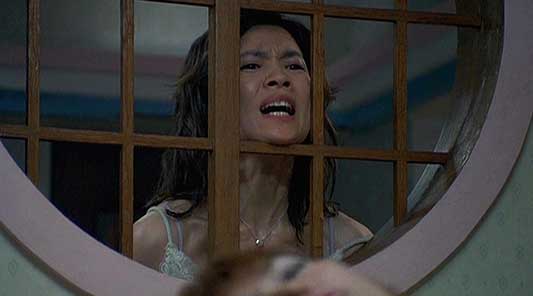
The reverse-shot alternation removes the wall from the stage composition. SHE watches through the grate, and HE is being looked at by someone behind a grate. Both sides are subjectivized. The grate bars HER face, meaning the grate is not equally distant from each, SHE is the one about to break through the fence.
Eye-to-eye, they emotionally connect with a naked truth into this intense regard. Still no shame, no embarasment, no guilt, as the action continues to take place around them (at this point there is no exchange between the 2 sides, except visually). A hypnotic curiosity instead. The close up on HE puts all the rest out of focus : it's only about the tension between them in a tunnel effect, the rest doesn't matter.
Both slowly open their mouth simultaneously. SHE begins to simulate the moaning of an orgasm. HE who was quite dispassionate in the performance of this non-simulated intercourse, is finally turned on with HER help. SHE sits her head on the grate, now making a move towards him in sign of reconciliation both physicaly and emotionaly.

The formal shift along this sequence moved from a judgmental distance when SHE considered the pornographic act in an impersonal way (HE out of frame, shot 5), then fully brought to her awareness his nature and his job. In an instant, and one sequence she took herself through the stages of jealousy, denial, shock, anger, indifference, frustration, curiosity and arrousal. In a way this scene is an express shortcut to forgiveness and acceptance of his job, nature, and gender (reconciliation of the sexual duality described in my last post allowing connection). I see this infamous epilog, and the whole film to some extant, as a symbolic confrontation of antagonist/complementary natures of male/female sexuality.

Shot 16-21

As noted on Rouge, the crew is gone off-screen for good now. They disappeared visually but also are disposed of their role that validated until now the realism of the porn film metaphor. The reconciliation consumed in the previous shots, the film focuses on the couple again, alone.
HE v. SHE >>> HE & SHE.
Wider shot with an odd angle, low and slanted, that isolates the grate on the wall (in a composition reminding more than ever a shot from The Hole) to relocate the junction between appartments separated by a locked door (vagina).
As SHE continues to moan, HE formalizes the vagina symbol of the peephole by literaly fucking the grate, like a glory hole. Which happens to be SHE's open mouth too, simulating a vagina for the male's fantasy. The serie of close-up's on either side of the grate, removes the wall once again from the composition, to isolate only the 2 protagonists in the position of a vertical fellatio.
From HE's side, the composition emphasizes the hole as a vagina, as he stands alone face to the wall, his penis into the grate.From SHE's side, the composition emphasizes the fellatio, HER face stuck in HIS pubic hair. It's like if the penis of the porn movie she was watching earlier on DVD came out of the screen in 3D and in flesh, which corresponds to what Freud called the "penis envy" (woman's fantasy to retrieve this member they are deprivated of).
A tear rolls on HER face (its meaning could go both ways? ecstatic relief or self-pity shame). The shoe she held in her hand throughout the sequence (that belongs the the japanese actress), is dropped to the floor as she's stunned by what just happened.
Rebirth of HE's sexual emotion, desir and real orgasm with a true ejaculation (unmistakenly suggested on screen).

This whole sequence lingers long enough on this uncomfortable pornographic act. I admit not to understand why Tsai insists to hold on this last image some more.

Shot 23

Another odd wider low angle that could pass as a look up to the pierced ceiling in The Hole. The parallel I meant to draw between the two films is they end in a very similar way, only with the function of protagonists reversed.
In The Hole, HE was obsessed with this hole in the floor with a very erotic exploration. And this scene from The Hole is getting really pornographic (with hindsights of The Wayward Cloud symbolism): he intruded things in, stuck his arm and his leg, just like he penetrated it with his penis here in The Wayward Cloud.
The Hole closes on an enlarged opening through which HE lifts SHE to his appartment. But we don't see them making out. The conclusion in The Wayward Cloud is initiated by the other gender (SHE) this time, with entirely explicited symbols in plain view. Although the bodies are separated by a wall, and the sexual relationship (if accomplished and shown by Tsai before the film ends) is only oral, which makes the statement of a dominated woman deprived of climax to the sole benefit of the male pleasure. Not quite a fully realized romantic ending yet.
The former film represents the awarness of a man to a female's sexuality (symbolized, timid, passive, foreplay), the latter the awareness of a woman to a male's sexuality (graphic, physical, agressive). Both stereotypes and symbolized.

Like when she meets HE asleep on the swing (first encounter), she meets her (sexual) rival unconscious. The inner reaction can develops without having to face her eyes and engage in the interpersonal argument that would take place if they were able to insult eachother.
Only the unconsciousness (or symbolic death) of the "other woman" (japanese actress) could make the revelation of HE's porno job possible and bearable. She is able to ignore her, and forgives in order to establish contact with him, on his (sexual) territory.

What's remarkable is how Tsai manages to stick to a silence treatment of his drama even in the most outraging situation, leaving the image and the mise-en-scène deal with the simmering emotions. Characters never resort to words to resolve their inner conflict (anger, jealousy, worry, questions, doubts), only bodies and body functions attempt to signify an answer.

I think all of these 'removals' are perfectly synthesized in the end scene, and then of course broken through, as Lee and Chen 'break through' the screen (I'd say the grate is meant to stand in, in one sense, for a TV or computer display -- cf. Chen's proximity only minutes earlier to the TV screen when the Japanese girl is laying on her floor, and the warping of the image given the perspective of the camera angle), -as much as is possible-. It's every porn viewer's wish, or mental image, that they be 'present' at the act. Craig Keller

Continuation:

16 mars 2006

The Wayward Cloud (3/4)

Previously:
Digging deeper beneath the surface of things, an arguable attempt at a psychoanalitical interpretation of the film's personality in the hope to better understand the infamous last scene. Proposing various possible keys and leads to contemplate, food for thoughts. Make it what you want if you care. Is it overanalysing? I don't care.
And for the puritan minds, be warned this part is again full of spoilers and mature content. Why should a critique be any less graphic than the film is? Sure the nature of mental suggestion isn't quite the same in the poetry of visual language and in blind words. That's the paradox of the written description of a visual medium.

Dual Sexuality
This film appears to confront male and female libido in a very manichaean way, almost stereotyped, to open a debate on the gap between men and women. Alternating musical and porn scenes recreates the sexual fantasy respectively represented by both gender: graphic-physical for male/idealized-romantic for women.
HE and SHE fail to meet eachother because their conception of sexuality is unreconcilable (until the end, partially, controversially)
HE has turned sex into a mechanical job, and SHE fantasizes an idealization of love.
  • Tsai's most heterosexual film or satire of the heterosexual couple? gigolo?
  • Homosexual transposition into a dual character male/female?
  • Confession of a closet homosexual male fighting to find interest in women in vain? echoed in the lavatory/latrine musical segment.
.
Female libido : SHE (CHEN Shiang-Chyi)
  • Fantasy, romanticism, innocence, idealism, private, dreaming, ingenue, naive...
  • Burning/simmering for love, needs to feel loved, waiting for love
  • Erring, wandering around, seeking love everywhere
  • Porn video backroom scene : languid fondling, slowish arousal, picking videos randomly, proximity of bodies.
  • SHE remains clothed till the end, she doesn't go nude, unlike HE. her sexuality is interiorized and dissimulated.
  • Opposition of the sexuality of the watermelon scenes with the girl and the disturbing/uncomfortable backstage porn scenes.
  • Concomittence of HE and SHE's fantasies through matching cutaways (languid in front of TV, watermelong porn scene)
  • Concordance of dream sequence (musicals) with reality (sex desir, love) :
    - bubbles from the sink tap after the water dragon dream with the shampoo cloud in the water tank
    - impotence during a porn scene after the lavatory dream when the penis man is assaulted/inhibited by dozen of pressuring women
  • key in macadam + water (generating a water spring amidst a general drought!) = sexual symbol, fairy tale of the virginity delivered from a freezing spell by the charming prince.
  • locked suitcase from Paris? (pandora's box) sex is closed, virgin? she's frigid. Manipulating the digital code lock (= foreplay/masturbation), unable to open up her way to the intimate secret inside (inaccessible orgasm). He tries to unlock her, without much motivation, but can't. He also refuses her sexual invite (watermelon juice glass) but pretends to accept (and licks his lips to fake he enjoyed it which is good enough for her).
  • videostore/crossing the bridge feet on feet (playful teasing romanticism)
  • cooking together/crab on the floor (fear and excitation, craving for security, appeased/fullfilled by the presence of her man)
  • smoking under the table (her feet is turned into a cigarette holder, sensualization of her body, involvement in this smoking selfish ritual), she's left alone when he falls asleep (echoing the swing scene when they first meet: sleep shuts the door, keeping each on their side of the fence, sleep is excluding)
Male libido : HE (LEE Kang-sheng)
  • Often naked, or baring shamelessly lots of his skin
  • Unspoken inner feelings, miscommunication, silence, desirless, needs to feel attracted
  • Selfish pleasure, egotism, individuality, no string attached, vague loneliness
  • Sex is a mechanical function of his body
  • Male sexuality identified to pornography, especially in the last scene when feeling and action meet.
  • Performance, show off, public exhibition
  • Multiple conquests, casual sex, ritual, sexualy active
.

Analysis of the Musicals
Again, the musical numbers highlight in a burlesque way (parody of the genre) this sexual duality, clearly identifying the male and female aspect in their stereotypes conveyed by the genre establishment of cheesy romance. Although Tsai introduces a touch of subversion because his characters shift the expected representation of their gender. Cross dressing, male weakness/sensuality, female coldness/nymphomania that clash with the traditional conventions. They are literally small films within the film, with a thematic complexity, that could be analysed independently, metaphorically and symbolically.
I can't believe Tsai pretended (at the Berlin press conference) there is no meaning in the crossdressing, and genders are indifferently interchangeable for characters, that genders are meaningless. Faceciously excusing the awkward dress wore by HE in the umbrellas musical by the fact the costume designer couldn't provide a male suit in time for LEE Kang-sheng... I seriously doubt such an obvious "faux-pas", of course it was intentional and participates to the film's overall thesis.
  • MUSICAL 1: "Waterdragon's grief"
    Song "Half-moon" : HE cries the pain of being separated from his missing half, the distant moon shining away from him, inaccessible.
    This vignette features a very feminine male figure, bare naked with make up on, lasciviously swiming in the water.
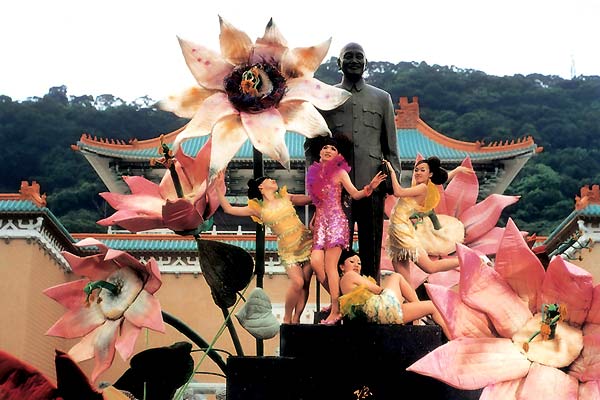
  • MUSICAL 2 : "Statue Choir at the National Palace Museum"
    girls fondling sleezily against a cold metal statue (brown) of a placid smiling man (a Taiwanese president?) surrounded by oversized fantasy flowers made of fabric. 1 lead singer + 3 back vocals (in a typical music video style)
    This musical sequence impersonates the female perspective, and plays right after the museum scene when SHE steals flush water from the public toilet.
  • MUSICAL 3 : "Spider's heart"
    The porn star (LU Yi-ching) cries for love, she sold her soul to the porno industry but saves her heart. Like a swan song, apocalyptic setting, men in black tied to a fluffy spiderweb hold her in their hands, fire-throwers in the background.
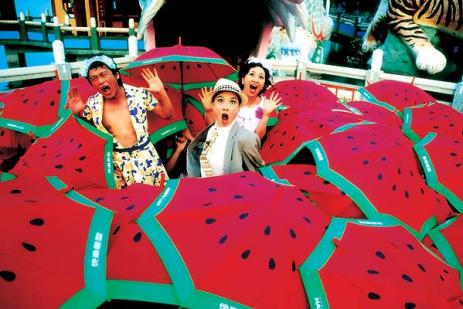
  • MUSICAL 4 "Odd rendez-vous"
    Spoof of Les Parapluies de Cherbourg, with watermelon motif on the umbrellas. Inversion of gender, crossdressing, boy in woman clothing and girl in suit. The songs says "I realized I had the wrong shoe on the wrong foot" (left-right inversion).
    HE meets 2 girls neither are the one he expected to date (confusion of identity, names and look).
    HE arrives with a pink dress (crossdressing), meet a girl (LU Yi-Ching) who wears a yellow dress, he mistakes for his date.
    In the next plan he looks at himself in a convex mirror (deforming identity), and wears the yellow dress of the girl he just met.- Interlude of an unidentified crowd (hidden by umbrellas) coming in a dragon's mouth with umbrellas of various colors and coming out of a tiger's mouth with uniform red umbrellas with a watermelon motif. (another symbolic/magic/mythical transformation)
    Then another girl (YANG Kuei-Mei) arrives in a grey suit (crossdressing), while the song says "she arrived late still wearing her sleepers and her dress isn't fixed" (dissynchronicity between words and images)
    Finally HE realizes the second one was the wrong girl again. The song says "Chen wasn't her name and she couldn't remember my name". And the two girls (one in suit, one in the pink dress) leave together.
  • MUSICAL 5 Latrine musical number
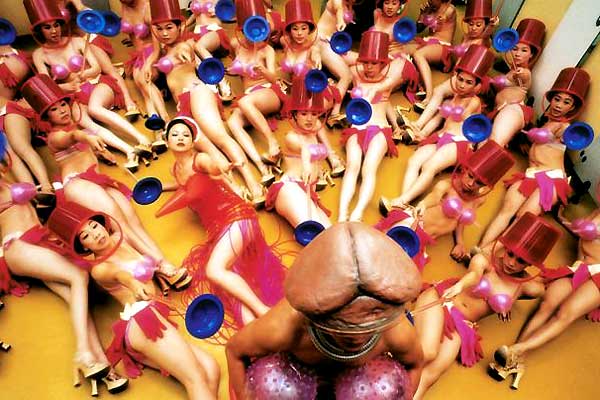
    plastic bucket-hat, funnel-bra, rubber-glove-made skirts, high heels, trumpet-plunger in hand. HE is disguised as a giant phallus with a cockhead helmet, a plastic hose circles his waist and 2 pinky transparent plastic balls hanging from his belt. Phallus inhibited/scared off by an army of women chasing him down, menacing with plungers. (following the impotence scene on the porn set, shame, guilt) echoes the videostore horny scene (with impotence issue too).
    Echoes the museum latrine scene where SHE steals water from the flush, and the correspondant musical number of the Statue choir, where girls fondle against the male statue, but this time it's from the male perspective and feels like oppression.
    The song says "Be patient, you're a man, not a rat! Raise your head, go ahead, cross obstacles for love is not readily available"Nightmarish. Human-penis hides away, scared by women, marching on him, demanding erection.In a last move, HE pushes away all the girls who drop their guard and lean back in defeat.
see the musical clips on the french website

Moral / Worldview
Shiang-Chiyi saunters through life everyday, oblivious and unaware of the society functioning around her. She pans the rubble for her keys amid construction work; she digs for her key off the side of an intersection; she scavenges for water bottles from the depths of a public trash can. She does not make an attempt to connect with others and is actually uncomfortable, acting like a five year-old at times. Filmacco
Ennui, idleness, existentialism, solitude, social alienationThe world outside our routine doesn't exist, an indifferent crowd. disconnectedness, impossibility to find a soul mate
Love has disappeared in our society, substitued by a dispassionated (sexual) desir to perform, to own, to dominate.
"Dialog is kept to a minimum -- there are probably less than ten lines in the entire film -- yet as always Tsai manages to say so much without words. As incredible as it is to watch Shiang-chyi and Hsiao-kang's relationship develop non-verbally, the meaning behind their actions (and reactions) during the final sequence is not entirely clear, or at least open to debate. (Surely this is
exactly as Tsai intended, hence all the discussion today.)" Filmbrain
De-erotized physical bodies abandonned to their natural behavior (need/desir out of control) drained from feeling, emptied of emotionality
The absence of love make naked bodies cruder, nudity becomes vile, disgusting, undignified, and de-humanized. Bodies are only vital functions, objects of pulsions, tools for work, consumer goods.
He is an anti-hero, no plan, no ideals, no desir, issues with love and sexuality, inner conflicts, inhibited love, unsatisfied/unaccomplished romance, sexual inadequation, compulsive/mechanical sex, vain repetitiveness.
Coming up next :

10 mars 2006

Lagging

I've postponed writing about new films until I had finished the Wayward Cloud critique but it failed to hurry the process. Writing alone is not my thing. Leaving disordered notes will be easier hopefully. Also I tried to focus on collective interactive discussions instead of unilateral blog statements, which was unsuccessful as well.
Too much films to discover at a time, too much topics going on to comment, and too little time to commit... I made watching the films a priority so I'm a bad blogger.

Marguerite Duras died 10 years ago, on March 3rd 1996. Her abstracted directing style is rather unique. I've seen only a few and I can't really understand her point but I'm interested to find out more about her peculiar contribution to the cinematic language. So I couldn't write anything substential in a blog entry, however I'd like to read what other people have to say about it and discuss the possible interpretations on an informal forum.
Calling for participants in a tribute to Duras filmography on The Cinema Roundtablers forum. Please meet me there, to link to critical study material available online or in print and comment her films.

Special thanks to Katie MacLean for the new banner design of my blog!

31 janvier 2006

Criticism On Air

"[Oral critique] is more efficiente than [written critique] because more
capable, more abundant, and more sincere or more severe, but one cannot exist
without the other one. (...) Debates should not take place behind closed
doors."
André Bazin, 1943


Film criticism is spelling out a visual medium into textual commentary, and the radio is a medium exploiting sound and words without the easy support of images. Audio criticism seems the most absurd way to illustrate a visual art, as suggested like this ironic teaser created for the TV broadcast of La Marche de l'Empereur / The March of Pinguins / The Emperor's journey on CANAL+.
When we read or listen to a film description our imagination automatically adds images to figure the big picture and that's how false expectations are built up prior to film viewing, as a correct representation of the film is dependent on the accuracy of the critic's description. While it's not the best adapted medium, there is little conflict of interest in the radio industry (TV being a client of the distribution circuit), thus the voice of radio criticism enjoys more freedom of content and tone.I know the reader of this english-written blog will not be interested in these 3 weekly french-speaking shows but what I review here is the mode of expression of group radio criticism to contrast with the print mode of columnists or bloggers.

Let me know what radio shows you listen to, their mode of expression, and where I could download them if available online. Thanks


Le Cinema l'après midi
(France Culture) SAT 1:40-2:30pm

Le club des cinéastes / The club of filmmakers.
Hosted by Claire Vassé (critic), a 50 minutes long show gathers 4 or 5 filmmakers to discuss 3 films back and forth. The films are ones opening commercialy in theatres, or being released on DVD, or showing soon in a retrospective, but already accessible. This is not a preview recommending films that only critics had access to. Sometimes the films echo eachothers with certain similitudes other times they clash, the debate questions each film successively but also transversally.

These non-professional critics deconstruct the making of the films with the insights of their personal backstage experience in this trade. Movies as seen by people who make them, a biased but much informed minority audience with an intimate relationship with the work accomplished. A very auteuristic viewpoint, in the french tradition of critic-filmmaker. Even if they tend to show respect to their friends and masters preferably, the large spectrum of films reviewed and the confrontation of the independant personalities of this panel keep the discussion away from complacency and is often more violent and emotional than print critics pan.
Filmmakers (who are not there to sell their own film for once) evaluate the projects of their peers and break into reflexions on cinema, technique and significance, rather than reviewing the plot. Their vast culture recalls great auteurs by way of citations of other films, on-set anecdoctes, literary references aplenty. Cinema in lights of other arts, and its cultural role in society are recurrant concerns.

The selected films are judged as subjectively as in the press by the combination of a polyphonic debate creates a somewhat balance ground to assess high and low aspects of the production, the directorial choices and the social implication of the narration. Although each takes a turn to give their opinion, ultimately the confrontation, dissent, controversy force everyone to moderate their stance in an informal conversation mending fences or asking for a deeper justifications.

Once a month they invite a filmmaker (not part of the club) to discuss their work. One filmmaker interviewed by other filmmakers.

Rotating members of the club :

  • Mathieu Amalric - actor, director
  • Luc Béraud - director, screenwriter
  • Pascal Bonitzer - screenwriter, director, actor
  • Catherine Breillat - director, screenwriter, actress
  • Emilie Deleuze - director, screenwriter (yes, daughter of philosopher Gilles Deleuze)
  • Claire Denis - director, screenwriter
  • Vincent Dieutre - director, screenwriter
  • Philippe Grandrieux - director
  • Christophe Honoré - director, screenwriter
  • Philippe Le Guay - director, screenwriter, actor
  • Claude Miller - director, screenwriter, actor
  • Emmanuel Mouret - director, screenwriter, actor
  • Brigitte Rouan - director, screenwriter, actress
  • Marie Vermillard - director, screenwriter


Projection Privé
(France Culture) SAT 6:30-7pm

Hosted by Michel Ciment (Positif) a distinguished critic of the french cinema press with a comprehensive erudition of world cinema invites guests to discuss 1 film or 1 oeuvre. Sometimes the filmmaker if it's a current release, or scholars who published a related biography. An elaborated discussion on the interview mode, with pertinent and profound questions saving however much room for the guest's voice. Always a great selection of films, mostly high-brown cinephilia, intellectual discourse, theorical issues. Fascinating source of knowledge.The show is only 30 min but focuses on a single film to get deeper under the surface of omnipresent selling arguments. This only covers 4 films per month, and like in his monthly magazine Positif (opposed to the weekly newspapers), implies a picky selection rather than a full coverage of the weekly releases.


Le Masque et la Plume
(France Inter) SUN 8-9pm

This most famous founding radio show celebrated its 50th anniversary of weekly critiques on air in november 2005! Alternating one week for cinema and one week for Theatre and Literature, the show hosted by Jérôme Garcin, recorded live with audience, puts the spotlight on the cultural must-see. A panel of 4 cinema critics from the french press (popular press, newspaper and cinema magazine) reviews about 5 films from the fortnight releases. This covers only 10 films per month, but the selection isn't elistist: from low-brow/popular movies to high-brow/intellectual indies. So the reactions are often loud and strong. But again in this form the group of multiple voices help to self-moderate each position. The conversation is easygoing and straightforward, spontaneous ideas and rough language, sarcastic controversy and mockery are frequent to trigger the laughter of the audience. In spite of the informal tone (worded more loosely than in their respective column), the level of critical judgement is mostly well thoughtout and backed up by sound arguments.

Adding to this collegial form of viewpoints confrontation, the show lets the audience reacts freely to the discussion of the films debated, to give their own impressions or to ask questions directly to the critics. And the radio audience sends emails to comment the show, these are read live in the following show.
Allowing the audience to participate, within a restricted speaking time, influences the discussion among the critics who are subject to polite corrections and snide remarks from their public. Something that never happens to a print columnist. A dose of self-derision lights up this panel, conscious of the image conveyed by their personality, thanks to the feedback.

This is the same type of collegial MovieClub organized by David Edelstein on Slate, only it happens all year long, and the oral dialogues are more interactive than through a compilation of written emails.

For this 50th anniversary party they invited authors to the show to give them the opportunity to criticize the critics, and it was a very interesting moment. A playwrighter said he expected and welcomed critics to evaluate the technique objectively, to inform the subtext of the play with the cultural background and the distance the critic has that the dramatic author might not have. But most of all the author wants to read the personal impressions the critic experienced, and if (s)he liked the play or not. Other authors complained the critics panned without watching the work they talked about, or that they didn't know anything about criticism, refusing to be tougth how they should do their work. Authors welcome the artistic judgement of their achievements but don't like revisionist advice like "this should have been done that way", "This is how it would have worked better"...

Rotating team of critics :

  • Sophie Avon (Sud-Ouest - daily newspaper)
  • Alain Riou (Nouvel Observateur - general magazine)
  • Michel Ciment (Positif - monthly cinema magazine)
  • Jean-Marc Lalanne (Les Inrockuptibles - culture weekly magazine)
  • Pierre Murat (Télérama - culture weekly magazine)
  • Danièle Heymann (Marianne - weekly general magazine)
  • Sophie Avron (Sud Ouest - daily newspaper)
  • Eric Neuhoff (Figaro Madame - fashion magazine)

p.s. each show is available online after each broadcast, archived for a week only until next show (see links)

14 janvier 2006

The Wayward Cloud (2/4)

Follow up from The Wayward Cloud (1/4)


Sex and nudity have become more prevalent in popular culture (novels, comics, advertising, music video, TV, cinema, contemporean theatre, internet) since taboos around sex losened up, and pornography gained a subversive hype claimed by certain alternative scenes (porno-chic). Erotism or hardcore porn are tolerated public discourses now, in the street or among scholars, either for banalized entertainment or out of derision. Today private issues such as initiation, frustration, masturbation, impotence, voyeurism, perversion are official plot drives in comedies or dramas, bringing to the spotlights the action hidden backstage in the lives of fictitious characters.

Sexuality used to be implicit or just absent of mainstream movies, with characters ridiculously deprivated of sexual lives. Never since In The Realm of Senses (1976/Oshima) did high-brow artfilms promote a serious look at sex than in recent years.
Sex is THE subject and object of the film now, no longer a suggestive elliptical climax.
More auteurs risk to introduce pornography in their work, fascinated by the impact of raw sexual images on screen as a narrative item dissociated from the arousal potential of X-rated movies that are not shown in public theatres. They bare it all and get right to the point, being as factual as possible.
  • A Vendre / For Sale (1998/Masson) Sexual road trip
  • Romance (1999/Breillat) unsimulated sex with a real porn star.
  • Lies / Gojitmal (1999/Sun-Woo Jang) S&M sexual relationship between middle aged artist and virgin schoolgirl
  • Intimacy (2001/Chéreau) casual sex relationship between strangers without social interaction
  • Irréversible (2002/Gaspar Noé) uncut rape plan-sequence
  • The Brown Bunny (2003/Gallo) B.J.
  • 9 Songs (2004/Winterbottom) recurrant intimate sex, masturbation
  • Battle in Heaven (2005/Reygadas) B.J., sex prostitution
Also films of Hong Sang-Soo, Greg Araki, Larry Clark, Kim Ki-duk, Catherine Breillat

They always cause a moral controversy among critics and split the audience, but push an evolution of mentalities after censorship vetoes are overturned by rehabilitations, questioning the issues around this taboo born of a deeprooted strict christian moralisation of sexuality (structuring the western culture for centuries) that is totally absent in eastern culture for instance. This is the social and artistic context that informs the motivations behind The Wayward Cloud's overt provocation.
.

Porn videos are extremelly popular in videostores and online, lots of people watch it whether it's illegal or immoral. And if it sells, somebody has to make it, cheap and fast.
Performers sell body and soul to the business, they turn themselves into mindless robots on autopilot, sexual objects unable to feel anymore, and when they think too much it's impotence getting in the way of productivity. This is the theme of the third musical number staring the aging porn actress (LU Yi-ching). She sings "I will sell everything, my soul, but I will never sell my heart", so she thinks...

Porn actresses are single-serving interchangeable Barbie dolls. New faces come up and old ones are forgotten. Nobody cares, it's all so natural. Which is not so far from the movie business, only few stars make a long-term career.

Ironically money has no mention in the film at all, depicting a fantasized industry outside the economic market. Porno is illegal in Taiwan, and only proliferates in underground circles with amateurs, unless it is imported from Japan, the porn heaven. Nudity in local movies is also a big deal, baring a shoulder is insulting for the reputation of the performer.
LU Yi-ching (usually playing mother roles in Tsai films) accepted to be a porn actress, and act in the nude, but got in trouble with the local critics, and felt uncomfortable afterward (she swore to quit acting everafter). YANG Kuei-Mei (another recurrant actress in Tsai films) declined to play a porn actress and only appears in the last musical number. Thus a japanese professional porn actress had to be cast.
The Wayward Cloud was banned in Malaysia (Tsai's birth country) for its bold sexuality, nonetheless it opened in Taiwan (Tsai's home country) uncut.
I'm surprised by this counter-intuitive feedback by the comments of this cinephile from Taiwan (on Like Anna Karina's Sweater) who claimed porno was an all-family entertainment in Taiwan... then again there are the scenes in Unknown Pleasures (2002/Jia Zhang-ke) where teenagers meet in a videostore booth to watch porn films like if it was sports.
At the Berlin press conference, Tsai considers sex is a consumerist good. Porn is the fastfood of pleasure. He uses this provocative topic, which is still socially taboo in Taiwan (and most parts of the world), to open up a public debate on its influencial role on intimate sexual relationship within the couple. Yet the film is less a statement on the absurdity of the porn industry than a deeper reflexion on emotionless interactions in a degraded world based on broken communications. Extreme physicality and low feelings. Porn is an allegory for lust substitute of love in our shame-liberated bodies.

Porn, a burelesque joke.

Tsai doesn't take himself seriously, the perversion of genres (porno, musical) and conventions (dialogue, continuity, unity, versimilitude) is part of a general satire of society, a deliberated provocation to accuse snobbish art censors, frigid moral makers, tasteless commercial cinema, timid complacent audience... Graphic sex is both criticism (shock value for provocation) and self-criticism (facile tempting bait to arouse the audience with controversy). The camera shifts from subjective porn maker (what we see on screen is the video the crew shoots), to documentarist (we see the crew at work), to active porn maker (a professional porn film about a group of people making an amateur porn film), and Tsai keeps changing his role by modifying the significance of the frame (P.O.V.) along the story.

Porno is made to sell maximal excitation but is paradoxally boring to performers and film crew. A camera avid of a close look at the action slips in-between the bodies, like if the actors made love directly to the camera.
The visual gags revealing behind-the-scene secret tricks (light-man, grip, and cameraman all busy as bees) are constant reminders to turn off any potential fantasy. For instance the shooting stops because the home-made shower runs out of water, and not because of the actor's impotence. The porn crew is totally desensitized, indifferent to what is going on, like if it was a usual job. Sex action is banalized, vulgarized like a sexless massage. HE has become atone and unresponsive to the point of having erection and arrousal issues both in his work and his private life. Although the film director moves around his bare naked actress forcefully, he's all embarassed when he has to retrieve the misplaced bottle cap from her vagina, which reassesses the boundary between mechanical porn and individual intimacy that seems to be violated by pornography.

The film, built just like one porno movie with an alternated succession of mundanity (boring plot) / action (plotless entertainment), features a history of adult cinema, from the morally rigid ages to the extreme underground hardcore.
Sex is absent from the HE & SHE story, their love affair is purely platonic, no kisses (like in early movies). Then some allegorical suggestions lead to believe they made out even if the action is cut (the crab dinner filmed in shadows - symbolic language is developped to overcome Hays code censorship). HE and SHE finally kiss when they discover the videostore backroom (ironic environment and sexualy charged for the opening of their romance), but still no sex (impotence of HE). This scene is followed by a tender moment when they cross the illuminated bridge dancing feet on feet (erotic soft porn). The last scene of the romance closes with oral sex which is as far as they go physically (hardcore).

A parallel history of pornography with corresponding visual aesthetics. The first representation is a lavish playfull simulation with a watermelon, then masturbation and voyeurism (from an -overtly re-framed- softporn), homely sex in the shower (from rough amateur porn), hardcore close-up's, culminating with the rape of a sleep-drugged woman (from illegal extreme hardcore).

The musicals follow the same evolution of explicit content that might parallel the music videos from classic decency to erotic dance moves to deviant impersonations to outrageous genital costumes.

Throughout the film, each new scene seems to go further again, breaking more taboos, shocking more people, daring dirtier provocations. Highly taunting pornographic imagery (penis, frontal nudity, pubic hair, graphic positions, wet noises, blow job, sperm ejaculation) exposing asexual bodies, de-humanized partners (to the extant of a lifeless puppet in the final scene). It was as disturbing to see the de-dramatized rape scene in Kika (1993/Almodovar) when even Kika herself didn't feel concerned by the violence of this surprise aggression on herself.


"The last sex scene involves a dead woman's body and culminates with oral ejaculation through the bars of a window. It looks like a travesty of classical gay porn imagery — in spite of the fact that the action happens not in a prison but near a poster advertising China Airlines.Cinephilia is another subject of Tsai Ming-liang. In this case, the obvious pornographic, voyeuristic nature of cinema." FIPRESCI

Layered Pornography with multiple simultaneous readings
(Interpretations with corresponding representations in the film)

A - Plot (face value)
  • Film = romance/entertainment
  • Porn = a job
  • Crew = actors
  • Tsai = storyteller
  • Audience = audience
B - Politics (subtext)
  • Film = Social commentary
  • Porn = body functions
  • Crew = amateur pornmakers
  • Tsai = documentarian
  • Audience = witness

C - Fantasy (symbolism)

  • Film = Allegory
  • Porn = couple sex
  • Crew = animals
  • Tsai = professional pornmaker
  • Audience = voyeur

D - Sexuality (homosexuality)

  • Film = confession
  • Porn = heteronormativity
  • Tsai = HE
  • Audience = society

Coming up next :

06 janvier 2006

Tuttle Awards 2005


Best Film : Three Times (Hou Hsiao-hsien/Taiwan)


Special Prize : Me and You and Everybody We Know (Miranda July/USA)


Best Mise-en-scène : Caché (Michael Haneke/France)
Other Contenders:

  • L'Enfant (Luc & Jean-Pierre Dardenne/Belgium)
  • The Sun (Alexandr Sokurov/Russia)
  • The Wayward Cloud (Tsai Ming-liang/Taiwan)
  • Manderlay (Lars Von Trier/Denmark)

Best Screenwriting : Cristi Puiu & Razvan Radulescu for The Death of Mr. Lazarescu (Cristi Puiu/Romania)
Other Contenders:

  • Miranda July for Me and You and Everybody We Know (Miranda July/USA)
  • Jérôme Bonnell for Les Yeux Clairs (Jérôme Bonnell/France)
  • Michael Haneke for Caché (Michael Haneke/France)
  • Lars Von Trier for Manderlay (Lars Von Trier/Denmark)

Best Character : Hirohito in The Sun (Alexandr Sokurov/Russia)
Other Contenders:

  • Theresa Chan in Be With Me (Eric Khoo/Singapour)
  • Christine Jesperson in Me and You and Everybody We Know (Miranda July/USA)
  • Timothy Treadwell in Grizzly Man (Werner Herzog/USA)
  • François Dervieux in Les Amants Réguliers (Philippe Garrel/France)

Best Performance : Nathalie Boutefeu in Les Yeux Clairs (Jérôme Bonnell/France)
Other Contenders:

  • Miranda July in Me and You and Everybody We Know (Miranda July/USA)
  • Qi Shu in Three Times (Hou Hsiao-hsien/Taiwan)
  • Issei Ogata in The Sun (Alexandr Sokurov/Russia)
  • Michel Bouquet in Le Promeneur du Champs de Mars (Robert Guédiguian/France)
  • ensemble in The Death of Mr. Lazarescu (Cristi Puiu/Romania)

Best Camerawork : Pin Bing Lee for Three Times (Hou Hsiao-hsien/Taiwan)
Other Contenders:

  • Aleksandr Sokurov for The Sun (Alexandr Sokurov/Russia)
  • Diego Martínez Vignatti for Battle in Heaven (Carlos Reygadas/Mexico)
  • Céline Bozon for A travers la forêt (Jean-Paul Civeyrac/France)
  • Harris Savides for Last Days (Gus Van Sant/USA)

Best Image : William Lubtchansky for Les Amants Réguliers (Philippe Garrel/France)
Other Contenders:

  • Channa Deshapriya for The Forsaken Land (Vimukthi Jayasundara/Sri-Lanka)
  • Adrian Tan for Be With Me (Eric Khoo/Singapour)
  • Sharunas Bartas for Seven Invisible Men (Sharunas Bartas/Lithuania)
  • Ryszard Lenczewski for My Summer of Love (Pawel Pavlikovsky/UK)

Best Inspiration : Me and You and Everybody We Know (Miranda July/USA)
Other Contenders:

  • Three Times (Hou Hsiao-hsien/Taiwan)
  • The Wayward Cloud (Tsai Ming-liang/Taiwan)
  • Résfilm / Slitfilm (Sandor Kardos/Hungary)
  • Wallace & Gromit : The Curse of the Wererabbit (Box/Park/UK)

Stronger Content : Le Malentendu Colonial (Jean-Marie Téno/Cameroon)
Other Contenders:

  • Avenge but one of my two eyes (Avi Mograbi/Israel)
  • Un Silenzio Particulare (Stefano Rulli/Italy)
  • Manderlay (Lars Von Trier/Denmark)
  • Profils Paysans: Le Quotidien (Raymond Depardon/France)

26 décembre 2005

The Wayward Cloud (1/4)

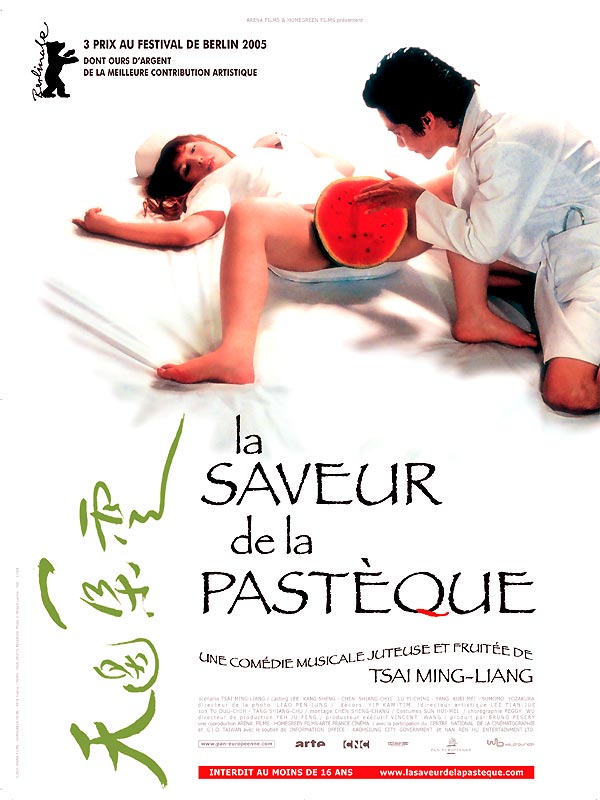
The Wayward Cloud / Tian bian yi duo yun (2005/Tsai Ming-liang/France/Taiwan) ++++


OPENING SEQUENCE


High angle stationary camera (wide angle lens) at the crossing of perpendicular underground tunnels. Dirty cement, artificial neon lights. Distant sound of heels resonates. Real-time crossing (90") of 2 women from opposite sides of the screen to the other. A long plan-sequence shot like a closed-circuit surveillance camera (repeated motif in the rest of the film). Faces are too small to be identified, although one wears a nurse uniform and carry a watermelon: the porn actress (Sumomo Yozakura) of the following sequence.

Cutaway to an actual erotic videotape involving nurse, doctor and watermelon, much more colorful, soft lit, activity cadenced by a faster editing.
Tsai clashes a slow paced impressionistic moment of wordless cinema (to the extant of boredom) with the most diverting excitment (porno) that provokes a reflective conflict to the audience's expectations. A dichotomy of form and content, suppression and debauchery (porn/musical) alternated throughout the film, escalating in degrees until they merge at once, an uncensored disillusioned crude reality.

Almost a satire of the classic vaudeville tragedy opposing "wife" and "mistress" rivals, legal love and physical satisfaction. In fact they represent the existential dilemma of the central character [HE] (Lee Kang-Sheng) between faltering platonic romance and oblivious hardcore activity, two ways out of an overbearing aloof routine. The sexual triangle at the heart of the story : the innocent love interest, museum guide [SHE] (Chen Shiang-Chyi), and the pornstar live nextdoor, unaware of eachother.
Although unmarried in this fable, the protagonists engage in a very tender but passionless, attentionate and indifferent, hide-and-seek juvenile flirtatious game, unable or unwilling to attach one-another. Surreal/discontinuous atmospherical romance like in 2046 (2004/Wong).

note: the 2 lead protagonists will be refered in my text as "HE" and "SHE" for clarity.

FORM

Repeating a gimmick used in The Hole (1998) both a tender homage and burelesque mockery of cheesy Hollywood/Asian musicals, Tsai collides his "boring contemplative style" with its total opposite, a deviant entertainment. Sentimental cover songs of the 50ies moraly-correct era are lip-synched by his actors disguised with ridiculous home-made costumes, no choreography, kitsch design and sexualized imagery to pervert their original meaning.
Five musical numbers, clash of cultures and times, substitute to the words unspoken in the film with dream sequences revealing a little more about their emotional load. They are more populated than the city, maybe to emphasize the sensation of isolation of these characters.
"There’s still some incredible imagery on display here from time to time, such as when shampoo seems to enclose Lee’s head in the titular cloud or when we see him sleeping suspended over a vertiginous stairwell, but these moments are just isolated moments. Throughout, the imposing landscape of the city makes the few people that move throughout it almost feel like afterthoughts, and Tsai’s decision to frame his leads so that even when they share a frame one’s usually leaving or sleeping pays off thematically, but not really emotionally."
Jeremy Heilman
Tsai says in an interview that people are only their true self (no pretention, no dissimulation) when they are on their own, without people observing/judging, or during sex. Like in his previous films, this one effectively focuses on the protagonists when they are alone, even after their romance has begun. And when they are in presence of someone else, they do not speak, or one of them is asleep, or isolated in side of the room.

They live in the same housing project (uniformized/anti-socialization) without ever crossing path. Only outdoor could they see eachother. The clever mise-en-scene of their meeting allows to observe each of them before the other has aknowledged their presence :
She recognizes HE sleeping on the swing. SHE falls asleep waiting for him to wake up. HE wakes up and doesn't recognize her. Then SHE wakes up : uncomfortable silence. Bad timing, their disposition to open up are not coordinated and makes the relationship impossible (just like the distance between Taipei and Paris materialized this ambiguous incompatible attraction). SHE asks if he still sells watches, refering in a one-liner to the two precedent episodes of the trilogy featuring these characters (What Time is it There? 2001/The Skywalk is Gone, 2002)
Tsai initiates the dissolution of the cinema illusion, the actors we recognized as Tsai's recurrant partners are not playing a new fictional character but they are in fact coming out of a previous story. The character of the new film is surprised to meet again a character of another film, so are we. First distanciation with the fiction, Tsai distracts the audience from the conventions that the actor is not himself but a character invented by the screenwriter.

CONTEXT

The project was originally meant to study the double-life of South Asian foreign labor, abused and exploited like under-citizens without visa, lost in a stateless limbo, confined to a marginal existence, selling soul and body for survival. They belong nowhere, incapable to return home, unwelcomed to fit in. If later extrapolated to the milieu of pornography, deviant love and perversity, which suggests a caricature of society, Tsai's latest provocation immerses a seemingly superficial romance in a social environment with comparable issues. In the first script, an aunt uncovered her nephew was a porno actor. Changed to a girlfriend due to casting problems, the role commits to a more intimate humiliation, adding jealousy to shame. She must swallow her pride to forgive if she wants to save their relationship, but is it that simple?

PREMISE / DROUGHT

In the near-abstracted social anticipation, an exceptionally dry season in Taiwan drained rivers and water supplies, the price of bottled water skyrocketed, and the population fell in an arrested languor. An idealized hot dry summer. Deserted streets instill a sense of suspended apocalypse. This sunshinier weather shows the wealthy areas of an idyllic Taipei in contrast with the usual trademarks of Tsai Ming-Liang's previous films: poor, overcrowded, dirty, polluted, and derelict city with non-stop pouring rain, water leaks or overflows.
We are invited to ponder over the effects of shortage (instead of affluence) on human behavior and vital nervous functions. Tsai internalizes the cycle of water. The various overwhelming watery phenomena that drenched the body in a damp macrocosm, now simmers inside the microcosm of the body itself, like a humanly cloud. Debilitating fluid exchanges with a depleted environment cause awkward, uneasy sensations and a craving to quench desirs. The vital needs of the body are out of control like the natural elements in the sky.
Surprisingly the cinematography does not show off hot colors, sweating skins, suffocating rooms and the sound design does not resort to the clichés of omnipresent ceiling fans, noisy insects or drying/melting material. Tsai prefers to insist on the amusing everyday activity/economy to find/keep water anyplace and the slowish pace of a thirsty person. Exausted people seek a rarefied liquid inside fruits, the precious watermelon juice is cherished.

SYMBOLISM OF WATER

The theme of essential substitution proves particularly metaphoric (and revelatory) in light of Tsai Ming Liang's own comments on the symbolism of water in his films (as transcribed in the Editions Dis Voir publication, Tsai Ming Liang): "...I always regard the characters in my films as plants which are short of water, which are almost on the point of dying from lack of water. Actually, water for me is love, that's what they lack. What I'm trying to show is very symbolic, it's their need for love." acquarello
This clue helps greatly to decypher the symbolism and gives a whole new reading to the events in the film. Considering this equation (water = love) the body language that replaces verbalization in the film becomes more evident.
  • Thirst = desir: incarnation of an immaterial feeling into a vital physical need.
  • Water bottle = human body either filled with love or emptied, either topped with a cap or parted from a soul-mate.
  • Watermelon juice = romantism, love stream, fun, bodily fluids.
  • Full Watermelon (green, dry) = emotion, feeling, baby.
  • Cut open watermelon (red, wet) = vagina, sex.
  • Food = sex, sensuous appetite, sexual fantasy.
SHE picks up empty bottles in trash cans and steals water from the public toilet flush! She also finds a watermelon in a dirty canal. It tells about her desperate craving for love... She capitalizes/stockpiles water bottles in her fridge like in a safe/incubator.
Unlike HE who doesn't seem to worry about water conservation (love is not a concern to him).


"she forces glasses of watermelon juice on him, despite her overstock of bottled
water. " Adam Balz
This scene uses a faux "split-screen" mise-en-scene, showing the kitchen with SHE, delighted, making watermelon juice on one side and the living room with HE on the other side, trying to open the suitcase, indifferent. Again a clever way to show the protagonists on their own, while both on screen. Fed up with the watermelon overused in his porn movie, HE disposes of the juice through the window while SHE is not looking. An uncomfortable moment when HE cannot refuse the generous offer, he cannot tell why either.

In opposition to the wet orgasm of Warm Water Under a Red Bridge (2001/Imamura), illustrated by an hyperbolic water leak from the woman's body, the porn actress from the same country plays here with an empty bottle striving to simulate a mechanical excitation. In this scene, the mislaid cap is separated from the bottle.
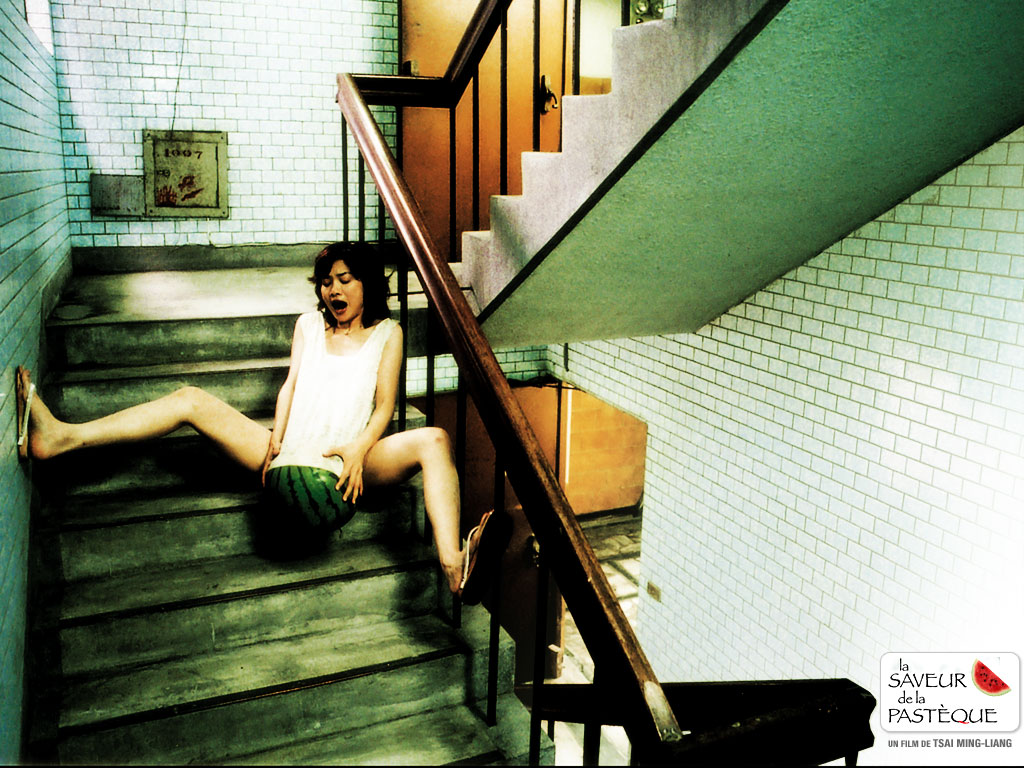
A metaphor of disconnectedness, unrequited love echoed in a later scene when HE hides away from SHE in the staircase. SHE goes down and sees an opened bottle full of water abandonned (by HE), then finds a cap on the stairs below. SHE comes back to put the cap back on the bottle but the bottle has disappeared in the meantime (retrieved by HE who didn't want to be seen near where he films porno). HE hides away upstairs again, and finally throws the bottle to cut short her curiosity. The bottle spills out its precious content. The symbolic meaning is all the more interesting since it was precedented by another scene when SHE pretended to deliver a child with a watermelon hidden under her shirt. Does it mean she asks for a baby and he's scared off? It's certainly one of the reasons that hinders their relationship to a stale.

The first porn scene overtly identifies the watermelon half with sexual symbolism. The foreplay in the flesh of the fruit triggers pleasure to the nurse. Directly paralleled by SHE watching TV in a lascivious position with an opened watermelon squeezed between her thighs too, scooping it up with a spoon. Thus before they even met, both on their own. The parallel montage suggests the two actions are simulatenous as if the fantasy of SHE was enacted by HE. They are in the mood for sex, each on their own way.
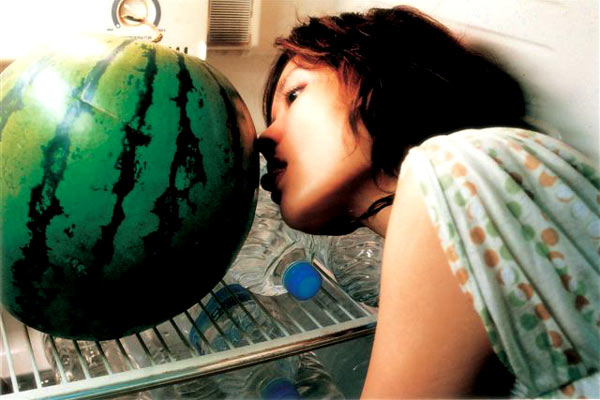
SHE later licks sensuously the full watermelon in the fridge. All this food fetishism is reminiscent of the infamous Kika (1993/Almodovar) where the man sexually attrated by her eats a mandarin orange off her genitalia.

In a memorable scene, HE and SHE eat crabs they cooked together, we do not see them but their shadows on the wall (like the ghost dance in Dreyer's Vampyr, 1932), illustrated by loud suction noises and laughters (echoes of the squishy noises of the first porn scene). Visually self-censored like in erotic scenes from the Hays code era. A strong symbol of sexual intercourse through voluptuous appetite, followed by the scene underneath the table, both lying sleepy smoking a cigarette (like after making love).


(s) ++ (w) +++ (m) ++++ (i) +++ (c) +++

Berlin 2005:
Silver Bear (Outstanding Artistic Achievement) + FIPRESCI Prize
Alfred Bauer Prize for Cinematographic inovation

Official Website (french, 2 musical clips, trailer, 3 scene clips)

Coming up next :

15 décembre 2005

2005 Top10

Year-end lists (acquarello, Girish, Darren Hughes) are a great opportunity to look back on the 2005 production and compare it to the 2005 distribution which seldom overlap. Also very useful to note down the gems that we might have missed or that we can still look forward to and build a wish list anticipating the future releases of 2006.
I realize I don't even write the reviews of my favorite films... probably because they are loaded with emotion and content hard to define, harder to explain, for me anyway. Expect updates before January.

Top10 of 2005 (ordered arbitrarily by personal taste) :

  1. Me and You and Everyone We Know (Miranda July/USA) Sundance 2005
  2. Three Times (Hou Hsiao-hsien/Taiwan) Cannes 2005
  3. The Wayward Cloud (Tsai Ming-liang/Taiwan) Berlin 2005
  4. Caché / Hidden (Haneke/France) Cannes 2005
  5. Battala en el Cielo / Battle in Heaven (Reygadas/Mexico) Cannes 2005
  6. Solntse / The Sun (Sokurov/Russia) Venice 2005
  7. The Forsaken Land (Jayasundara/SriLanka) Cannes 2005 - Un Certain Regard
  8. The Death of Mr. Lazarescu (Puiu/Romania) Cannes 2005 - Un Certain Regard
  9. Tale of Cinema (Hong Sang-soo/Korea) Cannes 2005
  10. Manderlay (Lars Von Trier/Denmark) Cannes 2005

Honorable mention : L'Enfant (Dardenne); Be With Me (Khoo); The Hand (Wong) in Eros; Les Amants Réguliers (Garrel); Les Yeux Clairs (Bonnell); Johanna (Mundruczo); Le Promeneur du Champs de Mars (Guédiguian);

Films that made my favorite list in the past: 2046; La Blessure; The World; Café Lumière; Comme une Image; 3-iron; The Holy Girl; Nobody Knows; L'esquive; Tropical Malady...

Documentaries (ordered by preference):

  1. Estamira (Marcos Prado/Brazil) Rio 2004
  2. Profils Paysans: Le Quotidien (Depardon/France)
  3. Un Silenzio Particulare (Stefano Rulli/Italy)
  4. Le Malentendu Colonial / The Colonial Misunderstanding (Téno/Cameroon) NY HRW 2005
  5. Les Artistes du Théatre Brûlé (Rithy Panh/Cambodia) Cannes 2005 - Off
  6. Grizzly Man (Herzog/USA) Sundance 2005
  7. El Cielo Gira (Mercedes Álvarez/Spain) Valladolid 2004
  8. La Peau Trouée (Samani/France) Nyon 2004
  9. Born into brothels (Briski/Kauffman/India/USA) Sundance 2004
  10. Avenge but one of my two eyes (Mograbi/France/Israel) Cannes 2005 - Off


I still need to see:

State of Fear (Yates); The Squid and the Whale (Baumbach); Seoul Train (Butterworth/Lubarsky); Funny Ha Ha (Bujalski); Un Couple parfait (Suwa); Pin Boy (Poliak); Something Like Happiness (Slama); Mary (Ferrara); Where the truth lies (Egoyan); Vers le sud (Cantet); Tony Takitani (J. Ichikawa); The Blue Younder (Herzog); Darwin's Nightmare (Sauper); Los Angeles PLays Itself (Andersen); Code 46 (Winterbottom); Who's Camus anyway (Yanagimachi); Le Filmeur (Cavalier);

What about you? Comments, questions, recommendations welcomed!


09 décembre 2005

Grizzly Man (2005/Herzog)

Grizzly Man (2005/Werner Herzog/USA) DOC +++

Herzog watches lovingly the footage filmed by this self-made actor-director, Timothy Treadwell, ecolo-activist who felt invested in the mission to protect Grizzly bears against the evil of civilisation in the remote wilderness of Alaska. A captivating posthumous biopic documentary put together with the video remains of a reckless solitary adventure.
Citing his diary and interviewing his relatives isn't as powerful as watching the video segments he himself directed and dramatized a few feets away from fierce animals on their very territory. Stitching together all the takes of his reportage, that were made for the editing table, is like assembling a puzzle with missing pieces. A one-man-made TV reality show.

The man is a frustrated actor showing off not a scientist, he's naive or maybe just nuts. The exploration of his upbringing and addiction background comfirms. Nobody could dispute however his passion for nature, his sincere interest and understanding of animals behavior, and most of all his confident bravery! I say this man is a hero, even if a reasonable society thinks he's out of his mind. He's one of these lunatic pioneers on the edge of charted maps who are always criticized for going too far. There are more stupid ways to die than that. And he knew exactly the risks. which he repeats on and on in his videos to educate children. The crude details of a violent death were endlessly running through his head as he spells out the words decapitation, disembowelment, slashes...
One could argue there is no obvious redeeming value to get in arm's way as such, unlike a war reporter for example, but that would be overlooking the existential dimension of this life lived fully to the limits as an art.

Herzog's narrator voiceover sounds a little judgemental, as he seeks to parallel with his relationship with Klaus Kinski on Aguirre. But he doesn't make the mistake to postpone the revelation of Treadwell's death for a final climax. He also makes obvious we're not going to ear the soundtrack of his death. At the same time he merely conceals the manipulation to get his interviewees to say what he wants: the travelling backward interrupting the coroner's speech, the staging of Timmy's watch handed out to Gizzly People president, the scene when Herzog appears on screen while listening to the death tape. This might be a conscious critique of how far TV/Cinema can exploit the desir of people to be filmed.

I didn't like when Herzog silence Timmy's curse words with a moralizing speech that misses the spark of truth revealed right there by this outburst of rage. Herzog wastes his time on the "what" instead of analyzing the "why". We don't care if Treadwell is right or not in insulting the National Park guards... What's taking place here is a genuine "moment" of symbolic pride.
This is the end of the summer, his expedition is over, he is unarmed and alive for the twelveth or thirteenth time in an everyday life-threatening journey. It's not a one-strike fluke, he challenged and proved it every year.This intensity of survival instinct drains a lot of energy to constantly prevent an imminent hazard. Imagine the level of controlled fear when he frequently glances back at the bear standing right behind him as he talks to the camera. His eyes and mind are always on watch. Thus when the season is done, and the danger is gone, the adrenaline rush falls dramatically, and lets out of his chest this puerile ressentment towards people who didn't believe in him and underestimated his challenge.
Treadwell acts out in front of his own camera, speaks to the world for the record, and shares his frightening promiscuity with death, be it clumsy or misplaced. In another take he say it out loud, nobody has ever faced human predators this close and for so long. I believe he has the right to brag about it.

Treadwell is not an isolated case. Dian Fossey with gorillas, Sigfried & Roy with tigers, people living with wolves, people who mingle with sharks or alligators, snake charmers... Wild life is a fascinating attraction to humans and some want to cross the safety fences.
There was this freaky video on the net where a guy jumped into the lions compound at the zoo to tell them to accept Jesus as a savior. The guy was clearly deranged, so totally fearless, he didn't even back off when the claws hit his leg. He kept an authoritative voice and a finger pointing dominant posture, just like Treadwell with his teasing bears. This is probably what made the lion think twice before eating him up.
So Treadwell was onto something with his "kind warrior" theory. The mind confidence replaces the physical superiority in a territorial face-off. That's how the little mongoose defy the mighty cobra. As long as there is no provocation fierce animals prefer to avoid contact especially if the opponent shows no fear to intimidative postures. Maybe animals sense the intellectual ascendant of humans even though they are no match to their jaws. But it takes serious guts to believe in this theory with a bear growling in your face.

In the light of his personal history, I see this reportage as a setup for an exit with panache.
He fancies himself a public enemy, victim of an fantasized manhunt, pursued by friendly tourists who leave smiley faces on his campsite. I wonder what was the detterence of his presence among the grizzlies if he hid away as soon as people came in and threw stones at his bears. He did nothing to stop them just to preserve the mystery of his legend. Real people afraid him more than bears! The clash of titans sequence between two males competing for a female and the aftermath debriefed by Timmy full of empathy for the defeated bear is quite telling.
He refused the mediocre death of an everyday-man, or to be caught and condemned by the justice of humans. The frustrated actor who almost passed out on O.D., and watched in the eye the criminals sentenced to death at the courthouse had a repressed ego-trip that couldn't express itself and found the most tragic way to claim his need for fame and grandeur. It's most unusual for a biologist to share intimate love-life issues during a field study. Maybe he was afraid to leave life, and truly enjoyed this sympathetic indifference of animals, for the liberty civilisation didn't allow him.

I think Timothy Treadwell wanted to stage his own death, to pick his executioner, an adversary of his stature. When the Ripper came to take him he made sure the camera was recording, and we know he met his expected fate with honor and courage like he always lived in this inhospitable environment. Meanwhile the secret role of his last girlfriend, Amie Huguenard, who was crazy enough to follow him to the heart of danger, gives a truly romantic, passionate ending to this tragedy, almost creating a universal myth bigger than fiction.

(s) +++ (w) ++ (m) +++ (i) +++ (c) ++

http://www.grizzlymanmovie.com/