28 juin 2006

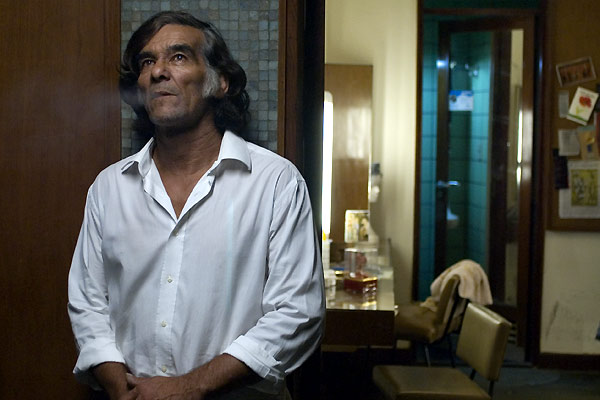
Conversations with other women (2005/Canosa)

Conversations with other women (2005/Hans Canosa/UK/USA) +++

I like when mainstream cinema picks up some refreshing ideas from the experimental scene. The film runs a dual screen throughout, showing simultaneously two actions in two views. This is purely formalist but since the concept is maintained end to end, it becomes integer part of the narration in a playful way.

A man and a woman meet at a wedding, chatter with a certain self-conscious distanciation, joke around cynically about marriage and flirting, and inevitably spend the night together in the hotel, all in one breath, uninterrupted. Like a grown up pram flirt, with all the mature irony of a late thirties couple with a divorce under their belt. Tacitely agreeing to play an awkward pretense game, a mysterious connivence seems to build up quickly despite constantly refering to their absent better-half. They intellectualize the inconsequential guilt to talk themselves out of an imminent mistake as they approach closer to the adultary bed... The clever conversation drops scarce clues that reveal they know more about their past than we do. Through incremental steps, the intrigue develops on who we think they are. The "surprise" effects are largely underplayed though, almost en passant, as the revelations are rather amusing than a proper "twist".
Actually this pretense is part of their accomplice courtship, based on double-entendre. So it's not a complicated storytelling helding back information, it's the characters themselves willingly roleplaying for the purpose of this one-night stand.

They are desillusioned and convey a hopeless romanticism.The boring melodrama, mostly dialogue-driven, is wittingly written, takes a new turn by the simple fact we see twice as much on a split screen.

Notes on the dual screen "gimmick" :
  • The split in the middle is a reminder that the cinemascope aspect ratio (2.35:1) is nearly the sum of two standard square format (1.33:1).
  • One side is dedicated to the man, one to the woman. Although the switch of view allocation is part of the fun.
  • 2 cameras film each scene, one framing the man (Aaron Eckhart), one framing the woman (Helena Bonham Carter).
  • The film is about a couple, man v. woman, about the clash of two point of views, about each trying to figure the other's perspective without telling too much... therefore the form meets content and the screen is split physically to give both an equal platform of expression.
  • Perception of two realities at all time. Spatially : 2 places, or 2 views of the same room. Temporally : current time and flashback (memories or selective memory re-enactment of the past, confronting their younger-self).
  • Not always creative... sometimes the split is redundant as the 2 shots are almost forming the 2 halves of the equivalent widescreen shot.
  • Really interesting diptych compositions, identical type of shot or disparity : duplicated shot, great variation of head shots, back shots, wide shots...
  • Artificial re-composition (by way of split-screen) of a scene unlike reality. The angle of the two cameras make protagonists look in opposite or the same direction which may or may not correspond to reality. Which gives a supplementary reading of the scene, with 2 parallel meanings of the same action.
    Playful switch of a character, or an extra from one shot to the other. Co-ordinated camera movement of the two POV to make an harmonious apparent motion. Extras blocking the view on one side. Side swapping...
  • Doubles the theatrical possibilities for shot entry/exit (2 rights and 2 lefts). Continuous (slide from one view to the other) or discontinuous (unrelated motion). Complex mise-en-scène, but the technique could offer much more potential for dramatic effects.
  • A third character entering the scene unbalances the duality, and it's funny to see how the director copes with 3 characters on 2 screens. Either cutting faster to display 2 talking heads, or duplicating the shot with 6 people on screen at once.
  • Reaction shots on the same screen without the need to cut away. A new interpretation of the reverse shot code. Each looking to the other side of the screen so they seem to be at arm length while they are at the other side of the room (discontinuous background in the two shots).
  • Allows to insert a cutaway on screen while keeping an eye on one or two protagonists. The main conversation keeps going during the apparition of flashbacks or cutaways.
  • Co-existence of alternate takes of the same action. We see the actors doing the same thing, perceptibly de-synchronous, because they are different takes, filmed separately but played on screen simultaneously. And this has a particular meta-significance on the act of filmmaking and performances. We are allowed to compare outtakes in the final cut, in fact 2 outtakes become both "good". Several different ways to deliver a line, or to act an action are played in a row or simultaneously, alteration of the voice inflection, pause, posture, timing or change of the line altogether.This formal construct, anti-film, making-of material, contributes to dissociate the dual screen and emphasizes a differentiation between male and female perception of the same event, which is the point of the film.
  • Storytelling variations. The inclusion of alternate takes in the film propose a narrative multiplicity.

(s) ++ (w) +++ (m) +++ (i) ++++ (c) +++


26 juin 2006

Leonard Cohen Tribute

I don't usually post non-cinema related stuff here, cause I don't know how to write about anything else, but this blogathon honors a documentary from Toronto 2005, Berlin 2006 and Sundance 2006 : Leonard Cohen: I'm Your Man (2005/Lian Lunson/USA) I haven't seen the film unfortunately (not distributed in France yet). Although I can't miss the opportunity to show my admiration for my most favorite songwriter with a quick post.

Leonard Cohen is the anti-hero, a romantic loser who can't afford love. He remembers affairs in hotels around the world. He collides supreme poetic moments and crude erotism in a novelist way. Solitude, existential struggle, self-pity modesty, political cynicism, resistance of ideas and revolution. He's a modernist akin to Antonioni, Bergman or Cassavetes. I like the melancholy of his stories, its indirect angles, his mundane poetry, his careful and useless details that make all the difference in memories.
Not to mention the beauty of his chords.

I'm Your Man is my dearest song for it will always remind me of my girlfriend.
Few favorites among many : So Long Marianne; Hey, That's No Way To Say Goodbye; Suzanne; Who By Fire?; Sisters of Mercy; Chelsea Hotel #2; The Partisan...

And of course :

Famous Blue Rain Coat
Composed and written by Leonard Cohen, 1971

It's four in the morning, the end of December
I'm writing you now just to see if you're better
New York is cold, but I like where I'm living
There's music on Clinton Street all through the evening.

I hear that you're building your little house deep in the desert
You're living for nothing now, I hope you're keeping some kind of record.

Yes, and Jane came by with a lock of your hair
She said that you gave it to her
That night that you planned to go clear
Did you ever go clear?

Ah, the last time we saw you you looked so much older
Your famous blue raincoat was torn at the shoulder
You'd been to the station to meet every train
And you came home without Lili Marlene

And you treated my woman to a flake of your life
And when she came back she was nobody's wife.

Well I see you there with the rose in your teeth
One more thin gypsy thief
Well I see Jane's awake
--She sends her regards.

And what can I tell you my brother, my killer
What can I possibly say?
I guess that I miss you, I guess I forgive you
I'm glad you stood in my way.

If you ever come by here, for Jane or for me
Your enemy is sleeping, and his woman is free.

Yes, and thanks, for the trouble you took from her eyes
I thought it was there for good so I never tried.

And Jane came by with a lock of your hair
She said that you gave it to her
That night that you planned to go clear

Sincerely, L. Cohen


It's like a great film. It's not a song, it's a letter. It's not a letter, it's a written monologue. It could be the synopsis of a Cassavetes film : New York, a love triangle, brotherly friendship, love/hate antagonism, miscommunication. A woman encompassed in a firstname. A suggested past between the characters, symbolized by objects (raincoat, lock of hair, rose), establishing a powerful melodrama without the need to elaborate any further, everything is there.

I'd like to mention Jeff Buckley's interpretation of Hallelujah, because he plays it even better than its author and transcends it. Simply magnificent!


Check out also other participants of this Blog-a-thon :

20 juin 2006

Bruno Dumont on filmmaking

Discussion with Bruno Dumont

by Marie Vermillard, Philippe Grandrieux, Khalil Joreige
from the filmmaker club at Le cinema l'après-midi, on June 10th 2006

Really interesting discussion among filmmakers who get into the artistic concerns of filmcraft, and the ideology of Dumont's aesthetics. Although the atmosphere is friendly and Grandrieux is clearly in total connivence. They are not promoting a commercial product with complacent questions here. This type of live radio show winds up a little confusing and disorganized, leaving us frustrated by interrupted sentences and spontaneous digressions that never answered a question raised along the way. The interview would gain in intelligence if written down and edited, structured without this urge to say too much at the time. An interesting approach to interview resulting in a richer, deeper material than the press conference digest in Cannes for instance (partial transcript).
The art of cinema is the center of discussion. They talk of his relationship with actors and viewers, how a film commands and alter perception of reality. Dumont doesn't explain his synopsis here but confesses why he makes films.
Former philosopher, turned autodidact director, he speaks with self-confidence and a certain authority that could be alienating if he didn't place the audience at the core of his theory. It does sound a little all-knowing and condescending, maybe a feeling prompted by his recent win of the Grand Jury Prize for Flandres at Cannes 2006.
Which brings the question : "How to speak of cinema?"
Sometimes putting delicate images into words desacralizes the poetry in them by an excess of vulgar materiality. I mean filmmakers aren't always the best persons to explicit their instinctive inspiration, but they are the first people to go to.

* * *

Cinema

Dumont admits "intellectual/illustrative cinema" is boring, he doesn't believe in Cinema of Emptiness. Cinema = Time. Closest art to life itself. Primordial sensibility. Cinema isn't imaginary. What he wants is a simple cinema of reality : the metaphysics of banality. Going beyond intellectual complexity (desires, will, ideas of cinema) in order to make the shot a beginning : nothing. There is nothing to see. No preconceived ideas, no intentions, no established meaning, just a "nothing" that will reverberate into the audience and make sense then through the articulation of montage that echo one plan with another.
Cinema is a powerful but complicate art. Plans, aesthetic values, positions of actors in the shot, light, camerawork, sound... A complex art requiring a lot of upstream work, which paradoxally allows to reach ultimately an apparent simplicity. He humbles before great masterpieces (without citing any films or auteurs in particular). "Cinema isn't technical, I learn when I walk down the street, by meeting people" he says. Cinema is about patience, humility, a look upon others. Today's cinema is overwhelmed by codes, clichés, references to other films. Dumont believes in "decodage".
A film is an experience of astonishment (to be flabbergasted). The subject isn't the object in the film, but the gaze on this object.

Screenwriting

To write a film is to wait for images, sensations to come up, and to reject silly images. (In this he meets David Lynch's own method)
To grasp a scene Dumont writes down the description of a sensation in a literary style, like a novel. But this is only a preparation, literature cannot be filmed. Only remains the emotion summoned, refined by its wording yet devoid of any constructed sense, and will be the raw substance to work on during shooting. Working hard to go beyond clichés. There is nothing to see. The contemplation of a cinema story is secondary. The audience needs a motif however, a basic love story for identification, to relate to the work. Mise-en-scène can never go too far into abstraction.

Set

The most difficult is to make the set designer understand he shouldn't touch anything on location. After a long location scouting, the right place imposes itself and should be preserved intact, thus dismissing all the intentions mentionned in script. Any accentuation, characterization is out of question. The scenes will adapt to the real location instead, to maintain the authenticity and truth of a living space with genuine history.

Acting

Dumont prefers the ingenuity of non-actors who do not ressort to performance tricks. They don't bring in a "prepared color". Non-actors convey with their real-life personality (which belongs to the story) everything that is needed for the film credibility. He regrets his experience with professional actors on Twentynine Palms, and made it despite their active acting. Acting virtuosity is prohibited. "I expect nothing, I await for a miracle to happen, an accident" he declares.
He knows exactly what he wants from the actors, so improvisation is not welcomed. And he makes sure the actors do not know too much about the action planned in a scene to preserve spontaneity and surprises. He's very demanding with actors, pushing them to their limits, against their resistance, insisting, making several takes (up to 15). And then being able to give up when it fails to happen, dropping the scene altogether. There are a lot of wasted out-takes. He's not constrained by script imperatives. He lets chance and accidents rewrite the course of the story, according to what succeeds or not during shooting. For instance the actress on Flandres cried instead of saying her lines and he kept the scene as is. But another actor abandonned the set, because of the directorial (dictatorial?) pressure. "We cannot shoot with maximum security", he says, speaking of the shooting conditions with bomb stunts on Flandres, "the possibility of risk saves a part for lively events".

Sound

Direct sound, mono, without much sound mix at all. Recording reality, out of control, waiting for something to happen, the accident. (same moto)

Mise-en-scène

Like a painter who paints a mountain that ultimately blends in on the canvas where there is no mountain to be seen anymore. Sense is no longer at stake, what he likes is to work where the sense is gone. Reality offers the presence of things that do not imply a narrative construction. Dumont struggles against construction. Dissipate sense. Prevent an actor to formulate meaning. Make the auteur (Ego, gaze) vanish. Because the non-neutral audience is there, coming in with their own emotional load (desires), and a need of sense. The viewer is "full". Cinema must balance the equilibrium with a whole audience, and provide a full film, finished, ruled, moral, political. The heart of the work is in the story (conveyed by actors and scenes), the goal is to carry this story. Takes can be or should be mediocre, unfinished, spontaneous, real, away from the overstated stylization. He says "cut" when he feels the exposition of the audience was sufficient. Cinema is in the montage, that's where Dumont input a suggestive meaning.

Montage

The art to compose cinema elements together. A shot doesn't matter for itself. Shots too pretty, with an overt aesthetization are discarded. What interests him are the transitions obtained in editing opposition. Associating banal shots that will surge with an extraordinary exposure on the editing table by ways of confrontation with another flat shot. Imprevisibility sparks up on the editing table, long after a shooting "out of control", after watching the dailies. Contemplating the exact transition between shots, the right timing, he feels intuitively the shots to be alright.
Grandrieux and Dumont discuss the opening sequence of Flandres: A wide stationary shot of a distant farm to generate a great force. Cut to an extreme close up of a body part, an arm just hurt by the opening of the gate. The close up enters abruptly "inside" the previous shot, and the viewer is pulled in alongside.
The film is a "viewer montage". What is edited isn't what is seen on screen but the sensations, culture, experience, sensibility inside the audience. The viewer is captured into the screen. The thrill is generated by an alteration of the viewer's habits by projecting something unusual. The film is a go-between which leads the scenario and mise-en-scene to operate from the audience.

* * *
This theoretical talk is fascinating, I like most everything he says (non-actors, importance of montage, script improvisation, neutrality, emotional tabula-rasa, learning cinema in the street...), although the only film I saw (L'Humanité) doesn't yield as much visual power as other minimalist films by ascetic filmmakers. Bresson's system (albeit different) is very constraining and rigorous too but develops a much stronger and coherent language. I find it ironical to elaborate such a "populist" speech for such an elistist cinema. I'm not sure what audience he targets his films for but the popular success doesn't quite follow. I mean it seems contradictory to focus on this "universal viewer" waiting to be mesmerized if such viewer rarely responds to these films. I would always defend minoritary cinemas that never find their niche despite their overlooked quality. But what's funny there is the rational of intellectual films supposedly made to reach for the guts...

More on this once I've seen Flandres, out in France at the end of August 2006.

16 juin 2006

ParisCinema 2006

Paris Cinéma www
June 27th - July 11th 2006

For the first time this year, this huge cinema event founded by Costa-Gavras in 2003 becomes a proper Festival with a competition, which might give Paris a decent international film festival noticeable on the world scene. Until then we only had le Festival du Film de Paris, held in March, usually small, which was a debacle in 2006. Obviously Cannes explains why Paris doesn't appear on the International Festival circuit map. Maybe that's why the French capital doesn't attract as much world premiere. The festivals in Nantes (3 Continents) is bigger than here. There are lots of films shown at Paris Cinéma every year (about 400 titles in 20 venues for 70,000 admissions), but mostly second-run or older movies, whiches are available all year round in parisian arthouses anyway. Although there are many films coming from the Cannes selection (Climates, Lights in the Dusk, The Science of Sleep, Bamako, To Get To Heaven First You Have To Die, Luxury Car, La Raison du plus faible, Bug, El Violon, Nouvelle Chance...)

As always, recommendations welcomed to help me find the best screenings, especially for the Korean retrospective and the new films. (*) Films I've seen already.


COMPETITION www


  • Bamako (2006/Abderrahmane SISSAKO/Mali)
  • Our Daily Bread (2006/Nikolaus GEYRHALTER/Austria)
  • To Get To Heaven First You Have To Die (Djamshed USMONOV/Tadjikistan)
  • Old Joy (2005/Kelly REICHARDT/USA)
  • Au delà de la haine (2005/Olivier MEYROU/France)
  • Zemestan / It's Winter (2006/Raffi PITTS/Iran)
  • Quinceañera / Echo Park, L.A (Richard Glatzer, Wash WESTMORELAND/USA)
  • Die Große Stille (2005/Philip GRONING/France/Switzerland/Germany) DOC
  • In Between Days (2006/So Yong Kim/Mike OTT/USA)
  • La Leyenda del tiempo (2006/Isaki LACUESTA/Spain)
  • Montag kommen die Fenster (2006/Ulrich KOHLER/Germany)
  • Les Oiseaux du ciel (2004/Eliane de LATOUR/France)
  • Le Pêcheur et la danseuse (Valerï SOLOMIN/Russia)
  • Sehnsucht (2006/Valeska GRISEBACH/Germany)
  • 04:30 (2005/Royston TAN/Singapore)
PREMIERE - Off Competition


  • Climates (2006/Nuri Bilge Ceylan/Turkey/France)
  • Lights in the Dusk (2006/Aki Kaurismäki/Finland)
  • The Science of Sleep (2005/Michel Gondry/France)
  • Luxury Car (2006/Wang Chao, Chine/France)
  • La Raison du plus faible (2006/Lucas Belvaux/France/Belgium)
  • Bug (2006/William Friedkin/USA)
  • La Californie (2005/Jacques Fieschi/France)
  • Jardins en automne (2006/Otar Iosseliani/France) SEP 13 2006
  • Nouvelle chance (2006/Anne Fontaine/France)
  • Perhaps Love (2005/Peter Ho-sun Chan/Hong Kong)
  • La Tourneuse de pages (2005/Denis Dercourt/France)
  • The Violon (2006/ Francesco Vargas/Mexique)
  • La Dignidad de los nadies (2005/Fernando Solanas/Argentina/Brasil/Switzerland)
  • Le Regard (2005/Sepideh Farsi/France/Iran)
  • Pirates of the Caribbean: Dead Man's Chest (2006/Gore Verbinski/USA)
SHORT FILMS www

RETROSPECTIVE KOREAN CINEMA www


  • Die Bad, Ryoo Seung-wanBarking
  • Dogs Never Bite, Bong Joon-ho
  • The Moon is what the Sun Dreams of, Park Chan-wook
  • Trio, Park Chan-wook
  • Joint Security Area, Park Chan-wook
  • Sympathy for Mr Vengeance, Park Chan-wook *
  • Old Boy, Park Chan-wook *
  • Memories of Murder, Bong Joon-ho *
  • The Foul King, Kim Jee-woon *
  • Coming Out, Kim Jee-woon *
  • Girls' Night Out, Im Sang-soo
  • Tears, Im Sang-soo
  • A Good Lawyer's Wife, Im Sang-soo *
  • The President's Last Bang, Im Sang-soo
  • Adresse inconnue, Kim Ki-duk *
  • All For Love - The Most Beautiful Week of my Life, Min Gyu-dong
  • Blood Rain, Kim Dae-seung
  • If You Were Me 1* & 2 (Omnibus)
  • Memento Mori, Kim Tae-tong et Min Gyu-dong *
  • My Sassy Girl, Kwak Jae-young
  • Once Upon a Time in High School, Yu Ha
  • High Crime, Im Kwon-taek *
  • Peppermint Candy, Lee Chang-dong *
  • Rules of Dating, Han Jae-rim
  • Take Care of my Cat, Jeong Jae-eun
  • Turning Gate, Hong Sang-soo *
  • The Unforgiven, Yoon Jong-bin
  • Welcome to Dongmakgol, Park Gwang-Hyeon
  • Dear Pyongyang, Yang Yong-hi
  • Grain in Ear, Lu Zhang
  • In Between Days, So Yong Kim
  • Linda Linda Linda, Nobuhiro Yamashita
  • Go, Isao Yukisada
KOREAN EXPERIMENTAL


  • Nam June Paik
  • Kim Woojae
  • Jean-Claude Rousseau
  • A Tale of Two Cities 1 & 2 (Busan Bienale)
KOREAN DOCUMENTARY


  • Le Match de leur vie (Daniel Gordon)
  • Pyongyang Robogirl (Jouni Hokkanen & Simojukka Ruippo)
  • Les Renaissances du cinéma coréen (Hubert Niogret)
  • Repatriation (Kim Dong-won)
  • Une délégation de très haut niveau (Philippe Dutilleul)

CARTE BLANCHE to Peter Fonda

  • The Best Years of Our Lives (1946/William Wyler)
  • Woman In The Dunes (1964/Hiroshi Teshigahara) *
  • The Hired Hand (1971/Peter Fonda)
  • Ulee's Gold (1997/Victor Nunez)
  • The Limey (1999/Steven Soderbergh) *
RESTROSPECTIVES


MASTERCLASS

  • Im Sang-soo
  • Dario Argento
  • Agnès Varda : "L'ÎLE ET ELLE"
  • Claude Chabrol : "Au cœur du mensonge..."
ROUNDTABLES

- Costumes, with Elisabeth Tavernier (costume designer) & Miou Miou (actress)
- American Independent Cinema, with Costa-Gavras
- Screenwriters, with Santiago Amigorena, Pascal Bonitzer, Jacques Fieschi, Marc Fitoussi, Tonie Marshall, Frédérique Moreau
- Cinema Score, with Bruno Coulais
- Cinema & Videogames, with Marc Miance (concepteur visuel du film Renaissance), David Cage (concepteur du jeu Farenheit), Olivier Séguret (Libération), Denis Friedman (producteur, La Planète des Vents), Xavier Poix (directeur des studios France Ubisoft)
- Actors, with Marilyne Canto (actrice, réalisatrice), Laurent Couraud (directeur de casting), Christophe Moulin (directeur de casting), Richard Rousseau (directeur de casting)
- Arte France Cinéma, with Michel Reilhac (ARTE France Cinéma), Marie Masmonteil (Syndicat des Producteurs Indépendants), Patrick Sobelman (Agat Films), Maurice Tinchant (Pierre Grise Productions)
- Film Production, with Yves Darondeau, Emmanuel Priou, Christophe Lioud (producteurs associés de Bonne Pioche)- Seduction of the Movie Posters, with Michel Landi (artiste-affichiste), Nicolas Journet (journaliste), Soizig Petit (graphiste), Claude Terrier et David Sampedro (Iceberg)
- How to distribute with less than 5 prints, with Yann Kacou (ASC Distribution), Emmanuel Atlan (Zootrope), Eric Lagesse (Pyramide Distribution), Claude-Eric Poiroux (Europa Cinémas, exploitant) (sous réserve), Antoine Cabot (UGC Ciné Cité Les Halles)
- MEDIA 2007 (European program), with Mme Aviva Silver, chef de l'Unité MEDIA de la Commission européenne, et M.Costas Daskalakis, chef d'Unité MEDIA au sein de l'Agence Exécutive Education, Audiovisuel et Culture (EACE). - Filmstiftung NRW (Nordrhein-Westfälen)

MARKET Projects under-development seeking co-production support


  • A Good Woman in Paris (Im Sang-soo/Korea)
  • A Mexican Story (Artur Aristakisian/Mexico/Russia)
  • The Art of Murder (José Carlos Somoza/Spain)
  • Egg (Semih Kaplanoglu/Turkey)
  • Five Lives (Wong Ching Po/Hong Kong)
  • Jash - The Traitor (Fariborz Kamkari/Italy/Iran)
  • Keep Smiling! (Rusudan Chkonia/Géorgia/Germany)
  • Love & Other Crimes (Stefan Arsenijevic/Serbiea/Germany)
  • Tango Bar (German Kral/Germany/Argentina)

04 juin 2006

Fantasma (2006/Alonso)

Fantasma (2006/Lisandro Alonso/Netherlands/France/Argentina) +++
Opening Sequence : Long stationary shot in front of a shoe-repair shop window pane, inside Vargas awaits, one shoe in hand, his nose stuck to the glass. Cut to pitch black. Saturated electric guitar soundtrack for a couple of minutes in the dark. Cut to wide shot of an immense hall after a ceremony with empty glasses on the tables. Vargas slowly wanders around searching his way to the
main entrance downstairs. There, a poster of Los Muertos. The title, Fantasma, red on black slate, will only be intercut later.
A succession of long plan sequence, immobile or moving really slowly. Characters err along the neon-lit corridors, stairs and elevators. Nobody notices. Endless accumulation of levels and rooms. Marble walls. Carpet. Cement. Steel doors. Distant camera dwarfing onscreen people by the huge scale of the building. Silence. Or more precisely, impersceptible murmur from a waking city outside. This steady viewpoint captures the immensity of solitude and the absence of time.
We realize after a while Vargas has never been in a cinema theatre before and was invited to attend a projection of his film. He visits the premises halfway from awe to circumspection, like a child in a strange place. Not quite as familiar as his home jungle, although unrushed and never worried of getting lost or wasting time, two precious things in city life.

Finally the film is projected for only three people. Vargas, the housekeeper, and a young woman working in the building (secretary or PR). We see Los Muertos' oniric opening scene from behind Vargas discovering the film for the first time. Series of reaction shots of Vargas' face, equally impassible yet fascinated. The full screen projection takes us entirely into another film for a moment as the country nature fills the screen. Like an echoe of Vargas and Alonso's interest inside the multiplex. Like a shameless plug to his previous work.
Argentino Vargas, 56 yold, was the single protagonist of Lisandro Alonso's second feature film Los Muertos (2004), a somptuous wordless contemplative journey through the watery forest of Argentine's back country. Misael Saavedra was the lumberjack in La Libertad (2001), which I haven't seen yet.
Both are non-professional first-time actors from a countryside far away from Buenos Aires. The capital city is summarized here by the Teatro San Martin, the only location the film visits during an hour, a concert Hall multiplex of labyrintine architecture. We could see there a dichotomy opposing rural and urban, ancestral forest tradition and cold city anonymity, the personal and the industrial, and even, why not, Alonso's lonely Avant Garde cinema and the indifferent commercial mainstream industry.

Tsai Ming-Liang's Good Bye, Dragon Inn (2003) comes to mind immediately. Is it a conscious homage? a filmic response? Likewise, speachless characters err in an empty auditorium while a film (not one of Tsai's in this case) is projected on a huge screen. Tsai's film inspires nostalgia and admiration for this old theatre about to shut down, pertaining to a forgotten era. Whereas Fantasma feels indifferent for this lifeless multiplex, and its extensive bewildered visit of a displaced person would rather translate a critique of what represents the place.

His actors are alienated in Buenos Aires, and nobody shows up at the premiere. Quite a paradoxal picture for what is the popular culture of instant screen celebrity, Star System or 15-min fame on real TV.
What does suggest this thinly veiled allegory? Maybe the filmmaker shares with his protagonists the sentiment of not belonging there, in the official establishment of culture venues and movie business. They are more comfortable with simple people in the pampa. So the Buenos Aires audience was alienated by La Libertad and Los Muertos, so their very protagonists feel equally unwelcomed once brought to this unfriendly city, like images of remote locations were brought all the way to urban movie theatres.
Is it a complaint that his cinema is ignored by his own people? A complaint that might only be heard by festival crowds and passionate cinephiles though. Kaurismaki echoed this fatalistic grief by giving a surrealist press conference (Cannes 2006) with absurd answers, conscious nobody cares about the exploration of boredom in his art.
Abstracted wordless scenes. Plotless narration essentially carried by images. Careful sense of pace. Tangible appropriation of time. Maybe his Mexican neighbor Carlos Reygadas would share similar concerns about filmcraft. I could only compare this cinema to Apichatpong Weerasethakul from Thailand or Tsai Ming-liang from Taiwan, much less to the other filmmakers of Argentine's Nuevo Cine. As if the new generations of truly creative auteurs formed today beyond the outdated idea of "national cinema" confined by geographical bounderies.
* * *
Lisandro Alonso introduced briefly the projection. This film closes a trilogy, a urban and indoor installment mirroring the first two rural and open air films, apparently to move on towards something different... Arranging a meeting of their lives with his "actors" in the city : a way of thanking them for the critical recognition he received. His next project will take place in Tierra del Fuego, another remote region of Argentina, the utter south of inhabited land on the globe, again with simple, taciturn non-actors.
Despite the unanimous applause of an half-full auditorium at the end, the final Q & A was timed out unfortunately. It's a shame I wasn't bold enough to ask him a few questions in the street... I admit it took me some time to begin making sense of the experience.
Special Screening, off competition, at La Quinzaine des Réalisateurs (Directors' Fortnight), Cannes 2006.
(s) ++ (w) ++ (m) +++ (i) +++ (c) ++++

01 juin 2006

12:08 East of Bucharest (2006/Porumboiu)

A Fost sau n-a fost ? / 12:08 East of Bucharest (2006/PORUMBOIU Corneliu/Romania) +++

Opening Sequence : December 22nd 2005. Dawn. Small rural town in Romania, East of Bucharest. Succession of stationary shots in various places.All the lampposts turn off. On the monumental townhall square with the illuminated christmas tree. On a quiet hill with inexistant traffic. In a desertic social housing lane. By an old man's window, who ritualy taps with impatience on the table until the
light dies, and swallows his soup, back to us.This scene introduces an improbable allegory brought up later, and will bookend the full day of this story. A peaceful, contemplative visit across town before everyone wakes up.

Structured in two parts, this bureslesque and gentle critique of the post-Iron curtain Romanian society first introduce the interlaced lives of Manescu, Piscoci and Jderescu through the habits and problems of simple people. Hangover remorses, loans and debts, christmas trees and Santa Claus costumes, firecrackers jokes, neighbor clashes... Intimate scenes with tender banality observing the struggling humanity of proud characters within their very social environment, at home with their wife, at the pub, at school, in the street.This lucid derision reminds of the wry social humour of Kieslowski and more recently, Christi Puiu's riveting The Death of Mr. Lazarescu, also from Roumania. The second part unfolds over a real-time sequence of this history talk show on TV, hosted by Jderescu, a middle-aged TV producer very much fond of his screen persona.

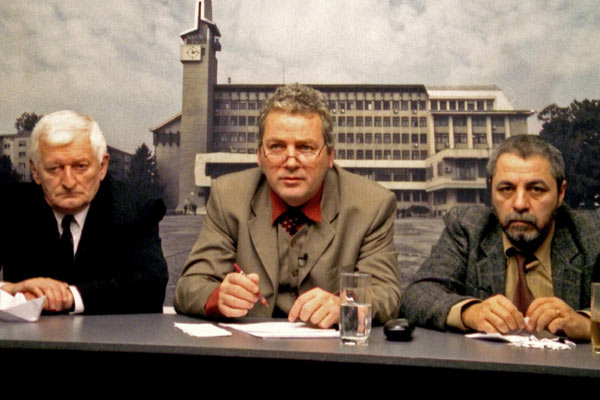
On the anniversary day of Ceausescu's demise, three men debate on local TV show whether the street protests started before or after 12:08, time when the end of the communist dictatorship was proclaimed on TV. Viewers call seem to contradict the heroic version presented by the guests. The literal title means "Was it or was it not?", a question repeated tirelessly until someone can prove there was a popular revolution in their town, alike the ones in Timisoara and Bucharest. Were the people that brave or did the alcoholic selective memory altered the perception of this euphoric and confusing liberation?
A chinese shopkeeper, victim of racists comments, will nonetheless shed an outsider look on this silly quibble in particular and on the Romanian people in general. "You Romanians should stop insulting/accusing eachothers!" Ironically the disgraceful absence of heroism is complacently clouded by a nitpicky reconstitution of crucial minutes around the official capitulation. Evidently this rally wasn't anything like the bloodbath of the French Revolution, subtly referenced twice in the film. Emphasizing the absurdity of pseudo-minutiae accuracy (timeline mockery by anonymous liars fortunately invisible at the othe end of the phone line), the serious of this debate seems to be the only way for them to grab some local glory from the national uprising.


This low-budget channel is totally burelesque. The cameraman trainee can't frame right and has "cinéma-vérité" aspirations. Awkward shots and clumsy zooms, the filmmaker enjoys to give us a faulty camerawork, shaking the cinema widescreen like an amateur homevideo. The effect is hilarious and contributes to embarass the protagonists and lighten up their "grave" discussion. Jderescu, the owner and star anchor, struggles to give some professional dignity to the program, while his bored friends fold or tear paper on air.

A remarkable debut film, of modest but talented ambition, supported by the Cannes Cinéfondation at the Festival Residence. Selected at the Director's Fortnight, won the Camera d'Or (Best debut film) at Cannes 2006.

(s) ++ (w) ++ (m) +++ (i) ++ (c) +++

31 mai 2006

DIGEST : May 2006

Un-reviewed screenings, current reading, links, recommendations, free talk
(updates in comments) sticky entry for a month

30 mai 2006

Marie-Antoinette (2006/Coppola)

Marie-Antoinette (2006/Sofia Coppola/USA) ++

Opening Scene : Rock guitars soundtrack. Aerial shot of a lazy Marie-Antoinette sleeping next to her dog on an unmade bed. Dreaming, smiling, enjoying the idleness of an aristocratic leisure at the Hasbourg court. Her life is about to take a dramatic turn for her own lifestyle as well as for the future of Europe. The ambassador announces Louis XV agreed to her marriage with his grand-son Louis XVI. She must leave everything behind, youth, innocence, family, belongings... to meet her fate and duty. After brief farewell and motherly recommendations she travels to the border in a horse-drawn carriage.
While the opening sequence in Vienna was really short, planting a succinct pre-France background as a matter of reference to clash with Versailles later, the second sequence, with pink opening credits, lingers on the long carriage trip across the Austrian landscape. The montage shows her looking by the window, laughing with her company, contemplating a small painting of her futur spouse. She doesn't seem to realize what is going on and entertains this ceremonious protocol like a fairy tale. She's then 14, and the dauphin Louis Auguste, 15.
Neither kitsch enough to be shocking nor accurate enough to be respectable, the historical biopic turns into a trivial chick flick, monotonous, descriptive, uniform, and unfortunately lost the alleged subversion on the way. Her most daring attempt was to introduce Converse shoes in a fashion montage. The superficial melodrama lacks the grandeur and complexity of real life Marie-Antoinette, who was both better and worse than the simplified fantasized Hollywood version of a puerile libertine. Detractors reproach anachronistic liberties. I found it quite interesting to portray a major historical figure through the deliberately narrow prism of her intimate life, out of any context. However it might not have been achieved by the most convincing means.

Inspired by the biography by Stefan Zweig (1933), French historian Evelyne Lever (2000), and British historian Antonia Fraser (2002), Sofia began to write this script in 2001, before Lost In Translation. She dropped the adaptation rights for the french book after 36 months, finally leaving historical accuracy for the glamour and modern diary-style of Antonia Fraser, based on the intimate and detailed correspondance between Marie-Antoinette and her mother Marie-Therese, empress of Austria. Sofia Coppola was granted special access to visit and shoot in the actual palace of Versailles, some rooms under restoration were reopened especially for the film. The revival of this dusty museum by a costumed crowd and horses is an impressive rendition, even if the French aristocracy speaks like Californians... The Marienbad-inspired tracking shots through the geometrical gardens and ornemental corridors are quite delightful indeed.

The subversion is meant to draw a facile parallel with the fastuous, luxurious, extravagant, and vain milieu of the stardom millionaires. Hollywood, and Cannes too incidentally, are new incarnations of the ancient aristocracy. Lady Di, doomed princess with illicit love affairs, being the perfect link between Versailles and today's jet-set. Thus feeling a complacent empathy for the petty problems of the richest people : ennui, melancholy, recognition, fame, attraction, seduction, domination, entertainment, pleasure, thrill...

Now, the atmosphere does offer nice unconventional touches at times, more on par with what we'd expect from Sofia Coppola's inspiration. There are many charms. A very personal period movie highlighting a secret lesserknown personality of the queen usually associated with the Revolution.
What the film achieves very well is to represent the Versailles way of life from inside, with emphasis on the flaws and inconveniences, unlike most period films showing the nobility of it all. Here we see a queen bored by her status, the oppressive etiquette, the snobbish rivalry. Even if this view isn't quite historicaly accurate, it is interesting to follow a discontent queen who cares about her private life, dear friends, parties and bucolic leisure and much less about the kingdom's grandeur.
King and Queen have separate appartments in the palace, and rarely meet eachother but for meals. The royal family, greatfather Louis XV and his official mistress la Du Barry, as well as her own children are mostly out of the picture. Which reveals how solitary is the life of a queen because there are always people to take care of things for her, she doesn't have to worry about a thing, not even her children's education. Although the illustration of the queen's passion for gambling, dancing, fashion, wigs, Champagne and colorful biscuits can be too caricatural and uninspired.

The royal couple is assisted to get dressed and undressed in public. Going to bed and waking up are ceremonious showcases for the court. Marie-Antoinette turns away from the rigorous, extraneous, overbearing protocol and the courtly company established by Louis XIV. While her husband is busy with state business, hunt and locksmith, she grows a vulgar fad for farm and sheep, reading Rousseau in a Hamilton-lite flower field, watching sunrise near the canal. A quick plan puts cleverly in perspective this fancy lunacy by showing a servant cleaning the muddy eggs before the queen arrives with her daughter to collect them. She recreated an idealized farm in Versailles, a dollhouse out of touch with reality. Centered exclusively on Marie-Antoinette's viewpoint, the film is appropriately claustrophobic, shut out from outside events, from Paris, from France, from the World.
The court gossips is figured by a voiceover while the queen crosses the vast corridors and gardens, so we don't see the courtisans deriding her and maybe they are not even present. The overlay with Marie Antoinette's perfect composure, pretending she doesn't pay attention to petty mockery, creates a provocative collision of distinct (cinematic) realities, one of the polite public facade of everyone (visual) and one of the snide deriding backstage (auditive).
Sofia Coppola said she didn't feel comfortable to depict religion, politics and history that were too far from her immediate concerns. This wouldn't undermine a transgressive project if it wasn't nonetheless overwhelmed by its own decorum. The originality meant to expose the decadente modernity of a bohemian queen seems overtly distracted by an adolescent fascination, on the part of Sofia Coppola, for fancy dresses fetishism and the majesty of grandiloquent scenes. The private tragedy so well orchestrated in her previous intimate films through understatements and precautious mundane scrutiny misses here.
The narration is encumberred by reconstitution of famous events. For instance, the only political reference feels anecdotical on the wider scope of the end of monarchy : the participation of France to help americans in the War of Independence against the archenemy, the British Empire.

The film already cuts short before the French Revolution, making a strong statement not to show the world that exists and dies outside the idyllic frontiers of the Versailles property. The notorious escape to Varennes of the royal couple organized by Thomas Fersen (to save his secret lover) failed because someone recognized the disguised king from his profile engraved on the gold coins. When Louis XV was beheaded by the guillotine, Marie-Antoinette kneeled before her son who had just inherited the throne, a king in prison. The behavior of the queen in Paris, first at Le Palais des Tuileries and then locked at La Bastille before her execution is what contributed to build the legend of Marie-Antoinette. However none of this made the cut.

Kirsten Dunst, 23 yold, plays Marie-Antoinette from 14 in Vienna to 35 when she leaves Versailles, without any make up or acting changes. Same for Jason Schwartzman as Louis XV. She remains an eternal adulescent. Again this subversive gimmick would work better if the rest of the film also took advantage of an abstract, timeless mise-en-scène, cleared of historical referent that remind us of time passing.

My ultimate impression of the film is that it goes too fast, spanning over too many years, too many important events that are inevitably overlooked and underdevelopped anyway, despite the awkward storyline jump cuts. For example the first royal intercourse transitions with the child delivery in a wink. Only a male heir could solidify this union and the European diplomacy it involves. The film accentuates the virginity of Marie-Antoinette, from 14 to 21, as a sexualy inhibited Louis XV refuses to touch her during 7 years of marriage! If the insight does inform the estrangement and incompatibility of this couple, the illustration becomes a mere running gag of a recurrent bed scene where the contact is continually aborted. Silly phrases such as "I'm exhausted", "I have to wake up early for hunt tomorrow" that play on the comical relief by today's soap opera standards.

I think Sofia Coppola would have expressed her talent best by limiting the timeline to a random slice of life, without the need to show her teenage marriage and her demise. Just a continuous period of days between Versailles and Trianon. A transcendental portrayal a timeless queen with sentimental issues and a precursor eccentricity. The location in Versailles and the costumes would have been enough to characterize the era and personality. The film could have been much more subversive, formally and morally, within a lose framework disregarding the hassle to narrate her full biography. Maybe she would have written scenes more surprising about her intimacy, her daily boredom, her desires and her dreams. The humanity of an immature woman constrained by an unhappy forced marriage and a ridiculous protocol, the anti-comformist queen who built a farm in Versailles to take care of plants and sheep. Although she failed to developped the sentiment of alienation and solitude so deeply mastered in Virgin Suicide and Lost in Translation.

Official Website (french) - trailers
Cannes 2006 - Official Competition
(s) + (w) ++ (m) +++ (i) ++ (c) +++

21 mai 2006

CANNES 2006 : Cinéfondation

Cinéfondation 2006 www

[EDIT Award results]

Honorary presidents: Martin Scorsese & Abbas Kiarostami

CINÉFONDATION (Completed Feature Films) www
Created in 1998 and devoted to the search for new talent, the Cinéfondation selects each and every year fifteen to twenty shorts and medium-length works, presented by film schools from all over the world.

Jury : Andrei Konchalovsky (director) President;Sandrine Bonnaire (actress); Daniel Brühl (actor); Souleymane Cissé (director); Zbigniew Preisner

  • A VÍRUS / The Virus (Ágnes KOCSIS/Hungary) 3rd Prize Ex-aequo
  • BIR DAMLA SU / A Water Drop (Deniz Gamze ERGÜVEN/France)
  • DOORMAN (Etienne KALLOS/USA)
  • EEN INGEWIKKELD VERHAAL, EENVOUDIG VERTELD / A Complicated Story, Told Simply (Jaap VAN HEUSDEN/Netherlands)
  • ELASTINEN PARTURI / The Elastic Hairdresser (Milla NYBONDAS/Finland)
  • EVEN KIDS STARTED SMALL (Yaniv BERMAN/Israel)
  • FIRN (Axel KOENZEN/Germany)
  • GE & ZETA (Gustavo RIET/Argentina) 1st Prize
  • GRACELAND (Anocha SUWICHAKORNPONG/Thailand)
  • HA'CHAVERA SHELL EMILE / LA COPINE D' EMILE (Nadav LAPID/Israel)
  • HUNDE / DOGS (Matthias HUSER/Switzerland)
  • JABA (Andreas BOLM/Germany)
  • JUSTIÇA AO INSULTO / JUSTICE A L'INSULTE (Bruno JORGE/Brasil)
  • MOTHER (Siân HEDER/USA) 3rd Prize Ex-aequo
  • MR. SCHWARTZ, MR. HAZEN & MR. HORLOCKER (Stefan MUELLER/Germany) 2nd Prize
  • SNOW (Dustin FENELEY/Australia)
  • TETRIS (Anirban DATTA/India)
L'ATELIER CINEFONDATION www
Films In development : Seasoned directors and new talents PDF
The Atelier selects every year about twenty feature-film projects throughout the world, and invites their directors to the Festival de Cannes to put them in touch with professionals. They can thus access international financing and speed up the transition to directing.

  • SCAR (Teboho Mahlatsi/South Africa)
  • TARDE (Santiago Palavecino/Argentina)
  • SHIVER (Christina Andreef/Australia)
  • LA REGATE (Bernard Bellefroid/Belgium) 1
  • THE SKY, THE EARTH AND THE RAIN (José Luis Torres Leiva/Chile)
  • BLACK IRON DAYS (Wang Bing/China)
  • BUICK RIVERA (Goran Rusinovic/Croatia)
  • THE QUAGMIRE (Luiso Berdejo/Spain)
  • DON'T LET ME DROWN (Cruz Angeles/USA)
  • VIRTUAL LOVE (Richard Press/USA)
  • BLACK BOX (Fabrice Genestal/France) 1
  • EAT FOR THIS IS MY BODY (Michelange Quay/Haiti) 1
  • ROAD, MOVIE (Dev Benegal /India)
  • KISHTA (Dover Kosashvili/Israel) 1
  • SCENE OF A CRIME (Cristi Puiu/Romania)
  • DAU (Ilya Khrzhanovsky/Russia)
  • HOME (Ursula Meier/Switzerland) 1
  • UTOPIA (Apichatpong Weerasethakul/Thailand)

CANNES 2006 : Critics Week

45th International Critic's Week www

[EDIT : Award results]

Gaspard Noé - godfather of the Critic's Week

COMPETITION - Feature films
  • Les Amitiés maléfiques (Emmanuel Bourdieu/France) 1 2 3 4 Grand Prix, Grand Rail d'Or, SCAD Award
  • Pingpong (Matthias Luthardt/Germany) - Debut www 1 2 3 4 SCAD Award, OFAJ Young Award
  • Den Brysomme Mannen / The Bothersome Man (Jens Lien/Norway) 1 2 3 ACID Award
  • Sonhos de peixe (Kirill Mikhanovsky/Brasil/Russia/USA) - Debut 1 2 3
  • Komma (Martine Doyen/Belgium) - Debut 1 2
  • Drama/Mex (Gerardo Naranjo/Mexico) 1 2 3 4
  • Friss Levegö / Fresh Air (Àgnes Kocsis/Hungary) - Debut 1 2 3 4
COMPETITION - Short films


  • Kristall (Christoph Girardet & Matthias Müller/Germany) Canal + Award
  • Iron (Hiroyuki Nakano/Japan)
  • Printed Rainbow (Gitanjali Rao/India) Rail d'Or, Kodak Discovery Award, OFAJ Young Critic Award
  • Alguma Coisa Assim / Something Like That (Esmir Filho/Brasil) Grand Crû Prize
  • L’Écluse (Olivier Ciechelski/France)
  • News (Ursula Ferrara/Italy)
  • Kvinna Vid Grammofon / Woman and Gramophone (Johannes Stjärne Nilsson & Ola Simonsson/Sweden)
SPECIAL SCREENING


  • Destricted (2006/Gaspar Noé/Larry Clark/Marina Abramovic/Matthew Barney/Sam Taylor-Wood/Marco Brambilla/Richard Prince /USA/GB) www 1 2 3 4 5 6
  • Free Jimmy (Christopher Nielsen/GB/Norway) Debut 1 2 3
  • Look Both Ways (Sarah Watt/Australia) Debut
  • I Psihi Sto Stoma / Soul Kicking (Yannis Economidis/Greece) 1 2
  • Nocturnes pour le Roi de Rome (Jean-Charles Fitoussi/France) 1 2
  • Kigali, des images contre un massacre (Jean-Christophe Klotz/France) DOC Debut 1 2
  • Une équipe de rêve (René Letzgus/France) 1
MEDIUM LENGTH FEATURES


  • Marilena de la P7 (Cristian Nemescu/Roumania)
  • Les Deux vies du serpent (Hélier Cisterne/France)
  • Charell (Mikhaël Hers/France)

ACID
Agence du Cinema Indépendant pour sa Diffusion www

Jury : Béatrice Champanier; Marina Déak; Joseph Morder; Claude Duty; Pierre Schoeller

  • ALLEZ YALLAH ! (2006/Jean Pierre Thorn/France) Doc
  • BABOOSKA (2005/Tizza Covi & Rainer Frimmel/Austria) Doc
  • BARAKAT ! (2005/Djamila Sahraoui/France)
  • ÇA M'EST ÉGAL SI DEMAIN N'ARRIVE PAS (2006/Guillaume Malandrin/Belgium)
  • LES FEMMES DU MONT ARARAT (2004/Erwann Briand/France)
  • HOREZON (2006/Pascale Bodet/France)
  • PETITES RÉVÉLATIONS (2006/Marie Vermillard/France)
  • SONG OF SONGS (2005/Josh Appignanesi/UK)
  • VOYAGE EN SOL MAJEUR (2006/Georgi Lazarevski/France)

Special Screening :

  • LA VISITEUSE (1983/Jean-Claude Guiguet/France) Short

CANNES 2006 : Director's Fortnight

[EDIT : Award results]

Quinzaine des réalisateurs / Director's Fortnight 2006 www

COMPETITION Feature films

  • A Fost sau n-a fost ? / 12:08 East of Bucharest (2006/PORUMBOIU Corneliu/Romania) Debut 1 2 3 4 5 Camera d'Or, Europa Cinemas Label
  • Anche libero va bene / Along the Ridge (2006/ROSSI STUART Kim/Italy) Debut 1 2 3 4 CICAE Art & Essai Prize
  • Les Anges exterminateurs / Exterminating Angels (2006/BRISSEAU Jean-Claude/France) 1 2 3 4
  • Azur et Asmar (2006/OCELOT michel/Spain, Italy, Belgium, France) Anim 1 2 3 4
  • Bug (2006/FRIEDKIN William/USA) 1 2 3 4 5 6 7 8 FIPRESCI Award
  • Ça brûle / On Fire (2006/SIMON Claire/France, Switzerland) 1 2 3
  • Changement d’adresse (2006/MOURET Emmanuel/France) 1 2 3 4
  • Congorama (2006/FALARDEAU Philippe/Canada, Belgium, France) 1 2
  • Daft Punk’s Electroma (2006/BANGALTER Thomas/DE HOMEM-CHRISTO Guy-Manuel/USA) Debut 1 2 3 4
  • Dans Paris (2006/HONORE Christophe/France) 1 2
  • Day Night Day Night (2006/LOKTEV Julia/USA, Germany, France) Debut 1 2 Regard Jeune Prize
  • Fehér tenyér / White Palms (2006/HADJU Szabolcs/Hungary) www 1 2 3 4 5
  • The Hawk is Dying (2005/GOLDBERGER Julian/USA) 1 2
  • Honor de Cavalleria (2006/SERRA Albert/Spain) Debut 1 2 3
  • The Host / Gue Mool (2006/BONG Joon-ho/Korea) vdo 1 2 3 4 5 6 7 8 9
  • Jindabyne (2006/LAWRENCE Ray/Australia) 1 2 3 4 5
  • Lying (2005/M. BLASH /USA) Debut 1 2
  • On ne devrait pas exister (2006/HPG /France) Debut 1 2 3
  • Princess (2006/MORGENTHALER Anders/Denmark, Germany) Anim Debut www 1 2 3 4 5
  • Sommer 04 An Der Schlei (2006/KROHMER Stefan/Germany) 1 2
  • Transe (2006/VILLAVERDE Teresa/Italy, Portugal, France) www 1 2
  • Yureru / Sway (2006/MIWA Nishikawa/Japan) www 1


COMPETITION Short films

  • The Aluminum Fowl (2006/CLAUER James/USA)
  • Bugcrush (2006/SMITH Carter/USA) Debut
  • By The Kiss (2006/GONZALEZ Yann/France)
  • Dans le rang (2006/VIAL Cyprien/France) Debut SACD Award
  • L' Étoile de mer (2006/DERUAS Caroline/France) Debut
  • Manue Bolonaise (2006/LETOURNEUR Sophie/France)
  • Menged (2006/WORKOU Daniel Taye/Ethiopia)
  • Rapace / Bird of Prey (2006/NICOLAU João/Portugal)
  • Sepohon Rambutan Indah Kepunyaanku Di Tanjung Rambutan / My Beautiful Rambutan Tree In Tanjung Rambutan (2006/U-WEI Bin HajiSaari/Malaysia)
  • Le Soleil et la mort voyagent ensemble / Sun And Death Travel Together (2006/BEAUVAIS Frank/France)
  • Un Rat (2006/SIMONOVITCH Bosilka/France) Best Young Director Award

SPECIAL SCREENINGS

  • Fantasma (2006/ALONSO Lisandro/Argentina, France, Netherlands) 1 2
  • Mala noche (1985/VAN SANT Gus/USA)
  • Melvil (2006/POUPAUD Melvil/France) Debut 1

CANNES 2006 : Un Certain Regard

[Edit Award results]
UN CERTAIN REGARD www

Jury : Monte Hellman (Director) President; Jean-Pierre LAVOIGNAT (Journalist); Lars-Olav BEIER (Journalist); Laura WINTERS (Journalist); Marjane SATRAPI (Writer); Maurizio CABONAT (Journalist)

  • PARIS, JE T'AIME (Olivier Assayas, Fred Auburtin, Sylvain Chomet, Ethan&Joel Coen, Wes Craven, Alfonso Cuaron, Gérard Depardieu, Christopher Doyle, Richard LaGravenese, Vincenzo Natali, Alexander Payne, Bruno Podalydès, Walter Salles, Oliver Schmitz, Nobuhiro Suwa, Tom Tykwer, Gus Van Sant) www vdo 1 2 3 4 5 6 7 8 9
  • BLED NUMBER ONE (Rabah AMEUR-ZAÏMECHE/Algeria) vdo 1 2 3 4 5
  • IL REGISTA DI MATRIMONI (Marco BELLOCCHIO/Italy) 1 2 3 4 5 6
  • TEN CANOES (Rolf DE HEER/Australia) www 1 2 3 4 5 6 7 8 Special Prize of the Jury
  • LA TOURNEUSE DE PAGES (Denis DERCOURT/France) 1 2 3 4 5 6 7
  • HAMACA PARAGUAYA (Paz ENCINA/Paraguay) Debut 1 2 3 4 5 6 7 FIPRESCI Award
  • URO (Stefan FALDBAKKEN/Norway) Debut 1 2 3
  • LA CALIFORNIE (Jacques FIESCHI/France) Debut 1 2 3
  • SUBURBAN MAYHEM (Paul GOLDMAN/Australia) www 1 2 3 4 5
  • MEURTRIÈRES (Patrick GRANDPERRET/France) www 1 2 3 Jury President Prize
  • Z ODZYSKU / Retrieval (Slawomir FABICKI/Poland) Debut 1 2 3 4 5 Ecumenical Jury Special Mention
  • SALVADOR PUIG ANTICH (Manuel HUERGA/Spain) 1 2 3 4 5
  • 977 (Nikolay KHOMERIKI/Russia) Debut 1 2
  • A SCANNER DARKLY (Richard LINKLATER/USA) www 1 2 3 4 5 6 7 8 9 10
  • CUM MI-AM PETRECUT SFARSITUL LUMII / The Way I Spent The End Of The World (Catalin MITULESCU/Italy) Debut 1 2 3 4 5 6 Best Actor Ex-aequo (Dorothea Petre)
  • SERAMBI (Garin NUGROHO/Indonesia) 1 2 3 4 5
  • TAXIDERMIA (György PÁLFI/Hungary) www vdoFR vdo 1 2 3 4 5 6 7 8 9 10
  • GWAI WIK / Re-cycle (Oxide PANG CHUN, Danny PANG/Hong-Kong) 1 2
  • BIHISHT FAQAT BAROI MURDAGON / To Get To Heaven First You Have To Die (Djamshed USMONOV/Tadjikistan) 1
  • EL VIOLIN / The Violin (Francisco VARGAS/Mexico) Debut 1 2 3 4 5 Best Actor Ex-aequo (Don Angel Tavira)
  • YOU AM I (Kristijonas VILDZIUNAS/Lithuania) 1 2 3 4
  • LUXURY CAR (WANG Chao/China) 1 2 3 4 5 Grand Prize
  • THE UNFORGIVEN (YOON Jong-bin/Korea) Debut 1 2 3 4 5 6
  • TWO THIRTY 7 / 2:37 (Murali K. THALLURI/Australia) Debut www 1 2 3 4 5

CANNES 2006 : Competition

[Edit : Award result]
59th International CANNES Film Festival (May 17th - 28th 2006) www


COMPETITION (20 feature length films)

Jury : Wong Kar-Wai (director) President;
Monica Bellucci (actress); Helena Bonham Carter (actress); Samuel L. Jackson (actor); Patrice Leconte (director); Lucrecia Martel (director); Tim Roth (actor); Elia Suleiman (director); Zhang Ziyi (actress)


  • L'AMICO DI FAMIGLIA / Friend of the Family (Paolo Sorrentino/Italy) 1 2 3 4
  • BABEL (Alejandro Gonzalez Inárritu/USA) vdo 1 2 Best Director, Ecumenical Jury Prize
  • IL CAIMANO / The Caiman (Nanni Moretti/Italy) www vdo 1 2 3 4 5
  • CRÓNICA DE UNA FUGA / Buenos Aires 1977 (Israel Adrian Caetano/Argentina) www
  • FAST FOOD NATION (Richard Linklater/USA) vdo 1 2 3 4
  • FLANDRES (Bruno Dumont/France) www 1 2 3 4 Grand Prix
  • IKLIMLER / Climates (Nuri Bilge Ceylan/Turkey) www vdo 1 2 3 FIPRESCI Award for Best Film
  • INDIGÈNES / Days of Glory (Rachid Bouchareb/Belgium) www 1 2 3 Best Actor (ensemble), François Chalais Prize
  • JUVENTUDE EM MARCHA (Pedro Costa/Portugal) 1 2 3 4 5 6 7
  • EL LABERINTO DEL FAUNO / Pan's Labyrinth (Guillermo Del Toro/Spain) www vdo 1 2
  • LAITAKAUPUNGIN VALOT / Lights in the Dusk (Aki Kaurismäki/Finland) vdo 1 2 3
  • MARIE-ANTOINETTE (Sofia Coppola/USA) wwwFR vdo 1 2 3 4 5 National Education Prize
  • QUAND J'ÉTAIS CHANTEUR / When I was a Singer (Xavier Giannoli/France) vdo 1 2 3 4
  • LA RAISON DU PLUS FAIBLE (Lucas Belvaux/Belgium) vdo 1 2 3
  • RED ROAD (Andrea Arnold/UK) Debut vdo 1 2 3 Jury Prize
  • SELON CHARLIE (Nicole Garcia/France) vdo 1 2 3
  • SOUTHLAND TALES (Richard Kelly/USA) vdo 1 2 3
  • SUMMER PALACE (LOU Ye/China) vdo 1 2
  • VOLVER (Pedro Almodovar/Spain) www vdo 1 2 3 4 5 6 7 8 Best Screenplay, Best Actress (ensemble)
  • THE WIND THAT SHAKES THE BARLEY (Ken Loach/UK) vdo 1 2 3 Palme d'Or
COMPETITION (10 short films)

Jury : Andrei Konchalovsky (director) President;
Sandrine Bonnaire (actress); Daniel Brühl (actor); Souleymane Cissé (director); Zbigniew Preisner


  • PRIMERA NIEVE (Pablo AGUERO) 15' Jury Prize
  • POYRAZ (Belma BAS) 13'
  • BANQUISE / Icefloe (Claude BARRAS, Cédric LOUIS) 7'
  • ONGERIEWE (Robin KLEINSMIDT) 14'
  • CONTE DE QUARTIER (Florence MIAILHE) 15' Special Mention
  • FILM NOIR (Parker OSBERT) 3'
  • SNIFFER (Bobbie PEERS) 10' Palme d'Or
  • SEXY THING (Denie PENTECOST) 14'
  • NATURE'S WAY (Jane SHEARER) 10'
  • O MONSTRO / The Monster (Eduardo VALENTE) 13'

OFF COMPETITION

  • AN INCONVENIENT TRUTH (Davis GUGGENHEIM/USA) Doc 1 2 3 4
  • AVIDA (Benoît DELÉPINE/France) 1 2
  • BAMAKO (Abderrahmane SISSAKO/Mali) www 1
  • THE BOY ON A GALLOPING HORSE (Adam GUZINSKI/Poland) Debut 1 2
  • CLERKS 2 (Kevin SMITH/USA) vdo
  • THE DA VINCI CODE (Ron Howard/USA) Opening
  • EL-BANATE DOL / These Girls (Tahani RACHED)
  • ELECTION 2 (Johnnie TO/China) 1 2
  • GUISI / Silk (SU Chao Pin/Taiwan) 1 2
  • ICI NAJAC, À VOUS LA TERRE (Jean-Henri MEUNIER/France) 1
  • OVER THE HEDGE (Johnson/Kirkpatrick/USA) Anim
  • REQUIEM FOR BILLY THE KID (Anne Feinsilber/France) 1
  • SHORTBUS (John Cameron MITCHELL/USA) vdo 1
  • SKETCHES OF FRANK GEHRY (Sydney POLLACK/USA) Doc www 1 2 3 4 5 6
  • TRANSYLVANIA (Tony GATLIF/France) Closing 1 2
  • UNITED 93 (Paul GREENGRASS/USA) www 1
  • VOLEVO SOLO VIVERE (Mimo CALOPRESTI/Italy) Doc
  • X-MEN: THE LAST STAND (Brett RATNER/USA)
  • ZIDANE, UN PORTRAIT DU 21e SIECLE (Parreno/Gordon/France) Doc www 1 2
OFF COMPETITION (short film)

  • THE WATER DIARY (Jane CAMPION/Australia) 17' 1
  • LES SIGNES (Eugène GREEN/France) 32' 1
  • STANLEY'S GIRLFRIEND (Monte HELLMAN/USA) 27'
  • SIDA (Gaspar NOE/France) 19'
  • UN LEVER DE RIDEAU (François OZON/France) 28'
SPECIAL SCREENING :

  • CHAMBRE 666 (1982/Wim Wenders) short 1 2
  • THE HOUSE IS BURNING (2006/Holger Ernst/Germany) debut
  • NOUVELLE CHANCE (2006/Anne Fontaine) 1 2
  • Tribute to Anouk Aimée : LOLA (1961/Jacques Demy); LA DOLCE VITA (1960/Federico Fellini); 8 ½ (1963/Federico Fellini)

CANNES CLASSICS

Restoration www

  • A KID FOR TWO FARTHINGS (1955/Carol REED/UK)
  • BEJIN LOUG / BEZHIN MEADOW (1936/Sergei EISENSTEIN/Russia)
  • BLAST OF SILENCE (1961/Allen BARON/USA)
  • CABIRIA (1914/Giovanni PASTRONE/Italy)
  • EL TOPO (1970/Alejandro JODOROWSKY/Mexico)
  • INDIA SONG (1975/Marguerite DURAS/France)
  • KAZE NO TANI NO NAUSHIKA / Nausicaa (1984/Hayao MIYAZAKI/Japan)
  • LA DROLESSE / THE HUSSY (1978/Jacques DOILLON/France)
  • LA TERRA TREMA (1948/Luchino VISCONTI/Italy)
  • LE MYSTERE DE LA TOUR EIFFEL (1927/Julien DUVIVIER/France)
  • LES AVENTURIERS / THE LAST ADVENTURER (1967/Robert ENRICO/France/Italy)
  • L'ESTATE VIOLENTA (1959/Valerio ZURLINI/France/Italy)
  • MIRT SOST SHI AMIT / HARVEST: 3000 YEARS (1975/Haile GERIMA/Ethiopia)
  • MONTE-CRISTO (1929/Henri FESCOURT/France)
  • ODD MAN OUT (1947/Carol REED/UK)
  • OKTYABR / OCTOBER (1927/Sergei EISENSTEIN, Grigori ALEKSANDROV/Russia)
  • PLATOON (1986/Oliver STONE/USA)
  • ROMA CITTA APERTA (1945/Roberto ROSSELLINI/Italy)
  • SHI SI NU YING HAO (1972/Cheng KANG/Hong Kong)
  • THE FALLEN IDOL (1948/Carol REED/UK)
  • THE HOLY MOUNTAIN (1973/Alejandro JODOROWSKY/USA)
  • THE SEARCHERS (1956/Jonn FORD/USA)
  • THE WAY AHEAD (1944/Carol REED/UK)

Documentaries www

  • BOFFO! TINSELTOWN'S BOMBS AND BLOCKBUSTERS (2006/Bill COUTURIE/USA) 1
  • IL ETAIT UNE FOIS...ROME VILLE OUVERTE / ONCE UPON A TIME... ROME OPEN CITY (2006/Marie GENIN, Serge JULY/France)
  • JOHN FORD / JOHN WAYNE: THE FILMMAKER AND THE LEGEND (2006/Sam POLLARD/USA)
  • MARCELLO, UNA VITA DOLCE (2006/Annarosa MORRI, Mario CANALE/Italy)


MASTERCLASS

Director Masterclass : Sydney Pollack 1
Actor Masterclass : Gena Rowlands 1 2 3
Music Masterclass : Alexandre Desplat / Jacques Audiard 1

CAMERA D'OR (Best debut film)

Jury : Jean-Pierre Dardenne & Luc DARDENNE (director) Presidents;
Alain RIOU (critic); Frédéric MAIRE (Locarno Festival); Jean Louis VIALARD (cinematographer); Jean-Paul SALOME (director); Jean-Pierre NEYRAC (tech); Luiz Carlos MERTEN (critic); Natacha LAURENT (Cinémathèque de Toulouse)