21 mai 2006

CANNES 2006 : Director's Fortnight

[EDIT : Award results]

Quinzaine des réalisateurs / Director's Fortnight 2006 www

COMPETITION Feature films

  • A Fost sau n-a fost ? / 12:08 East of Bucharest (2006/PORUMBOIU Corneliu/Romania) Debut 1 2 3 4 5 Camera d'Or, Europa Cinemas Label
  • Anche libero va bene / Along the Ridge (2006/ROSSI STUART Kim/Italy) Debut 1 2 3 4 CICAE Art & Essai Prize
  • Les Anges exterminateurs / Exterminating Angels (2006/BRISSEAU Jean-Claude/France) 1 2 3 4
  • Azur et Asmar (2006/OCELOT michel/Spain, Italy, Belgium, France) Anim 1 2 3 4
  • Bug (2006/FRIEDKIN William/USA) 1 2 3 4 5 6 7 8 FIPRESCI Award
  • Ça brûle / On Fire (2006/SIMON Claire/France, Switzerland) 1 2 3
  • Changement d’adresse (2006/MOURET Emmanuel/France) 1 2 3 4
  • Congorama (2006/FALARDEAU Philippe/Canada, Belgium, France) 1 2
  • Daft Punk’s Electroma (2006/BANGALTER Thomas/DE HOMEM-CHRISTO Guy-Manuel/USA) Debut 1 2 3 4
  • Dans Paris (2006/HONORE Christophe/France) 1 2
  • Day Night Day Night (2006/LOKTEV Julia/USA, Germany, France) Debut 1 2 Regard Jeune Prize
  • Fehér tenyér / White Palms (2006/HADJU Szabolcs/Hungary) www 1 2 3 4 5
  • The Hawk is Dying (2005/GOLDBERGER Julian/USA) 1 2
  • Honor de Cavalleria (2006/SERRA Albert/Spain) Debut 1 2 3
  • The Host / Gue Mool (2006/BONG Joon-ho/Korea) vdo 1 2 3 4 5 6 7 8 9
  • Jindabyne (2006/LAWRENCE Ray/Australia) 1 2 3 4 5
  • Lying (2005/M. BLASH /USA) Debut 1 2
  • On ne devrait pas exister (2006/HPG /France) Debut 1 2 3
  • Princess (2006/MORGENTHALER Anders/Denmark, Germany) Anim Debut www 1 2 3 4 5
  • Sommer 04 An Der Schlei (2006/KROHMER Stefan/Germany) 1 2
  • Transe (2006/VILLAVERDE Teresa/Italy, Portugal, France) www 1 2
  • Yureru / Sway (2006/MIWA Nishikawa/Japan) www 1


COMPETITION Short films

  • The Aluminum Fowl (2006/CLAUER James/USA)
  • Bugcrush (2006/SMITH Carter/USA) Debut
  • By The Kiss (2006/GONZALEZ Yann/France)
  • Dans le rang (2006/VIAL Cyprien/France) Debut SACD Award
  • L' Étoile de mer (2006/DERUAS Caroline/France) Debut
  • Manue Bolonaise (2006/LETOURNEUR Sophie/France)
  • Menged (2006/WORKOU Daniel Taye/Ethiopia)
  • Rapace / Bird of Prey (2006/NICOLAU João/Portugal)
  • Sepohon Rambutan Indah Kepunyaanku Di Tanjung Rambutan / My Beautiful Rambutan Tree In Tanjung Rambutan (2006/U-WEI Bin HajiSaari/Malaysia)
  • Le Soleil et la mort voyagent ensemble / Sun And Death Travel Together (2006/BEAUVAIS Frank/France)
  • Un Rat (2006/SIMONOVITCH Bosilka/France) Best Young Director Award

SPECIAL SCREENINGS

  • Fantasma (2006/ALONSO Lisandro/Argentina, France, Netherlands) 1 2
  • Mala noche (1985/VAN SANT Gus/USA)
  • Melvil (2006/POUPAUD Melvil/France) Debut 1

CANNES 2006 : Un Certain Regard

[Edit Award results]
UN CERTAIN REGARD www

Jury : Monte Hellman (Director) President; Jean-Pierre LAVOIGNAT (Journalist); Lars-Olav BEIER (Journalist); Laura WINTERS (Journalist); Marjane SATRAPI (Writer); Maurizio CABONAT (Journalist)

  • PARIS, JE T'AIME (Olivier Assayas, Fred Auburtin, Sylvain Chomet, Ethan&Joel Coen, Wes Craven, Alfonso Cuaron, Gérard Depardieu, Christopher Doyle, Richard LaGravenese, Vincenzo Natali, Alexander Payne, Bruno Podalydès, Walter Salles, Oliver Schmitz, Nobuhiro Suwa, Tom Tykwer, Gus Van Sant) www vdo 1 2 3 4 5 6 7 8 9
  • BLED NUMBER ONE (Rabah AMEUR-ZAÏMECHE/Algeria) vdo 1 2 3 4 5
  • IL REGISTA DI MATRIMONI (Marco BELLOCCHIO/Italy) 1 2 3 4 5 6
  • TEN CANOES (Rolf DE HEER/Australia) www 1 2 3 4 5 6 7 8 Special Prize of the Jury
  • LA TOURNEUSE DE PAGES (Denis DERCOURT/France) 1 2 3 4 5 6 7
  • HAMACA PARAGUAYA (Paz ENCINA/Paraguay) Debut 1 2 3 4 5 6 7 FIPRESCI Award
  • URO (Stefan FALDBAKKEN/Norway) Debut 1 2 3
  • LA CALIFORNIE (Jacques FIESCHI/France) Debut 1 2 3
  • SUBURBAN MAYHEM (Paul GOLDMAN/Australia) www 1 2 3 4 5
  • MEURTRIÈRES (Patrick GRANDPERRET/France) www 1 2 3 Jury President Prize
  • Z ODZYSKU / Retrieval (Slawomir FABICKI/Poland) Debut 1 2 3 4 5 Ecumenical Jury Special Mention
  • SALVADOR PUIG ANTICH (Manuel HUERGA/Spain) 1 2 3 4 5
  • 977 (Nikolay KHOMERIKI/Russia) Debut 1 2
  • A SCANNER DARKLY (Richard LINKLATER/USA) www 1 2 3 4 5 6 7 8 9 10
  • CUM MI-AM PETRECUT SFARSITUL LUMII / The Way I Spent The End Of The World (Catalin MITULESCU/Italy) Debut 1 2 3 4 5 6 Best Actor Ex-aequo (Dorothea Petre)
  • SERAMBI (Garin NUGROHO/Indonesia) 1 2 3 4 5
  • TAXIDERMIA (György PÁLFI/Hungary) www vdoFR vdo 1 2 3 4 5 6 7 8 9 10
  • GWAI WIK / Re-cycle (Oxide PANG CHUN, Danny PANG/Hong-Kong) 1 2
  • BIHISHT FAQAT BAROI MURDAGON / To Get To Heaven First You Have To Die (Djamshed USMONOV/Tadjikistan) 1
  • EL VIOLIN / The Violin (Francisco VARGAS/Mexico) Debut 1 2 3 4 5 Best Actor Ex-aequo (Don Angel Tavira)
  • YOU AM I (Kristijonas VILDZIUNAS/Lithuania) 1 2 3 4
  • LUXURY CAR (WANG Chao/China) 1 2 3 4 5 Grand Prize
  • THE UNFORGIVEN (YOON Jong-bin/Korea) Debut 1 2 3 4 5 6
  • TWO THIRTY 7 / 2:37 (Murali K. THALLURI/Australia) Debut www 1 2 3 4 5

CANNES 2006 : Competition

[Edit : Award result]
59th International CANNES Film Festival (May 17th - 28th 2006) www


COMPETITION (20 feature length films)

Jury : Wong Kar-Wai (director) President;
Monica Bellucci (actress); Helena Bonham Carter (actress); Samuel L. Jackson (actor); Patrice Leconte (director); Lucrecia Martel (director); Tim Roth (actor); Elia Suleiman (director); Zhang Ziyi (actress)


  • L'AMICO DI FAMIGLIA / Friend of the Family (Paolo Sorrentino/Italy) 1 2 3 4
  • BABEL (Alejandro Gonzalez Inárritu/USA) vdo 1 2 Best Director, Ecumenical Jury Prize
  • IL CAIMANO / The Caiman (Nanni Moretti/Italy) www vdo 1 2 3 4 5
  • CRÓNICA DE UNA FUGA / Buenos Aires 1977 (Israel Adrian Caetano/Argentina) www
  • FAST FOOD NATION (Richard Linklater/USA) vdo 1 2 3 4
  • FLANDRES (Bruno Dumont/France) www 1 2 3 4 Grand Prix
  • IKLIMLER / Climates (Nuri Bilge Ceylan/Turkey) www vdo 1 2 3 FIPRESCI Award for Best Film
  • INDIGÈNES / Days of Glory (Rachid Bouchareb/Belgium) www 1 2 3 Best Actor (ensemble), François Chalais Prize
  • JUVENTUDE EM MARCHA (Pedro Costa/Portugal) 1 2 3 4 5 6 7
  • EL LABERINTO DEL FAUNO / Pan's Labyrinth (Guillermo Del Toro/Spain) www vdo 1 2
  • LAITAKAUPUNGIN VALOT / Lights in the Dusk (Aki Kaurismäki/Finland) vdo 1 2 3
  • MARIE-ANTOINETTE (Sofia Coppola/USA) wwwFR vdo 1 2 3 4 5 National Education Prize
  • QUAND J'ÉTAIS CHANTEUR / When I was a Singer (Xavier Giannoli/France) vdo 1 2 3 4
  • LA RAISON DU PLUS FAIBLE (Lucas Belvaux/Belgium) vdo 1 2 3
  • RED ROAD (Andrea Arnold/UK) Debut vdo 1 2 3 Jury Prize
  • SELON CHARLIE (Nicole Garcia/France) vdo 1 2 3
  • SOUTHLAND TALES (Richard Kelly/USA) vdo 1 2 3
  • SUMMER PALACE (LOU Ye/China) vdo 1 2
  • VOLVER (Pedro Almodovar/Spain) www vdo 1 2 3 4 5 6 7 8 Best Screenplay, Best Actress (ensemble)
  • THE WIND THAT SHAKES THE BARLEY (Ken Loach/UK) vdo 1 2 3 Palme d'Or
COMPETITION (10 short films)

Jury : Andrei Konchalovsky (director) President;
Sandrine Bonnaire (actress); Daniel Brühl (actor); Souleymane Cissé (director); Zbigniew Preisner


  • PRIMERA NIEVE (Pablo AGUERO) 15' Jury Prize
  • POYRAZ (Belma BAS) 13'
  • BANQUISE / Icefloe (Claude BARRAS, Cédric LOUIS) 7'
  • ONGERIEWE (Robin KLEINSMIDT) 14'
  • CONTE DE QUARTIER (Florence MIAILHE) 15' Special Mention
  • FILM NOIR (Parker OSBERT) 3'
  • SNIFFER (Bobbie PEERS) 10' Palme d'Or
  • SEXY THING (Denie PENTECOST) 14'
  • NATURE'S WAY (Jane SHEARER) 10'
  • O MONSTRO / The Monster (Eduardo VALENTE) 13'

OFF COMPETITION

  • AN INCONVENIENT TRUTH (Davis GUGGENHEIM/USA) Doc 1 2 3 4
  • AVIDA (Benoît DELÉPINE/France) 1 2
  • BAMAKO (Abderrahmane SISSAKO/Mali) www 1
  • THE BOY ON A GALLOPING HORSE (Adam GUZINSKI/Poland) Debut 1 2
  • CLERKS 2 (Kevin SMITH/USA) vdo
  • THE DA VINCI CODE (Ron Howard/USA) Opening
  • EL-BANATE DOL / These Girls (Tahani RACHED)
  • ELECTION 2 (Johnnie TO/China) 1 2
  • GUISI / Silk (SU Chao Pin/Taiwan) 1 2
  • ICI NAJAC, À VOUS LA TERRE (Jean-Henri MEUNIER/France) 1
  • OVER THE HEDGE (Johnson/Kirkpatrick/USA) Anim
  • REQUIEM FOR BILLY THE KID (Anne Feinsilber/France) 1
  • SHORTBUS (John Cameron MITCHELL/USA) vdo 1
  • SKETCHES OF FRANK GEHRY (Sydney POLLACK/USA) Doc www 1 2 3 4 5 6
  • TRANSYLVANIA (Tony GATLIF/France) Closing 1 2
  • UNITED 93 (Paul GREENGRASS/USA) www 1
  • VOLEVO SOLO VIVERE (Mimo CALOPRESTI/Italy) Doc
  • X-MEN: THE LAST STAND (Brett RATNER/USA)
  • ZIDANE, UN PORTRAIT DU 21e SIECLE (Parreno/Gordon/France) Doc www 1 2
OFF COMPETITION (short film)

  • THE WATER DIARY (Jane CAMPION/Australia) 17' 1
  • LES SIGNES (Eugène GREEN/France) 32' 1
  • STANLEY'S GIRLFRIEND (Monte HELLMAN/USA) 27'
  • SIDA (Gaspar NOE/France) 19'
  • UN LEVER DE RIDEAU (François OZON/France) 28'
SPECIAL SCREENING :

  • CHAMBRE 666 (1982/Wim Wenders) short 1 2
  • THE HOUSE IS BURNING (2006/Holger Ernst/Germany) debut
  • NOUVELLE CHANCE (2006/Anne Fontaine) 1 2
  • Tribute to Anouk Aimée : LOLA (1961/Jacques Demy); LA DOLCE VITA (1960/Federico Fellini); 8 ½ (1963/Federico Fellini)

CANNES CLASSICS

Restoration www

  • A KID FOR TWO FARTHINGS (1955/Carol REED/UK)
  • BEJIN LOUG / BEZHIN MEADOW (1936/Sergei EISENSTEIN/Russia)
  • BLAST OF SILENCE (1961/Allen BARON/USA)
  • CABIRIA (1914/Giovanni PASTRONE/Italy)
  • EL TOPO (1970/Alejandro JODOROWSKY/Mexico)
  • INDIA SONG (1975/Marguerite DURAS/France)
  • KAZE NO TANI NO NAUSHIKA / Nausicaa (1984/Hayao MIYAZAKI/Japan)
  • LA DROLESSE / THE HUSSY (1978/Jacques DOILLON/France)
  • LA TERRA TREMA (1948/Luchino VISCONTI/Italy)
  • LE MYSTERE DE LA TOUR EIFFEL (1927/Julien DUVIVIER/France)
  • LES AVENTURIERS / THE LAST ADVENTURER (1967/Robert ENRICO/France/Italy)
  • L'ESTATE VIOLENTA (1959/Valerio ZURLINI/France/Italy)
  • MIRT SOST SHI AMIT / HARVEST: 3000 YEARS (1975/Haile GERIMA/Ethiopia)
  • MONTE-CRISTO (1929/Henri FESCOURT/France)
  • ODD MAN OUT (1947/Carol REED/UK)
  • OKTYABR / OCTOBER (1927/Sergei EISENSTEIN, Grigori ALEKSANDROV/Russia)
  • PLATOON (1986/Oliver STONE/USA)
  • ROMA CITTA APERTA (1945/Roberto ROSSELLINI/Italy)
  • SHI SI NU YING HAO (1972/Cheng KANG/Hong Kong)
  • THE FALLEN IDOL (1948/Carol REED/UK)
  • THE HOLY MOUNTAIN (1973/Alejandro JODOROWSKY/USA)
  • THE SEARCHERS (1956/Jonn FORD/USA)
  • THE WAY AHEAD (1944/Carol REED/UK)

Documentaries www

  • BOFFO! TINSELTOWN'S BOMBS AND BLOCKBUSTERS (2006/Bill COUTURIE/USA) 1
  • IL ETAIT UNE FOIS...ROME VILLE OUVERTE / ONCE UPON A TIME... ROME OPEN CITY (2006/Marie GENIN, Serge JULY/France)
  • JOHN FORD / JOHN WAYNE: THE FILMMAKER AND THE LEGEND (2006/Sam POLLARD/USA)
  • MARCELLO, UNA VITA DOLCE (2006/Annarosa MORRI, Mario CANALE/Italy)


MASTERCLASS

Director Masterclass : Sydney Pollack 1
Actor Masterclass : Gena Rowlands 1 2 3
Music Masterclass : Alexandre Desplat / Jacques Audiard 1

CAMERA D'OR (Best debut film)

Jury : Jean-Pierre Dardenne & Luc DARDENNE (director) Presidents;
Alain RIOU (critic); Frédéric MAIRE (Locarno Festival); Jean Louis VIALARD (cinematographer); Jean-Paul SALOME (director); Jean-Pierre NEYRAC (tech); Luiz Carlos MERTEN (critic); Natacha LAURENT (Cinémathèque de Toulouse)

17 mai 2006

Bazin on Criticism - 1943

Pour une critique cinématographique
Toward a Cinematic Criticism

First published in L'Echo des étudiants (11 Dec. 1943); in Le Cinema de l'Occupation et de la Résistance; and in an anthology published by Cahiers, André Bazin : Le Cinéma français de la Libération à la Nouvelle Vague (1983).
Also available in English in French Cinema of the Occupation and Resistance: The Birth of a Critical Aesthetic (1994)

This is an early essay André Bazin wrote in a student journal, giving a remarkably clear-sighted and provocative understanding of the conservative French Film Criticism at the time during WW2. A lose and complacent trade about to be freshened up and thought out, to finally consider Cinema as a proper and honourable art alongside with Theatre and Literature. Therefore requiring an insightful and pertinent criticism, which Bazin will re-invent completely.
At 25 years old, André Bazin boldly calls into question the cinema press, considering the momentum of popular taste, the complacency of film critics, their arguable following among readers and audience, and the snobbism required for a militant critical judgement. He asks for a "criticism of criticism". Reviewing the trends of his contemporary fellow critics, the prominence of popular movies and popular reviewers.
This article is surprisingly still valid today, as if film criticism didn't learn anything and never evolved since the Golden Age. At least the questions raised in 1943 are the same questions coming up among cinephiles and critic circles, by Bordwell recently (Against Insight), or by various bloggers striving to claim the online conversion of print criticism.

It's difficult to quote Bazin out of context, as his texts weave a logic train of thought in a solid construction. However I'll just post snippets that have an uncanny resonance to today's state of film criticism (my titles added in all caps, quotes rearranged thematically, not necessarily chronologically):


POPULAR TASTE

"The film market is still controlled by laws of social psychology similar to those that before the war influenced the sale of printed matter."
(...)
"Because it is not, like the other arts, aimed at an elite but at several million passive spectators in search of a couple of hours of escape, the cinema cannot realistically be controlled by anything other than production."
(...)
"The historical and sociological conditions under which the cinema operates make it vitally important for the movies to address themselves to all public simultaneously"
(...)
"The public will always prefer -- if one respects certain psychological conditions -- a good film to a bad one; by this we simply mean that the quality of films cannot be modified by first educating the taste of the public, but that on the contrary it is necessary to first modify the quality of films so that they can educate the public. Everything we know about the social restrictions under which cinema
operates proves that though the other arts are inconceivable without aesthetic liberalism, cinema is absolutely incapable of existing without managerial direction. Indeed, the conditions that allow it to live are not yet those of an art but simply of an image-industry under a liberal capitalist regime."
(...)
"Let nobody say that all tastes have to be provided for in a field in which, alas, we are well below any taste. The truth is, on the contrary, that the crisis of cinema is less of an aesthetic than an intellectual order. What film production basically suffers from is stupidity, a stupidity so overwhelming that aesthetic quarrels are relegated to a secondary level. This is no longer a value judgement but a question of positive evidence."

CRITICS

"We are confronted by an art that is popular and a criticism that is not, and face the temptation of raising that art to the social and intellectual level of its criticism."
(...)
"Any elite aesthetic is radically incompatible with the basic laws of cinema. Cinema has need of an elite, but that elite will be influential only to the extent that it realistically understands the sociological demands of the Seventh Art."
(...)
"We will not only ask of the critic that in his way he be a sociologist of art, but also that he have a minimal technical competence."
"But one sometimes angrily wonders if those who undertake to write of the cinema have even an elementary notion of its means of expression, because if they do, they give no hint of it."
"If these basics were not lost sight of, nine times out of ten we would have critical unanimity at least about the workmanship of a film."
"An indisputable competence in other domains is, therefore, not license enough to write impressionistic criticism of the Seventh Art, no matter how witty and amusing this criticism may be to read. We want a little more respect, first for the cinema and then for the reader. "
(...)
"In this universe without grandeur, simple honesty has assumed the proportions of genius in their eyes. When they come across real grandeur, however, they run out of steam and are completely happy and content, after that momentary flood, to get back to the reassuring level of weekly production. Criticism respectful of its art should not lose sight of certain scales of value and should cling to them, perhaps ascending to higher echelons only two or three times a year. But they would have to cling to their severity with a little more perseverance."
(...)
"Now, many of our critics are afraid of being severe, and when they cease to be severe they simultaneously cease to be just."
(...)
"A good number of pre-war serious critics have therefore given up the struggle and ceded their place to inoffensive and amusing chroniclers."

WRITING

"Now we don't ask all that much of a film before qualifying it as "good." We ask that it not be stupid and that it be skilfully shot by making opportune use of the means of expression proper to the cinema. The first judgement is intellectual -- we have said what we think of that -- and the second is technical. After all, two carpenters would agree about the solidity of a table, and we don't really see why our critics, if they knew their profession, couldn't also agree about perfectly objective facts."
(...)
"There is no art that is not supported by a culture, and there is no culture without historical judgement. No doubt where cinema is concerned, we are faced with an art whose past productions are still for all practical purposes inaccessible; but this is only another reason for criticism to make every effort to assume the responsibility for the cinematic culture of its readers. As it happens, more than one of these readers has witnessed the development of cinema; in the absence of documents, he would need only to have his memory refreshed. Cinema already has its primitives and its classics, but where most criticism is concerned, it is useless to look for an allusion to this history, for a rapprochement in time or in space, for the recognition of an influence. One would think that, like the intangible shadows on the screen, this unusual art has no past, leaves no traces, has no depth. It is more than time to invent a criticism in relief."
(...)
" what it necessary is an aesthetic judgement on the style of a work. But I don't forbid my critic to make such judgements -- I merely doubt his authority when he has been unable to condemn as he should, for its stupidity and bad workmanship, this week's hit. An indisputable competence in other domains is, therefore, not license enough to write impressionistic criticism of the Seventh Art, no matter how witty and amusing this criticism may be to read. We want a little more respect, first for the cinema and then for the reader."
(...)
"We are ashamed to have to remind readers of such basic verities, because at bottom we ask nothing more than what is naturally expected of all other criticism: a minimum of intelligence, of culture, and of honesty. But isn't this simply to remind readers that cinema is an art, if only potentially? Though they occasionally proclaim this, some critics feel free to treat it as though it weren't, and they no longer respect the basic laws of criticism. Do they really think they are helping cinema with this philandering or with this somewhat condescending insiders' complicity which presides over the witty reports, the poetic observations, or the kind of accounts of what's going on around town that takes the place of cinematic criticism in a would-be literary press?"
(...)
"But this topicality should have a beneficial influence on criticism by emphasizing its militant character. "
(...)
"The daily press could provide a synopsis of the film and give a succinct opinion about its technical and artistic merits. In delivering this opinion it could make known the director, the dialoguist, etc, recalling as necessary their previous works. Even as it supplies what the popular public expects above all -- an account of the plot -- it would work to gain acceptance for the idea that a film's worth items from its auteurs and that it is much safer to put one's faith in the director than in the leading man."

CINE-CLUB

"Let us begin by distinguishing -- we will return to this point -- between oral criticism and written criticism. The first is, in any case, more effective than the second because it is more competent, more abundant, tougher and more sincere; but the one cannot do without the other. The press assures a certain flurry of notoriety to the judgments that competent circles have made about a film. These debates must not take place behind closed doors."

HIERARCHY

"Because the cinema does not have specialized theaters or public, because films necessarily address themselves to the entire public, cinematic works are treated as though they too did not have their genres and their hierarchies. As a result, films that have nothing in common have similar labels applied to them."
(...)
"The first hierarchy must therefore initially be established among the genres themselves."


SNOBBISM

"A film should not only be judged on its absolute value but for the effort that it represents under given production conditions, and for the progress in that production that it makes possible. That is why snobbism must be utilized by the critic."
(...)
"There is no longer any need to make an apologia for snobbism. In the modern corporate world, snobbism is initially the patronage of imbeciles. Since the mass of these unconscious Maecenas have no reasons for their opinions, the problem becomes one of an effective politic of snobbism within the more general framework of a politic of cinema."
(...)
"lower-grade snobbism: the depraved cult of the star."
(...)
"Snobbism is a militant form of taste."


POPULAR CRITICISM

"We don't ask of weekly criticism that it be a comparative history of cinema, we ask only that the critic not be unaware of this history and not limit it to the current season."
(...)
"Sacrifices will have to be made to current importance, mundanity, and style. There is something even sadder than a bad critic -- criticism which isn't read."
(...)
"This criticism which appears in the weekly press is important: it is the criticism that can recruit a cultivated public for the cinema; it is the criticism that creates movements of opinion. That is why it must be strongly militant; that is also why its lack of rigour strikes us as a betrayal, a squandering of a wonderful opportunity."
(...)
" Without ceasing to be militant, this criticism could exactly reflect the oral criticism mentioned above. Comparable on all points to literary, musical, or art criticism, it would cede nothing to them in terms of technical and historical erudition."


p.s. Thanks to Doug cummings for providing the English version of this article.

Continue reading the final essay of Bazin on film criticism : Reflexion sur la Critique (1958)

10 mai 2006

2005 World Cinema Stats

Every May before Cannes, Cahiers du Cinema publish a special issue on the past year's cinema market worldwide. It is entirely bilingual (french-english). Each country, among 32 with an active film industry, is overviewed by a local correspondant. A look at the mainstream movies followed en masse by the public as well as the critically acclaimed works that might not have been distributed internationally yet. The comparison too between domestic production and foreign films (which means Hollywood blockbusters squatting the Box Office, in about every non-USA country in the world) It's always an insightful retrospective at the current health of cinema. These stats contradicts the usual misconceptions we have about dominants and reveal the impressive resistance of cinema nations under-development despite the lack of a solid industry. It helps to relativize all the cries and awes at the mere 7% drop at the american B.O. that worried the press to no ends...

Here is the ranking of countries in 4 categories for 2005 :

FILMS PRODUCED
(including co-productions)
  • 2,601 - China
  • 1,041 - India
  • 931 - Europe
  • 611 - USA (in 2004)
  • 356 - Japan
  • 240 - France
  • 202 - Germany
  • 142 - Spain
  • 123 - UK
  • 90 - Italy
  • 83 - South Korea
  • 69 - Canada
  • 67 - Cambodia
  • 66 - Argentina
  • 66 - Iran
  • 62 - Russia
  • 55 - Hong Kong
  • 53 - Mexico
  • 46 - Brasil
  • 43 - Belgium
  • 43 - Taiwan
  • 39 - Thailand
  • 29 - Austria
  • 27 - Turkey
  • 27 - Québec
  • 24 - Czech
  • 24 - Poland
  • 23 - Malaysia
  • 19 - Australia
  • 15 - South Africa
  • 15 - Marocco
  • 14 - Portugal
  • 2 - Lebbanon

DOMESTIC SHARE
(percentage)

  • 99 % - Iran
  • 95 - USA
  • 95 - India
  • 68.5 - China
  • 59 - South Korea
  • 42 - Turkey
  • 41.3 - Japan
  • 36.9 - France
  • 35.1 - Hong Kong
  • 35 - Cambodia
  • 34 - UK
  • 29.7 - Russia
  • 24.2 - Czech
  • 20 - Thailand
  • 18.9 - Québec
  • 18.7 - Italy
  • 18 - Marocco
  • 17.1 - Germany
  • 16.6 - Spain
  • 16 - South Africa
  • 14 - Malaysia
  • 12 - Brasil
  • 11.4 - Argentina
  • 10 - Poland
  • 5.2 - Canada
  • 4.5 - Mexico
  • 4.1 - Belgium
  • 3 - Portugal
  • 2.8 - Australia
  • 2 - Austria
  • 1.6 - Taiwan
  • 1 - Lebbanon

ADMISSIONS (Million)

  • 1,430 - China
  • 1,400 - USA
  • 769.1 - Europe
  • 500 - India
  • 175.7 - France
  • 164.7 - UK
  • 162.5 - Mexico
  • 160.5 - Japan
  • 143 - South Korea
  • 127.3 - Germany
  • 126 - Spain
  • 105 - Canada
  • 91.8 - Russia
  • 90.5 - Italy
  • 82.2 - Australia
  • 45 - Thailand
  • 37.2 - Argentina
  • 29 - South Africa
  • 27.3 - Turkey
  • 26 - Malaysia
  • 26 - Québec
  • 23.3 - Poland
  • 21.9 - Belgium
  • 20 - Taiwan
  • 18.9 - Hong Kong
  • 15.7 - Portugal
  • 14.5 - Austria
  • 10.7 - Brazil
  • 9.5 - Czech
  • 7.8 - Iran
  • 6 - Marocco
  • 2.1 - Lebbanon
  • 0.8 - Cambodia

SCREENS

  • 38,500 - China
  • 37,482 - USA
  • 25,635 - Europe
  • 9,000 - India
  • 5,314 - France
  • 4,889 - Germany
  • 4,383 - Spain
  • 3,794 - Italy
  • 3,536 - Mexico
  • 3,357 - UK
  • 3,200 - Canada
  • 2,926 - Japan
  • 2,081 - Brasil
  • 1,943 - Australia
  • 1,634 - South Korea
  • 1,333 - Turkey
  • 1,000 - Russia
  • 862 - Poland
  • 789 - Argentina
  • 767 - Québec
  • 667 - Czech
  • 661 - Taiwan
  • 638 - Thailand
  • 629 - Portugal
  • 560 - South Africa
  • 552 - Austria
  • 527 - Belgium
  • 248 - Malaysia
  • 195 - Hong Kong
  • 125 - Marocco
  • 77 - Lebbanon
  • 19 - Cambodia
  • ?? - Iran

Some analytical notes on the stats shall be posted later in the comments below

[EDIT] adding cumulative stats for all European countries under "Europe" for reference.
See 2008 World Cinema Statistics here

03 mai 2006

Los Angeles Plays Itself (2003/Andersen)

Los Angeles Plays Itself (2003/Thom Andersen/USA) ++

During nearly 3h, this documentary reviews movies shot on location in Los Angeles in a long series of clips to figure how the city hosting the cinema industry Meccha is represented by Hollywood fiction films. And of course this collection is ripe for goofs, discontinuities, inconsistencies and outrageous shorthands. The irony towards a notoriously superficial popular culture is lacking however... I didn't understand why the narrator took such a pompous tone and dramatized every geographical misinformation as if anyone would expect fiction drama (especially pop flicks whiches are the bulk of the films cited) to be educational, and pay attention to map accuracy, and buildings real-life functions... Everybody knows that cinema uses reconstructed sets or squatt actual locations to refurbish them with a new set design to suit the script requirements and material constraints. Shutting down a public street for a day of shooting is very expensive and much difficult to pull off, so geographical continuities are the least worry of movie producers. Let alone the audience who couldn't tell the difference anyway.

This ends up being a refined trivia factoid for IMDb geeks, which is amusing from a cinephile point of view, as thematic or geographical parallels are drawn between movies made years apart, across a diverse array of genres and situations. But it hardly justifies the intellectual pamphlet suggesting a scholarly study of social and political contexts should be at the heart of every bad movie production. How utopic and naive. Thom Andersen, who speaks through his narrator, introduces himself as a bitter native inhabitant from Los Angeles who blames Hollywood for failing to document a faithful rendition of the city he loves.
For instance, Hollywood initiated the use of the acronym shorthand "L.A.", he concludes : only a city with an inferiority complex could tolerate such offense... I guess same goes for NYC and DC then.

Hollywood movies are dubious and unreliable? What's new? Like if it mattered... That's why they shouldn't be taken at face value.
I mean the geography angle is probably not the first in mind to scrutinize the relevance of popular cinema culture. These people can't even get a plot straight. Deceiving screenwriting in mainstream entertainment is a global issue that affects not only the very place where a cinema industry has implanted itself (Roma-Cinecitta, Bombay-Bollywood. Moscow-Mosfilm, Paris...), but whichever lookalike location is the cheapest to respect the budget. Is there any city in the world that could claim an acute rendition by the movies? It's always postcards, stereotypes and embellishment...

I've never been to LA, and I don't think I got a more comprehensive picture of the city afterward than I had acquired through movies and TV... The documentary essentially cites fiction footage evidence, and too rarely compares with newsreel or reportage images. I wish Thom Andersen had been out in the street with his camera and offered his own travelogue of the genuine city life, to confront fiction to reality in the educational way that would correct the misconceptions propagated by Hollywood.

Andersen speaks of high-brow tourist filmmakers like Antonioni, Hitchcock, Polanski, Jacques Deray, Jacques Demy (incidentally all non-american and auteurs) who give a better representation of the city than low-brow tourist directors who make inconsequential plot-driven, cliché-cluttered flicks... who would have guessed? The name-dropping is a little facile just to make cheap cinema look cheaper with such a manichaean contrast.

I don't mean to defend mainstream flicks, but that's the least flaw, most superficial issue, one could reproach them... And LA doesn't need an onscreen presence to exist. Andersen seems concerned by a "literal" neorealist depiction of the city. Paradoxally, his grief takes the movies too literally. The utopic/dystopic idealization/stylization of the city, its artistic interpretation, high-brow (art-film) or low-brow (TV series or commercial), are what convey the strongest mythology in popular culture. The raison d'être of pop culture isn't to document but to translate and extrapolate the people's secret fantasy.

It's an easy game to pick random scenes and perform a reality check. The whole documentary is set up to illustrate a these established beforehand, and the biased selection of clips tells. Is it fair to Hollywood trends? Is it even fair to Los Angeles? There is truth in there, nothing that we didn't know already though, but a different series of counter-examples could as easily make a cheerful apologia of the affective relation between Hollywood and Los Angeles' real-life locations.

The project sounds excellent in a book form, with pictures, because the commentary is quite literary, written with solemn and emphatic tone. Unfortunately, the narrator's grave discourse and the funny zapping-images seem to run after two separate goals. If it's an homage to LA in movies the documentary shouldn't take itself so seriously, if it's meant to restore the true face of LA then the documentary shouldn't rely so much on the poorest pop culture.

It's a really interesting overview of the role of a location in fiction movies, to study social environment, political implications, cultural evolution in visual media. This historical patchwork through cultural and economical generations explores the representation of clichés such as policemen (LAPD), cop killers (bad cops, dead cops), social segregation (flatlands, hilltops, downtown), transportation (streetcar, bus, taxi, traffic jam, highway interchange, gas station, train station, airport, walk...), architectural styles (Modernism, Frank Lloyd Wright, Richard Neutra, revival...), tourists, clubs, landmarks...
The second half gets more investigative. It's full of food for thoughts regarding social and urban studies (demolition of some areas, racial segregation, cultural communities, public housing, public space), as well as it's historical developments (water supply, beach and hills constructions, land speculation).

Finally the last half-hour becomes a loving cinephile homage to a very specific quarter of LA cinema, the black independant filmmakers. With longer clips of Kent MacKenzie, Charles Burnett, Haile Gerima and Bill Woodberry, a neo-realist contemplative B&W cinematography, portraying the struggle of ghetto communities. An aesthetics reminding early Jarmusch that I would like to watch now. The Exiles (1961/MacKenzie), Bush Mama (1976/Gerima), Killer of Sheep (1978/Burnett), Bless Their Little Hearts (1984/Woodbury). These are the only titles the documentary made me want to track down.

The documentaristic research in Hollywood archive is impressive and certainly worthwhile. There is enough material for 2 films, and I would have prefered them treated separately for coherence. Each with their own due tone and angle, the first humorous for derision, zapping through clips and cinephile trivia (with a more appropriate commentary) and the second more serious and indepth, historical and political (with the same sententious commentary).

The film received excellent ratings so I expect vociferous disagreement, and it's ok. I just hope it wasn't offending for me to express a somehow dissenting opinion for relativisation of the general praise.

(s) ++ (w) +++ (m) + (i) ++ (c) ++

Recommended related articles (more positive review than mine):

27 avril 2006

Pasazerka (1963/Munk)

Polish director, Andrzej Munk, died in a car accident in 1961, before completion of this film. Remaining footage and production stills were stitched together by Witold Lesiewicz in the most respectful manner, like an archeologist discovering a lost reel who puts it all together and investigates so to make sense of what could have been the final film envisioned by its director.
Like for other famous reconstructed films (Que Viva Mexico!, Bezhin Meadow or It's All True) the result is a "meta-film", a film describing itself, a new film beyond the original film.

Eisenstein's Que Viva Mexico! (1932-79)
The american production of this epic silent documentary was interrupted by the Great Depression, the stock footage had been long shelved unedited at the MoMA. 47 years later, co-director Grigori Aleksandrov restored the film with narrative guidelines and a "making of" commentary, plus sound effects. The main fiction story involving a villager uprising against the tyranic landowners is easy to follow, but some interludes are lacking coherence, like the death carnival folklore, that become an abstract montage of dynamic compositions. Without the sophisticated "propaganda" of Eisenstein's final cut, we are left with another kind of film, one that is less didactic and more poetical, summoning interrogations (on the value of images) instead of self-conscious plot.

Eisenstein's Bezhin Meadow (1935-68)
Banned in 1937 by the Soviets, all prints were destroyed. Only production stills remain of this lost film, and were edited back in a slideshow with a commentary track by Sergei Yutkevich in 1968 according to Eisenstein's storyboard. The spare frames from Eisenstein's editing table, freeze each take at an awkward instant, although showing the powerful visual composition of his great cinematographer: Eduard Tisse. So this succession of random pictures from a lost film that we can no longer see, is like watching the original film through a stroboscopic projector. Quite an unfriendly way to follow a silent slide show despite the few titlecards, yet powerfully intriguing and riveting. The viewer's imagination must fill the gaps more so than with the conventional cinema ellipsis, and saves an extraordinary room to project our thoughts onto the potential film held back from our sight.

Orson Welles' It's All True (1942-93)
After a budget cut by the studio, the 3-fold documentary could never be finished/edited by Welles. 51 years later, Wilson (Director assistant), Krohn and Meisel edited the finished narrative segment "Four men on a raft", with the various documentary footage from the abandonned segments (the Rio carnival and a traditional veal christening). Four Men on a raft is already a fictionized adaptation of the extraordinary real-life journey of northern fishermen who became national heroes fighting for their rights, and one of them died during the reconstitution. Welles' own commentary on the debacle of his project and the end of the RKO adds another layer of meta-film, further put into perspective by Wilson's commentary of the reconstruction. Which fabricates a superimpression of 5 layers of reality at all time as we watch the film, our mind wandering from one to another, each layer interrogating the next one, which re-qualify the images depending on the perspective:
Real-world reality (Brazil history), reality of the (staged) documentary (Welles' vision), reality of the filmmaking (death of the actor, budget cut), aftermath hindsights (Welles' commentary), reconstruction (Wilson's commentary)

Thinking of it, Vérités et mensonges / F for Fake (1974) is also a meta-film, mixing reality and fiction, documentary and narration in an ambiguous riveting document disputing the credibility of real and forged images (but this time purposely meant that way and finalized by its auteur).

The meta-film (I'm not sure if this term is correct) is not quite a finished work, imperfect, truncated, elliptical. A posthumous glimpse at a work-in-progress, suspended in time for ever because we can only speculate on the auteur's final cut. What could have been modified on the set during the shooting of the missing scenes, or rearranged on the editing table?
This rare chance composes three films in one, a portion of traditional narrative fiction, the reconstruction making of and the sum of the two, an hybrid storytelling mixing fiction and reality for an experimental film where the failed project becomes a powerful device in another unforeseen drama.
Like F for Fake, Peter Jackson and Costa Botes did just that in the mockumentary Forgotten Silver (1995), although the lost reel and the reconstitution was only pretense. Knowing the interruption of the production in Pasazerka is not a plot device adds a metaphysical dimension to the experience of a regular fiction drama.

I'm especially excited by this exceptional opportunity to leave the audience with an underachieved film, as a "deconstruction happening". I'd argue the meta-film is almost more interesting than just another film, be it a supposed masterpiece, which Pasazerka could have very well been, up there with the best achievements of the Czech New Wave. This experimental reconstitution made of edited footage, still pictures and a multilayered narration (both the one of the fictional story and the one of the archeological investigation) produces a new kind of film that could hardly be factured intentionally. The real-life tragedy incorporates the fictional film all rolled up in one new entity. We venture in a surreal territory. And the production stills filling the blanks for the unshot scenes become a slideshow reminiscent of Chris Marker's La Jetée (1962).

Pasazerka / The passenger (1963/Andrzej Munk/Poland) ++++

A German woman, Liza, onboard a luxury cruiseliner with her husband she married in an unspecified south american ("friendly") country, back to Europe for the first time since WW2, notices a familiar face on one of the passenger boarding the ship in England, last stop before the final destination on the continent. The cruiseliner is first described in a documentary fashion as an "island in time" where people are anonymous and social/cultural/professional backgrounds are put aside during the offshore lapse.
Through the rest of the trip, Liza follows this unknown woman who reminds her of Martha a jewish prisonner she met in a concentration camp during the war. Distraught, she reveals to her husband that she was never a prisonner during the war unlike he was told, but in fact a Nazi officer in charge of a block of women prisonners in Auschwitz. Martha was her helper.

A first flashback shows a heroic version of the story she tells her husband. She saved Martha by granting her privileges under her protection, allowing her to meet her fiancé.
Then she recalls the true story, guilty introspection, later in a second flashback for herself only. Her kind favors to Martha actually hid a manipulative and torturous behavior meant to gain herself a promotion in Berlin. She thought Martha had been executed. The abrupt resurfacing of this familiar face brings back sore memories of her past she thought her lies had erased for ever.

The core of the film taking place in Auschwitz is the completed portion. But the bookend scenes on the ship are figured by a slideshow and voice-over commentary. One male voice is the external narrator explaining the gaps in the narration and the reconstruction of the film. One female voice is the inner mind of Liza. Production stills on the ship, that are apparently location scout photographs taken with the actors, give glimpses at what could have been the action. Incidentally, the absence of motion footage for this part, like in La Jetée, gives a formal distinction between the two eras in the film, arguably in a much more powerful way that a completed shooting could have rendered. That's how the meta-film transcends the incomplete film and takes it even further through the multilayered speculations we must ponder simultaneously, following the female and male voice-overs who both wonder what happened... one to the story, the other to the film.
Not only the fragmentary aspect of the film echoes the intentionally partial recollection of a former Nazi striving to forget, but it also takes on a meaningful allegory for the political taboo around Nazi activities during and after WW2 from the Germans, from the Allies as well as the victims of the death camps. The reconstruction of this film could be seen as a reconstitution of the Holocaust memory. There is a strong parallel with Lanzmann's Shoah (1985) that runs 9h without a single archive document. Staging this memory "black hole" (island in time) episode on a ship between England and Germany (on the way back from political exile by this Nazi deserter) is rather significant to contextualize spatialy this political drama.
Also noteworthy to point out the honest depiction of the horribles conditions in Auschwitz (openly showing diseases, summary executions, inhumane games, humiliation routines, spoiliation, trains and gas chambers with Zyklon B capsules) made by a polish filmmaker. The drama in the camp told in separate incidents, mostly commented by Liza's inner voice, is remarkably directed, with a mastered mise-en-scène both restrained and shocking.
I'm going to track down the other films made by Andrzej Munk.
.
Selected In competition at Cannes 1964 - Won a (posthumous) honorary lifetime achievement award.
Venice 1964 - Italian Film Critics Award

(s) +++ (w) +++ (m) +++ (i) ++++ (c) +++

11 avril 2006

The Wayward Cloud again (5)

A great close analysis of The Wayward Cloud just published :
The Round, the Flat, and the Impossible:"The Wayward Cloud"
By Chris Fujiwara in Undercurrent (new online magazine by the FIPRESCI)


Concerning this recent debate around Bordwell's attack on the superficiality of film criticism in Cinema Scope (see over here for more links), I deeply believe only close analysis of filmmaking technique, even if some find this type of overanalysis clinical and boring, could help to shed light on the challenging film mastery that looks dull when summarized by a mere synopsis. Of course we need to get into details for some films, powerful films that can actually nurture a profound analysis on style, form and subtext. Only when the film is tested on details (composition, mise-en-scène, symbolism, dynamics, timing...) through a close observation of the cinema language would its genuine achievements be revealed and highlighted. Only film criticism focusing on such artistic accomplishments will help to educate the taste of the audience in appreciating the redeeming efforts, inspired talent and creative decisions of filmmakers developping subtle and understated skills.

Chris Fujiwara's insightful analysis, that I would like to comment here, further comfirms the film is indeed an anti-porn manifesto (contrary to Chris Fujiwara's own conclusion), deconstructing the tricks of simulation and staging at work behind the scene of a porn shooting. His clever description of how the porn scenes are carefully staged, in an alienating mise-en-scène, with use of a fruit as genitalia, the protagonist's "psychological need to separate sex from love", the fakery of the shooting props (shower), the oppressive camera crew, the disincarnated/numb bodies, the frustrating/castrating/objectifying conclusion, all concur to give a pessimistic meaning to Tsai's representation of porn. Or at least give a very cynical view of the immoral tolerance for pornography abuses in society. Thus incarnating the antithesis of Tsai's oeuvre that instead investigates the intimate roots of interpersonal disconnectedness between individuals, love being an impossible goal and pronography being a debauchery of flesh contact denying interiority and identity to the isolated partners.

The distortion of the wide-angle lens is exaggerated by the roundness of the corner of this underground intersection, which would lead us to believe the wall we are looking at is linear and straight, only deformed by a fisher-eye lens, bending a 180° field into 90°. If this tunnel was in a straight line in reality, it would mean the women could see each other when walking toward each other. The symbolism of this mise-en-scène suggests a showdown of the rival women, as if they walked to eachother, but they don't.
And the POV of this shot puts the audience in a position to look at both women advancing toward eachother within a single frame, without a parallel montage of countershots, a (literal) bending of reality to fit the facing sight lines on a plane.

I'd like to discuss his classification of layers of experience within the film diegesis. Notably the third one : "the representation of sex in scenes of which it is unclear whether they are part of a filmmaking situation (the watermelon sex scene, the mirror-masturbation scene); "
The contextualization is obviously ambiguous in Tsai's conscious mise-en-scène and editing, intentionally suppressing certain key continuity shots that would unmistakenably inform the ties between characters, the exact chronology between scenes and the logistical spatiality. Nonetheless, there is always a detail that hints to the logical relationship going on between fictitious layers.
I'd argue layer 2 and 3 are one and the same, with a variation in perception not in nature. The fantasy construct being limited exclusively to the musical scenes, perfectly identified by a distinct artificial style. The existence of another fantasy layer would complicate the understanding of the film unecessarily, which is already difficult to grasp. The understatement of the mise-en-scène requires a rigor/simplicity/clarity of formalism, and Tsai manages to hold it all together all along by establishing clear constructs and obvious hints.

The opening sequence in the tunnel isn't exactly "dislocated, unidentified, unreal" or "fantasy". In fact it links right away 2 layers of the film structure by showing in the same frame 2 characters that belong to distinct film layers throughout most of the film : Shiang-chyi to layer 1 ("the fictional narrative situations involving Hsiao-kang and Shiang-chyi, constituting") and Yozakura to layer 2 ("the representation of sex in scenes staged for pornographic videos"), who will only meet again in the last sequence.

The watermelon (recurrent symbolic motif in the film) and the nurse uniform also clearly link the first (layer 1) and second scene (layer 2) together. It is unclear if the second scene is a porn set, but the following scenes will comfirm since we'll meet again the same actor couple on other porn sets.
The mirror masturbation scene (layer 2) is also technically decontextualized, but subtle hints connect it back to the film reality. Yozakura is seen naked on a kitchen sink, and we'll see her again in this position in the infamous bottle cap scene (layer 2), shot from under her crotch, showing her onscreen with the porn crew, Hsiao-kang and Lu Yi-ching in the background. Hsiao-kang's masturbation is also a logical continuation from a preceeding scene when he is shown impotent in the bathroom (layer 2).

The scene of Shiang-chyi licking the watermelon in the fridge is linked to other scenes within layer 1 by the fridge that is seen in the watermelon glass scene, and other scenes in Shiang-chyi's kitchen notably the second last sequence when she picks a water bottle to refresh numb Yozakura.

The scene of Shiang-chyi bearing the watermelon under her shirt like a foetus ties up within layer 1 as she will be seen in the staircase (another staircase though) with Hsiao-kang when he dumped the misplaced cap (held with chopsticks in digust as retrieved from Yozakura's vagina in an earlier scene (layer 2). Shiang-chyi carries the watermelon in this scene. And the netting across the stairwell can be seen in that scene too, linking back to the decontextualized scene when Hsiao-kang sleeps in a fetal position on the net (layer 1).

note: Chris Fujiwara assumes the netting is to discourage suicide attempts which is perfectly credible. My assumption was the nettings were a protection against garbage fall, as people throw out the trash bags directly by the window into the courtyard (which is a custom documented in The Hole most notably).

Chris Fujiwara suggests the reality order (layer 1) could be perceived as fantasy (layer 4), although I'd argue the fantasy-looking scenes made surreal by Tsai's laconical mise-en-scène and editing should be seen as an outlandish aspect of reality. Unmistakably part of the real life of the protagonists, but affected with strange feelings (solitude, dislocation, awkwardness, unease) translated by a decontextualized editing, and little references for continuity in the diegesis, which skillfuly conveys directly to the audience the same feeling experienced by the onscreen characters (although for other reasons), achieving the goal to put us in their shoes : strange and disoriented.

Layer 5 : ("TV news broadcast") is also tied together with the first order of reality (layer 1), as the TV voiceover tells about many ways to declare love with watermelon gifts in the form of juice or whole fruit to express different feelings. Which will be utilized by Shiang-chyi (who was the one watching this TV program) with Hsiao-kang by offering him a glass of watermelon juice or chuncks of watermelon in a shy seducing parade.
But TV (including the porn DVD watched by Shiang-chyi in the second last sequence), acts indeed as an external construct separated from any other layers. The TV voiceover narration, giving explanations on the drought and the watermelon sales (which will inspire all the dream sequences on layer 4) could be mistaken for a narrator voice of Tsai film, as the TV narrator is not seen on the TV images (or is it?).
Btw, I believe we can see a cameo of Miao Tien (who usually play the father in Tsai films) eating a watermelon in a contest (?).

The theme of "impossibility" developped by Chris Fujiwara is interesting to deeper understand the disconnected relationship between the protagonists, especially in the final sequence when the wall and the grate materialize the distance impossible to cross between Shiang-chyi and Hsiao-kang. They are united by proxy of Hsiao-kang's penis only (unilateral and exclusively masculine sexuality) limiting their relationship to contactless carnality. The act of love is anything but sensual, the hands (that played a greater foreplay role in the videostore backroom) are totally inert and inactive here. Each protagonist remains isolated on their side of the wall, meeting physically for a mechanical performance of oral sex.
Although I don't understand his description of "impossible shots"... whiches are indeed unusual in a film mostly shot on real location (constrained by the appartments unmovable architecture). But the removal of the fourth wall in a tight room to get a deeper field onscreen is a common cinema trick, how could this be invested of a specific symbolic meaning in Tsai's film?

"In The Wayward Cloud, Shiang-chyi and Hsiao-kang are reunited on a two-seat swinging bench in a park. Tsai emphasizes the difficulty of this meeting (and the sharpness of the desire for it) by showing the stages that must be passed through before it can take place: first, Hsiao-kang is asleep, but Shiang-chyi apparently doesn't recognize him; next, she recognizes him, but he is still asleep; then, he wakes up, but now she is asleep. Here, two people who occupy the same space suffer a disjunction in biological time (or the time of awareness). "
I'm happy to see I had noted the same element of mise-en-scène (in a previous post) that Chris Fujiwara analyzes here. Which means I was right on this. :)

"And Hsiao-kang makes his body a bridge by wedging himself between the walls of the apartment-building corridor. "
This is a beautiful interpretation of a funny scene that initially puzzled me. Hsiao-kang playfully creates a gateway, suspended above the floor, when Shiang-chyi comes back from the grocery store with watermelon and food. She hesitates to cross underneath, worried about this unstable equilibrium, but does it several times to play along. Then she feeds him with watermelon chunks like a baby, as he's still suspended by the tension of his muscles. This senseless timebreak alludes to a young couple in love.
The bridge motif is also recurring element that structures the film as noted by Chris Fujiwara.
See also previously:

05 avril 2006

Renaissance (2006/Volkman)

Renaissance (2006/Christian Volkman/France) +++


Opening Sequence: Two teenagers are locked in a prison cell, steps resonate in the distance. Cross-cut between the corridors where a guard patrols and the cell where the kids try to escape by the broken window. Only one kid can get away before the guard opens the door. Enigmatic scene setting the climate of heroic crime (from the perspective of children) and cold authorities (jailhouse and cold guardians)
Cut to a hostage crisis on stale, the action team cannot storm the building, or they will execute the prisonner. Karas recklessly walks in unarmed, and manages to kill them with one of their weapon.

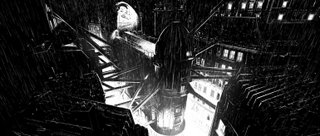
Here is an animated picture for purist fans of graphic novels, truly made in the spirit of panel composition, frame-to-frame ellipsis, graphical stylisation and expressionist ink filling. Exclusively black and white, the image is epured, white highlights against night background or black lines in an overexposed whitewashed environment. No gradients. Plain grey only used to distinguish glass reflection, computer screens or holographic ads. Punctual addition of CGI smoke (cigarette and sauna steam), maybe the only overdone detail betraying the traditional graphism.
The animation technique is revolutionary. Most sequences are acted by stunts in studio with motion capture sensors, and inserted in a 3D set, although they are entirely traced over and ink painted. The Black/White contrast cast simplified expressionist shadows on complex moving volumes restore a dynamic realism to the binary graphism. Making the most of both worlds, the real-time perspectives of 3D and the stylish touch of 2D drawings.
There is a surprise use of color in one plan, arguably justified, which I'm not sure was necessary. The all black & white concept works brilliantly all along. The soundtrack is also a let down.
Paris 2054, the city is under control of a sophisticated surveillance system to prevent crimes. Illona is kidnapped, a 22 yold genius scientist working for Avalon, a huge pharmacetical corporation, and Karas, a reckless supercop, investigates the case. Renaissance is a protocol researching a cure for progeria, a rare accelerating aging disease, secretly influenced by corruption, and Illona is caught in the midst of a global conspiracy. The historical architecture of Paris in 50 years is intact, the megapole has grown underneath supported by cyclopean metalwork columns giving an Eiffel tower style to every street. Wealthy penthouses extended in rooftop greenhouses. People use mobile phone implants, e-call, worn as a sticker in the neck.
The script can be a little conventional, obviously inspired by Akira (the secret genetic experiments on the progeria children), Blade Runner's neo-noir style (dark city with speaking luminescent billboards and hovering copters, Methuselah’s syndroma of Sebastian = progeria), Enki Bilal's anticipation (retro-futuristic underground Paris), and various manga (invisible gears, stylish guns and cars). Despite all this borrowing homage, the film stays genuinely original, with an ensemble of multi-faced characters confusing the plot resolution delightfuly until the end.

This is the kind of experiment I like to see when it comes to utilize CGI capabilities and special FX in animation. Unlike most recent 3D-hyperrealism animation creating crispier-than-life images that look so artificial because of the sophistication of reflects and textures, Renaissance develops powerful shots like a live storyboard without forgetting the artist imprint in the design.

(s) + (w) + (m) +++ (i) +++ (c) ++++

Check out the beautifully designed website for trailers and more info (french). Trailers.