15 septembre 2011

Stanley Kubrick (Dunton/Siety) 3

Une conférence de Joe Dunton (22-04-2011) 1h15'32"
L'intemporelle qualité visuelle des films de Stanley Kubrick est une des raisons pour lesquelles le public du monde entier continue d'être si fasciné par cette œuvre singulière. Le style cinématographique de Kubrick sert strictement la narration en donnant forme à des atmosphères et en intégrant à la perfection décors, jeu d'acteurs et mouvement. Kubrick reste imperméable aux modes visuelles, tout comme aux engouements de l'industrie du cinéma.
Il débute sa carrière en tant que photographe. Puis il s'adonne à des productions aussi diverses que des films à petits budgets et des épopées réalisées au sein des studios, jusqu'à ce qu'il devienne un « réalisateur total » maitrisant l'entièreté de son art. La plupart des cinéastes laissent les choix des objectifs et des lumières et autres équipements de prise de vues à leur directeur de la photographie, en leur confiant ainsi le style et l'aspect visuel du film. Ce n’est pas le cas de Kubrick qui travaille toujours avec des artistes et des techniciens de renom, mais qui se tient prêt en permanence à utiliser les innovations techniques et les procédés qui l'aideront à trouver la solution parfaite. Tout au long de sa carrière, il achète, modifie et teste des équipements de prise de vues très divers.
En quoi cette passion de Kubrick pour les techniques de prise de vues influence-t-elle effectivement ses images ?
* * *

Conférence d'Emmanuel Siety (18-04-2011) 1h17'36"
Dans L’Image-temps, Gilles Deleuze voyait en Stanley Kubrick, à l’instar d’Alain Resnais, un cinéaste « de l’identité du monde et du cerveau ». En partant de Shining, nous questionnerons et prolongerons ce rapprochement en avançant trois autres noms de cinéastes explorateurs d’états limites du monde et de la conscience : David Lynch, Michael Haneke et Gus Van Sant.


Related:

13 septembre 2011

Moviebarcodes

Imagine every frame of a film cut out from the reel and stack together in a pile, and you're looking at that pile from its side, as light passes through it effortlessly. Each slice, each stripe sums up the general colour tonality of the frame, and spreads it vertically along a 1 pixel wide image. As if that frame was compressed horizontally to occupy a one dimensional space. The vertical dimension for each frame is preserved, so what is on top of the stripe is what is actually on top of the cinema screen, conversely, what is at the bottom is at the bottom. But the lateral visual information is entirely compacted into 1 pixel, so it's only the average colour that transpires on the edge of each slice, at every height. Think of it as the visual genome of a film. It shows the cutting frequency very well, the change of sets, or sets colours, with the repeat of a similar overtone, or the brutal changes in colours. We can identify clearly the chapters of a film, if they are designed with a different overtone. And we could also measure the rhythm of a narrative, whether it goes back and forth to the same places, or if it cuts endlessly to different types of frame composition.

3 Couleurs : Bleu (1993/Kieslowski) ASL=12.1"
3 Couleurs : Blanc (1993/Kieslowski) ASL=10.6"
3 Couleurs : Rouge  (1993/Kieslowski) ASL=11"
Kieslowski's colour-based trilogy is the prototypical example to show the possibilities of the barcode analytical representation. When you look at these images, you think they aren't that different, it's all dark, brownish... but compared to all the other films in the databank (movie barcodes), there is more uniformity. A random film barcode looks very chaotic, disorganized, visually at least. At closer look, we do notice the few rays of eponymous colours, and a general tone throughout the film profile. A cold brown, blueish, for Bleu. A light brown, with more exterior scenes (the stripes with a white top), for Blanc. A warm brown, redish, for Rouge. The vertical stripes are very slim for all 3 films, indicating a lot of cutting, axis changes, cutaways... (compare with CCC barcodes to see how long takes show up) while maintaining a certain visual continuity by controlling the overall colour ambiance of the set/location within each shot. Although at this scale, it is hard to really pinpoint clear chapters, or sequences, that would stand out with a special overtone, or a different cutting pace, or separate sets. However, Rouge seems to show the most long takes, apparent because of some stripes tending to "smear" laterally (horizontal continuity).


Hero (2002/Zhang Yimou) ASL= 3.3"
The Life Aquatic With Steve Zissou (2004/W. Anderson) ASL= 7.4"
Delicatessen (1991/Jeunet)
Le fabuleux destin d'Amélie Poulain (2001/Jeunet) ASL= 7.2"
Blade Runner (1982/Scott) ASL= 5.3"

Brazil (1985/Gilliam) ASL= 7.2"
Hero is a very distinctive example of colour-coded mise en scène. The successive chapters are directly visible on the barcode. Black, Red (exterior), Dark Red (either night or interior), Orange, Bright Blue (interior), Light Blue (exterior), Dark, Green, Black, Red, Black. This should describe the exact plotline (I don't remember it), as the film is intentionally designed around episodes heavily identified by one dominant colour for each sequence.
Wes Anderson also likes to insist on particular colours in his films. The barcode profile of Life Aquatic is much brighter than most other films, and the green and blue scenes stand out in the timeline (probably the underwater sequences).
By contrast, Jean-Pierre Jeunet is more of a monochrome guy, the retro look associated with the sepia tone, particularly dark in Delicatessen, and brighter, golden in Amélie. Note the relative tonal uniformity, traducing a conscious coordination between the set designer and the director of photography to sustain a certain atmosphere throughout the films.
Blade Runner is rather dark, taking place mostly at night and in dark interiors. But the neon-blue hue, characteristic of Ridley Scott's retro-futuristic outlook leaves an unmistakable signature uniformly from end to end. The bright blue sequence at the beginning must be the neon-lit frozen lab. But what is the light brown scene right at mid-film?
Brazil also shows a stratification in "colour chapters", instead of the uniform dark brown overtone other movie barcodes feature. I'll have to check but it seems 5 or 6 dream sequences appear with a light blue tone. There are 5 other sequences with a earthy monochrome (red-brown). And also 5 grey parts. 
Again examples of films with normal cutting, with an Average Shot Length ranging from 3 to 7 seconds.


2001 : A Space Odyssey (1968/Kubrick) ASL= 13"
A Clockwork Orange (1971/Kubrick) ASL= 11.5"
Aguirre, the Warth of God (1972/Herzog) ASL= 11.8"
The long takes are more apparent on these three than in Kieslowski's trilogy, even though their ASL hits the same range. 
2001 opens and end with long credit sequences in pitch black. We can see the gold tone of the apes in the long desert opening scene, followed by the famous space station docking scene (pitch black), and the space station interiors in reddish tones. We can spot the confrontation with HAL in the computer core room, bathed in red light, towards the end. Later, the gold shots of Jupiter, and the multicoloured trip sequence (in bright blue). Then the scenes in the alien reconstituted bedroom (grey and light blue tones).
A Clockwork Orange changes a lot of dominant colours, and shows a lot of noticeable long takes (horizontal continuity).  
Aguirre is entirely shot outdoors in the forest, the greenish-beige overtone is consistent throughout the film, alternating brighter and darker shots, without any remarkable chapters identification.

Dogville (2003/LVT) ASL= 6.8"
In The Mood For Love (2001/WKW) ASL= 12.4"
Lost Highway (1997/Lynch) ASL= 7.2"
Essential Killing (2010/Skolimowski) 
 Source: Movie barcodes

We know Dogville takes place on a black soundstage and we see it on the barcode. But it doesn't appear as monotonous as we would guessed it. There are flashes of light marking different chapters.
We might remember the vivid colours of In the Mood for Love, but they are only touches within the frame, and the general overtone remains a pretty uniform brown (because of interior scenes). The red opening title sequence and closing credit sequence stand out in plain red. And the white cartons introducing the 2-parts story, one after the opening credits, and one right in the middle, divide the film very neatly.
Lost Highway is also a 2-parts story, but we cannot as easily denote its partition in visual terms. I suspect the swap to occur at the very thin blueish line, in the prison, followed by the outdoors scenes of the car mechanics sequences. 
Essential Killing's barcode reads like a book. The opening sequence in Afghanistan (sand canyon). Followed by a dark-blue sequence of the interrogation and transfer by plane. A white seizure (was it the dream sequence?). Then the escape by night. And the middle half of the long chase in a snowy landscape appears in light grey, with one brief interruption during a night scene I suppose. The last fourth goes back to nightscape, before the ending in the snow again.


Related:

10 septembre 2011

Movie fingerprints (Brodbeck)


cinemetrics by Frederic Brodbeck (Vimeo) 18 July 2011 
Frederic Brodbeck's bachelor graduation project at the Royal Academy of Arts (KABK), Den Haag
cinemetrics is about measuring and visualizing movie data, in order to reveal the characteristics of films and to create a visual “fingerprint” for them. Information such as the editing structure, color, speech or motion are extracted, analyzed and transformed into graphic representations so that movies can be seen as a whole and easily interpreted or compared side by side.
→ not to be confounded with cinemetrics (ASL database by Yuri Tsivian and Gunars Civjans)


See also:

Lignes de temps (IRI; Feb 2006)


Moviebarcode (21 Feb 2011)
Brazil (1985/Terry Gilliam)

* * * 


Related:


06 septembre 2011

Belle de Jour (Simsolo)


Mêlant adroitement rêve et réalité, Luis Buñuel brosse un portrait de femme ambigu et troublant, que l’exercice du vice transfigure. Une adaptation subtile du roman de Joseph Kessel, datant de 1967, hymne à la beauté de Catherine Deneuve dont le visage consumé par la luxure et la culpabilité reste inoubliable. Noël Simsolo est réalisateur, essayiste et critique. 

02 septembre 2011

Attendance history - World cinema stats (23)


Source: CNC; MPAA; Screen Digest


The golden age of the Hollywood studio era peaked in 1947 with 4.7 billion of yearly admissions. With the advent of TV, the yearly attendance for theatrical screenings dropped by 78% in only 17 years (reaching 1.02 billion in 1964). Clearly Americans went less to the movies. This is what I call a crisis for the cinema audience!

Meanwhile, the UK (which reached an all-time peak of 1.6 billion in 1946) lost 1.278 billion (also -78%) in 17 years (1946-1963). Futher plummeting to a lowest point in 1984 (54 million), just before the invention of the VHS, and has slowly climbed back up ever since. Only a slight plateau being experienced since 2002. We notice how the UK mirrors quasi-perfectly the variations of the market dictated by the USA, precisely because the distribution is so directly dependent on Hollywood imports.
France also peaked in 1947, although I'm curious to know why it only reached 420 million (a 1/4th of the peak number in the UK, country of a comparable size! also less than Japan, Italy and Germany! however the situation is reversed today and France leads the European pack) The notable difference is that the UK (like the USA) was not occupied by Germany during the 6 years of WW2 leading up to this golden age apogee. Anyway it is also interesting to emphasize that with such a lowest score of "mass appeal" within the general population, far from the score met in the UK and the USA, the cinéphile population in France achieved SO MUCH more in term of developing and improving serious film culture. And the cultural gap is obvious today. How come, with such an overwhelming enthusiasm/popularity for this medium (4 times higher in the UK and 11 times more in the USA, a bigger country though) amongst the general population, these 2 countries didn't find as many hardcore cinéphiles to educate the rest of the population in seeking art and worldwide diversity in their daily consumption on the big screen??? They got a larger total fanbase, and within this pool of consumers they still managed to get a lesser ratio of artfilm lovers vs. mainstream consumers... This is baffling. Contrary to the USA-UK twins, the postwar crisis didn't start immediately in 1947, France enjoyed a relatively stable plateau between 1947 and 1957, a period when all the golden-era Hollywood films blockaded by the Germans during the war, were finally screened. This coincides with the boom of the ciné-clubs and the Cahiers-Positif emergence. The phase of decline, until 1971, dropped 58% (239 million), in 14 years, remaining above the British level in the following decades. Since its lowest point in 1992 (116 million), it also enjoyed a progressive crescendo until today.
The stats for Japan I have do not track back as far as WW2, but there is a delayed peak (if not the all-time apex) in 1958 (1.1billion) corresponding to the rise of the Nuberu Bagu (the Japanese New Wave, the only one that predates the French Nouvelle Vague). There is also a dramatic drop until 1970, a relative plateau until 1953 and a slow but steady recovery since 1996.
There is also a delayed peak in 1955 for Italy (corresponding to the neorealist craze), and a much less dramatic decrease until 1974 (corresponding to the Modern cinema boom of Italian masters such as Antonioni, Fellini, Rossellini, De Sica, Pasolini, Leone, Bertolucci...) only losing 34% in 20 years. Then a quick fall, losing 77% in only 10 years.
The European Union (27 members) also shows a lowest point around 1988, and a steady progression since, paralleling the American numbers.

Now compare this genuine, visible debacle, to the virtual "pseudo-crisis" that paranoid Hollywood executives think they are being victim of today. The competition with VHS, DVD, VOD and BluRay is serious and also visible (bar chart superimposed; not just the numbers for American sales/rent but a worldwide survey). Since 1981-83 with the VHS (sale+rental), which was relayed by the DVD (sale+rental), and marginally by VOD, the competition traditional big screen theatres must face is fierce. And the unquantifiable black market of VHS piracy first, then online piracy, is probably a serious competition as well (at least in numbers, if not in direct customer conversion).
Yet, with all that, and the continued prosperity of TV (which channels offers have expanded exponentially since 1964!) Hollywood still managed to grow 17%... where is the so-called crisis??? Shouldn't we be looking at negative numbers there with such a multi-front competition? The American attendance didn't drop like in the post-war era, didn't even stagnate during that alleged "crisis" which would be understandable, NO, on the contrary, in spite of all adversity... it grew instead of plummeting.
Surely, the Hollywood executives would love this curve to climb steeper (instead of stabilizing around 1.5 billion since 2000), but shouldn't they feel grateful for what they have, a stable situation, rather than a drop of over half of its total, in comparison to the post-war demise?
Seriously, is it more likely the DVD market or the online piracy that broke the ascending curve around 2003???

Of course there are other hidden factors to take into consideration, like the population growth since 1947, the fluctuations of the ticket price, the variation of the purchase power, the quantity and quality of Hollywood films (since 95% of these numbers go to American-made movies), and the more appealing upgrades of theatrical premises, the explosion of marketing techniques, the lowering age of the target audience, the crave for event-releases, the appeal of sequels...

Moreover, if its the big screen sector that suffered (the proper way to experience a film), the cinema industry still makes money with the VHS-DVD-VOD-BluRay rental/sales... and sells broadcasting rights to TV for showing films on the small screen. It's more a crisis of the exhibition circuit than a crisis of the profits made by studios! And, I suspect, a bigger profit than ever before, due to the rise of ticket price, the spectrum of exposition and especially for Hollywood, the hegemony on the worldwide market of its blockbuster releases (although the average production budget also exploded since the Golden Age...)

But considering the evolution of the cinema consumer habits in the past 30 years, sharing its attention with TV, internet and videogames, from my point of view, I believe that a +17% growth is a good job. So stop saying that online piracy is stealing all your profits! Your profits are long gone since 1947... the epoch of cinema reigning supreme at the top as the sole popular mass entertainment is over. Today it's about sharing. Sharing space, sharing time, sharing investments, sharing exposition, sharing revenues... 
Let's not forget that, while online piracy DID NOT KILL whatever remained of the cinema industry in the 70ies, the internet helps bring more people to movie events around the world, in many subtle ways, most of which are not retributed by the studios. The buzz around new releases, or re-releases is in great part assumed by thousands or millions of unsung heroes, bloggers, forum-activists or YouTubers who spread the word like a publicist would do, only without getting paid for their job. We don't hear the studios campaigning for the grateful remuneration of everyone who contributed to make a publicity campaign a success. No. For this they don't owe anything... but if they're caught "stealing" the video of a trailer, they get banned right away! 
It's time to call for net equity. Give and take. This is the end of the total profit, controlled entirely by studios, 1 view = 1 fee. This cannot persist in the XXIst century, at the age of MULTIMEDIA and MULTIUSAGE. Fees shall adapt to the various uses. And gratuity should also be considered in certain cases, when the regulation is impossible/absurd/unfair and where the compensation in publicity/notoriety comes back to the studio through indirect ways. 


Related:

31 août 2011

Gorilla attention deficit 2 (Dargis)


Manohla Dargis picks up this book written by cognitive psychologists (The Invisible Gorilla) and emails David Bordwell about pattern recognition... all swell, and even a step up from Dan Kois' navel gazing journalism indeed. I can only praise a journalist background research and backing up evidences. Unfortunately, I'm afraid that inattentional blindness and retina tracking, alone, do not excuse why an audience rejects a certain film form, and calls it "boring". Sorry.


"Not everyone is open to abstract painting or Mr. Tarr’s long, beautiful films, but perhaps some of this resistance is fueled by cognitive habit rather than so-called taste."
Manohla Dargis (NYT, 8 July 2011)
The cultural barrier that alienates a certain mainstream audience from off-the-edge aesthetics (abstract painting) or paced cinematography (i.e. Tarr) is NOT due to any dysfunctional brains or eye-sight capabilities! (by the way, abstract art is 100 years old, and CCC is 40 years old... so it's about time that the mainstream zeitgeist feels more familiar with these aesthetics "ahead of there time"!!!) If you meant to give an intellectual counterpoint to Dan Kois' self-indulgence... I'm not sure that introducing the masses to the obscure science of "pattern recognition" will make this type of cinema any more appealing... Tarr Béla produces a minimalist and evident cinema, why unnecessarily complicate it with lab experiments that have nothing to do with it? You just make it sound MORE ELITIST than it actually is and contribute to reinforce the deceiving cliché of an "intellectual art". Dan Kois freed the lazy anti-intellectuals from guilt, and Manohla Dargis made art cinema sound like rocket science... The New York Times couldn't do a better teamwork effort to further put off its readers!
The fact that a formalist scholar like David Bordwell delves into cognitive science fits the level of discourse we expect from academic studies, and it's always possible to run over-complicated experiments on films (even if their primordial apprehension doesn't really require it), that's what film theory is about. But the public discourse we find in the mainstream press (which sole short term purpose is to indicate the weekly releases schedule) shouldn't scare away readers and spectators with superfluous jargon that kills the natural suspension of disbelief. Making a non-professional audience self-conscious about onscreen patterns is really the last thing we need to get immersed in a film that speaks for itself very well.
Educate the masses about film, stylistic evolution, geo-political culture that contribute to nurture the virgin viewing of a film. This will help yes.

Manhola Dargis: "Perhaps it's a lack of pattern recognition, not taste, that makes some people frustrated with Bela Tarr movies like “Turin Horse.” [..] Recognizing patterns is part of the film critic’s tool kit along with a good pen to take notes in the dark. You have to take in a lot of information when you watch a movie just once. [..] The tricky part, when I get to scribbling, is everything else [..] Was the lighting soft or hard, the editing fast or slow, the camera shaky or smooth, the acting broad or not? [..]" 
First, if you write notes during the film, you are doing a bad job! You cannot be present to the film, if you constantly re-verbalize what you see and think of the puns for your next review. Just watch the film once from end to end, like everyone else in the regular audience. Then you can do whatever you want during subsequent viewings. Do filmmakers really have to put up with the distracted judgement of critics who are scribbling throughout the screening??? 

BASIC OPTICAL LITERACY

Critics and the regular audience do no watch, perceive, register, understand and verbalize their experience of a screening in a comparable way. Critics are professional (not necessarily paid) viewers, (ideally) educated and trained in many areas of film analysis that the average spectator are oblivious of. So when you talk about "pattern recognition" for the audience, it means the general "optical pattern" recognition common in all human beings, the basic built-in stuff that comes in with all our innate abilities (visual, auditory, memorial, cognitive). Everything that makes humans able to interpret visual signals.
The regular audience doesn't need to know how to decipher all surrealist symbols in Le Chien Andalou, to watch and enjoy the film, just like a critic-level training is not necessary to watch a Tarr film. Films are made to be absorbed at a very sensory level, most symbols effect the perception below consciousness (inducing a certain idea/impression to the viewer without leaving a definite message that can be verbalized on a conscious level). If symbols are too arcane and beg for an extra-diegetic culture to understand in-jokes and subtle references (and it often happens without compromising the general understanding of the film for the neophytes), then it plays out to a very specific niche audience, which is not the case of Tarr films. If his audience is small, it's not because the images themselves are harder to COMPREHEND, but because it requires the viewer to be patient and NOT LAZY.

There are the real-life "patterns" that allow us to go about our everyday life without spending inordinate amount of time on every details we encounter; we ignore things that are identified as unimportant and/or invariable. The "narrative patterns" are something else, derived from the first set (optical patterns), but specific to the narrative medium and arranged in a superior degree of complexity (association of several/successive optical patterns). Some overlap, and the mirror neurons show that we react as if we did an action ourselves when we witness a fake reenactment on screen (through empathy, though it's another domain altogether...). But the editing tricks, the staging, the ellipsis, the subtitles, the split screen... are not innate instinct; we actively learnt to give sense to these abstract artifices. This second set of patterns are mostly processed unconsciously during the film, the average spectator doesn't stop to acknowledge every cuts, every space continuity, every time jump; and most importantly they would not be able to recall them or name them during or after the film, because it's become an intuitive language. We are conditioned to ignore it all. Just like we don't parse words into individual letters when we read a word, or dissociate words from their role in a complete sentence. We just read the content and forget we just deciphered a complex system of signs with painstaking grammatical rules.

ANALYTICAL LITERACY

Then there are critics. Critics have all that, are able to tell if that scene was cut up or shot in one plan-sequence, and their education also allows them to notice other patterns (secret patterns, technical patterns,  aesthetic patterns, structural patterns, overarching patterns, inter-textual patterns...) that are not necessary for the understanding of the immediate film experience, but will inform a more in-depth analysis of the film for critical appreciation purpose. Patterns that the average audience doesn't need, or wouldn't know what to do with, or don't care for. 
So you have to be very careful when you put pattern recognition for the public reception of a film on the same level as pattern recognition with a professional eye. Critics see more, it doesn't mean they will communicate everything they noticed in their review, but it informs the judgments they do write in for the readers (better than writing these summary judgments without being able to explain why, because they didn't seek for evidences to their claims!)
Anyway, the critical patterns necessary to evaluate the achievements of a film on various levels, are not the ones required to follow the story and the narrative cues. These, on the contrary, make themselves understood in the most evident and unnoticeable way, to the point of becoming an intuitive language. Not knowing the technical jargon and being unable to point at continuity errors is not an excuse to dislike challenging films. What is challenging is not the direct reading of the narrative, it's the apprehension of a radical artistic vision, after all the film has been successfully ingested. Detractors are not left behind because the film grammar was gibberish  but because the final content itself was perplexing.


Maybe we should distinguish the many forms of "understanding a film". From micro patterns to macro patterns:

  • Optical patterns allow people to SEE images
  • Narrative patterns allow spectators to MAKE SENSE of a narration
  • Critical patterns allow critics to ANALYSE film form


If an audience watches a film where the succession of images are incoherent (like some parts of experimental  cinema playing with non-narrative flicker effects), then we have a major language barrier, at the most basic optical level. If the point of the clip cited in the previous post was to incorporate a gorilla to the story, but most people miss it, then it would be a failure of the film narrative, a failure of basic perception of the raw content. That's the understanding of a film on a cognitive level (receiving images and sequences in the conscience). But like in mainstream fiction, our scientists call for an instant replay of the clip, to double-check about that infamous gorilla, and re-read the same scene with a newly acquired knowledge, and possibly alter our perception of the images and their meaning. This is the point of recalling an earlier part of the film, by self-quoting images of the film itself, further down the narrative line, to show overlooked characters and suspicious behaviours in a new light. 
Then, there is the perception of the organised content. The images and sequences are successfully perceived for one (by the eye), and also ordered meaningfully (by consciousness), a meaning intended by the filmmaker.
These constitute the immediate apprehension of a film, on an intuitive level. The audience doesn't need scientific education to go this far, because the art of dramatic art is to make itself understood, or else fail miserably. Again this is not the case with Tarr Béla films, their immediate understanding is in no way jeopardized by misunderstanding unknown narrative pattern that the everyday man could not figure out intuitively. If anything, intensified continuity poses bigger cognitive challenges if you were to blink during a fast edit sequence, you would MISS critical information that would, at least, confuse your reading of the following images for a while until you can fill the blanks again. 

"Moviegoers fed a strict Hollywood diet may find themselves squirming through, say, a film by the Hungarian director Bela Tarr less because of the subtitles than because of the long takes during which little is explained.  [..] Other moviegoers may just go with the flow. They, like critics — who ideally are open to different types of narratives, having watched nonmainstream, sometimes difficult cinema in school, at festivals, for pleasure and for work — may have developed specific cognitive habits.
People walk and talk in movies like Mr. Tarr’s “Werckmeister Harmonies” (2000) but not necessarily in ways that many moviegoers may immediately understand; the films don’t conform to familiar type. [..]
Maybe some moviegoers who reject difficult films don’t [..] have the necessary expertise and database patterns to understand (or stick with) these movies. When they watch them, they’re effectively (frustrated) beginners and don’t like that feeling." 

Nice of you to try and find a reason why people don't like to watch challenging films (and find them boring)... but it's a bit of a cop out to blame it on a hypothetical "pattern recognition"! 
I know the only difference you can see between Hollywood obviousness and Tarr Béla is excessive slowness and long takes... but even if this was the case (which is far too superficial to count as an argument),  the heavy editing of Hollywood is still the MOST ARTIFICIAL narrative rendering of reality (compared to scarce edits and factual representation of CCC such as Tarr Béla), and I'm talking strictly about the narrative structure. Despite the fact that the "Hollywood norm" has been conditioned and digested to the point of becoming universally comprehensible, it will always be more artificial than real life, by design. However intuitive, the Hollywood narrative conventions are still conventions themselves. And when a film cuts less, there are less conventions and more raw content within the frame. Tarr makes use of conventional editing too, sometimes, but compared to a Hollywood movie, what detractors have a problem with is not the excess of complicated narrative twists, new unknown conventions, or misunderstood editing patterns... on the contrary, what baffles them is the lack of signposts, railtracks, by-the-number formula, walkthrough, cues, which bring them closer to a naked reality outside of the fiction world, where there are no contrived narration pre-arranged by a demiurge. A reality that we live in everyday. A reality that we are all perfectly capable to perceive, apprehend, interpret and make sense of, without resorting to complicated pattern recognition bullshit. A "slow film" is de facto LESS ARTIFICIALLY CONSTRUCTED, LESS COMPLICATED to perceive. Making sense of a long take, even if there is not much going on, DOES NOT REQUIRE ANY SUPERPOWERS. Don't make a rejection of the aesthetic and content, an issue about the grammar of cinema, its cognitive perception. If anything, you need to un-learn your bad habits, to de-condition yourself from formulaic narration, standard formats, signposted tracks, and Pavlovian responses... to lose your automatic reflexes to stereotypical patterns.

What bored spectators cannot make sense of is not the form, which is rather simple, and in fact, intentionally simplified, minimalist (by definition!). Don't blame it on pattern recognition deficiency if patterns plays a much smaller role!

We could discuss whether CCC develops unique narrative patterns that a mainstream audience would be incapable to make sense of (purely on an editing level), which I doubt. But even if we discover some exceptions, this would be a very technical distinction, one for professionals to notice. We're talking about technical issues such as pauses timing, sequences alternation, rhythmic patterns, macro structures, soundscape, composition... abstract stuff from the very fabric of the work, nothing an average spectator would be conscious of during a normal viewing. Such hypothetical off-the-chart pattern would not constitute, if it existed in CCC, a language barrier that would make it impossible to get into the film without prior training.
Sorry, this hypothesis is bullshit. Especially when it is a clever cover up to excuse bad taste, narrow-mindedness, laziness, boredom and fatalism in self-indulgent spectators and reviewers alike!!!

Dargis: "The stronger the pull a narrative has on us, the more we’re hooked. [..]"
...if what you're looking for in a film is STORY. Which is, if the most widespread, one of many possible usage for cinema. The mainstream audience might believe it is the ONLY way to make movies... but a film critic ought to know better (scientific footage, raw documentation, structural films, surrealism, experimental cinema, and in this case... minimalism). You gotta stop expecting every film made on the festival circuit to offer a self-contained walkthrough for puerile spectators who need their hand held till the end of the tunnel. Come on, grow up! Be open minded and welcome films that not only do not "pull you into" through cunning tricks, and count on your genuine curiosity to remain seated till the end, without constantly comforting your need for distraction, begging you to stay and alleviating your fear of being bored for more than a minute...

Dargis: "We're hard-wired to respond to faces"
I believe men are hard-wired to respond to boobies, ask the publicists.


Source: The Invisible Gorilla (Chabris/Simons)
 What You See Is What You Get (Manohla Dargis; NYT; 8 July 2011)
Good and good for you (David Bordwell; 10 July 2011) 


Related:

23 août 2011

Gorilla attention deficit 1 (Chabris/Simons)

Where is Waldo?
You found Waldo? (squint your eyes and it's the darkest spot on the beach) But did you spot the cactus? did you notice there was not a single shadow? did you notice there was no lifeguard? did you spot the guy with polka dots sunburn? Chances are you didn't, because given a limited amount of time, you probably tried to skim through this picture containing a flurry of details with only one thing in mind, the red-stripped shirt pattern : Waldo (the implicit mission of this picture).

The invisible gorilla experiment is very funny, but it's a "gotcha" trick and it only surprises you once (with 50% success! no bragging rights there). Like when you point away to turn someone's head for an instant, and take advantage of their distraction to slap them in the face... It's a joke requiring the willing trust of the person.

- Hey, look away! ... Ah-ha, gotcha!
- But you told me to look away...
- Exactly.

 That's basically what this "scientific" test comes down to. They test our attention, we kindly obey to the directives... only to learn the directives themselves were lies. This breaks the pupil-professor social contract. How cheap is it to catch someone off-guard through a deceptive premise? Anything goes in the realm of jokes, but as a scientific procedure it's pretty sloppy.

They don't ask you to spot a gorilla, they divert your attention to something else (count the passes of the team in white) and then blaming you for not noticing something else (which they implicitly ordered you not to pay attention to). That's what illusionists do : misdirection. Granted, the gorilla is a big detail to miss, but it was concealed carefully... Is it a coincidence if the gorilla is black (just like the team you are specifically asked to ignore), the same size as all the players, and moving across the screen at a comparable speed? Of course not. It's part of the strategy to avoid attracting your attention. The gorilla suit is only there to ridicule you, but it's merely the irruption of a random intruder within a scene we have no business keeping track of, except for the ball.


 The center of gaze (corresponding to an area of the retina called the fovea), sees only a cone of vision of 2 degrees wide. This is what we use to decipher letters and read for instance. The rest of the field of vision (peripheral vision) is more blurry, unfocused and less acute. What this "awareness test" does is monopolize the attention of the fovea exclusively onto the white team players (and more precisely on the white players holding the ball), leaving the black team players in the peripheral vision. This is why, in the peripheral vision (less competent for subtle details, more competent in tracking motion), the gorilla can easily pass as a shape and behaviour resembling a black-team player without raising enough attention to the brains to require a fovea double-check (which would identify the difference in a fraction of a second). To make this trick work, the fovea must stay away from the gorilla at all time. Which is why you are asked to concentrate on a moving ball.

 If a real gorilla was to pop in the scene, several details would have alerted our peripheral vision : abnormal posture and displacement of one of the "black-team player", animal sounds one would assume, different ground vibrations, and first of all, the panic of all players and the end of the passes. The delimited frame of the video also removes important aspects of our environment. The fact a gorilla moves in up-close, amongst a group of people without causing mayhem, keeps our senses quiet. Noticing and reacting to the panic in somebody's eyes, face or unusual gestures is part of our defense system. Even if these scientists like to make fun of our blind spots, we still have a pretty good instinct for survival, notably to spot danger in a familiar setting before it arrives, with all our senses, even if it is not under the direct scrutiny of the fovea. I guarantee you that if someone rushed in on screen, bouncing up and down, in a gorilla suit or not, even in the corner of the screen, 100% of spectators would be able to say they noticed something odd during the counting, even without looking at it.

In fact, Derren Brown makes use of this gorilla awareness test in one of his shows (Evening of Wonders, 2007). 
Daniel Simons created another version (The Monkey business Illusion) destined to catch off guard the people who already heard about the gorilla. While viewers will be content spotting the gorilla, other subtle changes have been added to trick them. The fake curtain (added on green screen) changes from a red hue to an orange hue (without altering the general luminosity of the scene, which would otherwise alert our peripheral vision), and they use the entrance of the gorilla to exit one of the black-team player by the same side of the screen at the exact same moment (which is also the moment the curtain colour changes, for maximizing confusion and stealth), which easily fools the peripheral vision in thinking the black shape moving offscreen is the same as the lookalike black shape coming back on screen from the same spot.

In fact the gorilla didn't go unnoticed. We just didn't register its presence at the top level of our waking consciousness. If we are not told about the gorilla at the end of the test, we could easily retrieve this information under hypnosis. Under a state of trance (or focused concentration) we could revisit our memories of the video, even the details that we are not capable to access/verbalize consciously. This demonstrates that the center of gaze is not the only area that sees and remembers. (see Derren Brown's Trick or Treat Season 2 Episode 1; May 2008) We see more than what we are able to recall/spell out, because most details are relegated to low-level priorities and removed from verbalizable memory.

Again this is a trick only possible because of the offscreen suspension of disbelief. They use the off-screen space to sneak in/out, thus creating a false environment. Theatre uses the curtains to facilitate a live performance on stage, but if they started to abuse this convention to sneak in gorillas, spectators would give up disbelief and suspect everything going on, which would kill the necessary immersion in the narrative universe. The camera frame is likewise a convention we accept as long as it is not turned against us, to expose the blindspots created by our suspension of disbelief. For the benefit of the narrative plausibility, filmmakers don't need spectators to become suspicious of the non-diegetic space, behind the camera, or in the off-screen wings.

 This is a valid experiment in the field of psychology, to test the compliance to a procedure, regardless for its irrelevance. I'm not sure it is as pertinent to the field of neurology, since the attention deficit is caused by the suppression of information in the fabric of the test itself. Seriously, it doesn't prove anything, and certainly not what it says it does. The two guys, Christopher Chabris and Daniel Simons, interviewed on a radio show (CJAD radio) are more ambivalent/measured about the conclusions, when given a chance to expand on it.

On a short term prospect, the brains intentionally ignores certain elements (that are kept in check by the familiar permanence of the context) in order to become more efficient with a very specific task. But if there really was something fishy going on, the correlation of other signals (ear, feeling of vibrations, disorder of the environment...) would abort the silly task at hand (counting passes because we were asked to) and assess the general situation with all our senses, even for a second, until the suspicion is cleared up. At the cinema, we are dependent on what the filmmaker decides to reveal, visually on the screen, and aurally in the speakers.

That's why jump scenes are the easiest tricks in movies, and the cheapest (artistically speaking) effects. Like shouting "boo" in the back of an unsuspecting friend. Everyone falls for it. If we are in a safe environment, we never double check on everyone passing behind our back. We let ourselves betrayed by an excess of confidence with familiarity. In an unfamiliar place, we are on our guard, and would less likely let something fishy happen behind our back without double checking. The illusion of such tests is to pretend that the delimited diegetic world contained in a brief video sequence (to which we willingly grant the proverbial "suspension of disbelief") makes any claim on our real world perception. There are a lot of elements we take for granted in reality, that could fool us eventually, without checking them time and again, especially not more than once.

The Movie Perception Tests (Levin/Simons); Whodunnit? (WCRS&Co); Evolution of Games (MysteryGuitarMan)
Did you notice all the changes?

They play a brief clip from an unfamiliar scene where everything is new to us. We have to make sense of the context, while listening to a dialogue. And they ask us to pick up on gotcha changes that happen against the very logic of the scene and unbeknownst to us... In a real world environment we know what elements are unknown and which ones are known, because we've tested them before, we also assume that things stay the way they are. We also have a good sense of which elements are most likely to change in certain circumstances. A sudden change from the corner of our eyes or an atypical noise from the ambiance might make us reassess the permanence of things and check things again as if new. But when the edit ellipsis of a shot-countershot convention abuses our trust to slip in prop changes, it is not something we would naturally pay attention to, nor would such trivial details (fork switch, arm positions...) prove to be interesting at all. The Whodunnit clip abuses the offscreen space left by the close-up panoramic, to alter props that the main character (a detective of all characters) can see in plain sight. At the movies, we suspend disbelief for the editing shorthands and other camerawork tricks, provided the ellipsis maintains the coherence of the whole. We also rely heavily on the knowledge of the onscreen characters (even if some of them may lie purposefuly for the benefit of the story). But if ALL characters play pretend changes that occur in the diegetic world didn't happen (however we do expect them to ignore the technical staff from the non-diegetic world of course), then the narrative has no foundation to build on. And that's this loophole (the willingness of spectators to give credit to stage artifices) that these gotcha test exploit, which is a low blow to the suspension of disbelief. 

Applying this observation directly the movie narrative is rather abrupt and pointless. Comparing a chess master memory of checker conformations to reading the content of a movie is ludicrous. Of course, we let a lot of details pass by unchecked, especially when the talking and editing is accelerated. Just like in reality we could be fooled by something or someone we didn't go check out and assess firsthand, because details are too many around us, and because only a few of them will have any importance/influence in our life. When someone with an uniform on introduces herself as a nurse, we assume the hospital didn't let her enter and work there without qualifications. We don't verify her resume ourselves. Maybe we should. When someone walking in the park with a dog in leash says "this is my dog", we believe it without running a thorough administrative check up. Yet it could be another occasion to fool us. Another loophole of the "inattentional blindness" (an half-empty glass way of looking at the admirable evolution of one of our vital sense). Just like we assume that in a scientific video that unfolds very calmly, without scream or laughter  everyone on screen was put there on purpose by the scientists, and we have no reason to suspect anything tricky in this department, nor the directives ordered onto us.

Source: The Invisible Gorilla (Chabris/Simons)
 What You See Is What You Get (Manohla Dargis; NYT; 8 July 2011)
Good and good for you (David Bordwell; 10 July 2011) 


To be continued...


Related:

16 août 2011

France supports the big screen


Cinema Pass to watch unlimited films all year round (for people who watch more than 2 films per month) :
19.80€/month (2.3 x regular admission fee) = unlimited access to all theatres from the UGC-MK2 exhibition circuit (610 screens) nationwide.
35€/month (4 x regular admission fee) = same pass, for 2 people.

20.50€/month (2.4 x regular admission fee) = unlimited access to all theatres from the Gaumont-Pathé exhibition circuit (over 800 screens) nationwide (over 40 cities).

* * *

Yearly membership : 10€ / month (1.2 x regular admission fee) = unlimited access to all projections (up to 50-60 screenings / week) + weekly ciné club, conferences, museum, exhibition, videothèque, library

Membership fee : 3€ / screening = 15 screenings a week + ciné club, exhibition, library

Membership fee: 4.30€ / screening = 16 screenings a week + ciné club, conferences, museum, exhibition, library

* * *


Annual calendar of events for the promotion of big screen projections :
Festival Cinéma Télérama
(France) /3€/ 19-25 janvier 
At the end of January, every year, the magazine Télérama organise the projection of some 15 of the best films of the year, giving them a re-run during a week in selected theatres (210 theatres) in major cities throughout France. Every admission is 3€ instead of 9€ (after buying the current issue of Télérama). For everyone. We may revisit or catch up with the major films of the previous year if we missed them during a short distribution. Since 1997.

* * *

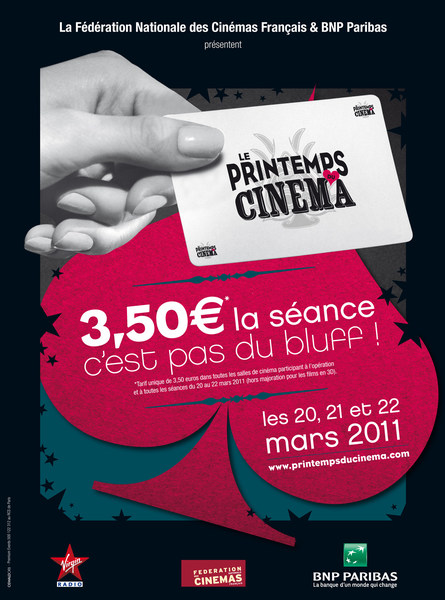
(France) /3.50€/ 20-22 mars
3 days every March, all admissions are 3.50€ instead of 9€, nationwide. For everyone. For all films available in commercial theatres.

* * *


Où va le cinéma? "L'Industrie du rêve
(Paris région) // 30 mars - 3 avril [MP3
Every year, a colloque about the state of cinema, with numerous guests, roundtables, masterclasses, exhibitions, projections. Since 1999.

* * * 

(France) /8€+3€/ 25 juin - 1er juillet 
Every year at the end of June, all admission fees are 3€ for a week, in every theatres nationwide, after buying the first admission (pass) at normal price (9€). For all films available in commercial theatres. Since 1985 (back when the regular admission was 18Francs=2.5€, and the event fee was 1Franc=15 cents of €). 

* * *

(Paris) /5€/ 2-13 juillet [PDF films selection]
Competitive festival in Paris showing a best of from the festival circuit, plus several comprehensive retrospectives, masterclasses, flea market, night-long projection marathons, exhibitions, roundtables. All admissions : 5€. No "gala" pricing. Pass for 10 days : 30€ (price of 6 films). Some events are free. Selected films (250) in selected parisian theatres (16). Since 2002.

* * *
(Paris) /FREE/ 17 Juin-2 Septembre [PDF selection of films]
Every year in Paris (11th district), 5 open air screenings of older feature films + short film. For everyone. FREE.

* * *

(Paris) 23-25 juin /FREE
Every summer, one weekend of June, in Saint-Cloud, 8 films, projected for free. Since 2003

* * *

(Paris) /FREE/ 17 juillet - 22 août [PDF films selection]
Every summer, during 30 days, 40-some feature length and shorts are projected in a park when night falls (weather permiting), for FREE. Thematic selection of films not in current commercial distribution. An average of a couple thousands spectators at each screening. Nearly ten or twelve thousands people can lay on the grass at peak attendance.

* * *

(Paris) /FREE/ 3-21 Août [PDF films selection]
Every august, a dozen of films shot in Paris are projected in situ, in the general neighborhood where the story takes place, on open air screens. Free entrance. Since 2000.

* * *

Festival Silhouettes
(Paris) /FREE/ 27 août-4 Septembre [PDF selection of films]
Every summer, 1 week at the end of august, open air projection of short films and a competition. Since 2001.

* * *
1Max2Ciné (La rentrée du cinéma)
(France) 1 place acheté = 1 offerte Tous les samedis de septembre

Every saturdays of September, in every theatres nationwide, spectators under 27 yold get 1 free ticket for 1 admission purchased.

* * * 

(Dijon) 20-22 Octobre 

Every Octobre, a weekend of conférence, roundtable, projections. Since 2008