31 janvier 2006

Criticism On Air

"[Oral critique] is more efficiente than [written critique] because more
capable, more abundant, and more sincere or more severe, but one cannot exist
without the other one. (...) Debates should not take place behind closed
doors."
André Bazin, 1943


Film criticism is spelling out a visual medium into textual commentary, and the radio is a medium exploiting sound and words without the easy support of images. Audio criticism seems the most absurd way to illustrate a visual art, as suggested like this ironic teaser created for the TV broadcast of La Marche de l'Empereur / The March of Pinguins / The Emperor's journey on CANAL+.
When we read or listen to a film description our imagination automatically adds images to figure the big picture and that's how false expectations are built up prior to film viewing, as a correct representation of the film is dependent on the accuracy of the critic's description. While it's not the best adapted medium, there is little conflict of interest in the radio industry (TV being a client of the distribution circuit), thus the voice of radio criticism enjoys more freedom of content and tone.I know the reader of this english-written blog will not be interested in these 3 weekly french-speaking shows but what I review here is the mode of expression of group radio criticism to contrast with the print mode of columnists or bloggers.

Let me know what radio shows you listen to, their mode of expression, and where I could download them if available online. Thanks


Le Cinema l'après midi
(France Culture) SAT 1:40-2:30pm

Le club des cinéastes / The club of filmmakers.
Hosted by Claire Vassé (critic), a 50 minutes long show gathers 4 or 5 filmmakers to discuss 3 films back and forth. The films are ones opening commercialy in theatres, or being released on DVD, or showing soon in a retrospective, but already accessible. This is not a preview recommending films that only critics had access to. Sometimes the films echo eachothers with certain similitudes other times they clash, the debate questions each film successively but also transversally.

These non-professional critics deconstruct the making of the films with the insights of their personal backstage experience in this trade. Movies as seen by people who make them, a biased but much informed minority audience with an intimate relationship with the work accomplished. A very auteuristic viewpoint, in the french tradition of critic-filmmaker. Even if they tend to show respect to their friends and masters preferably, the large spectrum of films reviewed and the confrontation of the independant personalities of this panel keep the discussion away from complacency and is often more violent and emotional than print critics pan.
Filmmakers (who are not there to sell their own film for once) evaluate the projects of their peers and break into reflexions on cinema, technique and significance, rather than reviewing the plot. Their vast culture recalls great auteurs by way of citations of other films, on-set anecdoctes, literary references aplenty. Cinema in lights of other arts, and its cultural role in society are recurrant concerns.

The selected films are judged as subjectively as in the press by the combination of a polyphonic debate creates a somewhat balance ground to assess high and low aspects of the production, the directorial choices and the social implication of the narration. Although each takes a turn to give their opinion, ultimately the confrontation, dissent, controversy force everyone to moderate their stance in an informal conversation mending fences or asking for a deeper justifications.

Once a month they invite a filmmaker (not part of the club) to discuss their work. One filmmaker interviewed by other filmmakers.

Rotating members of the club :

  • Mathieu Amalric - actor, director
  • Luc Béraud - director, screenwriter
  • Pascal Bonitzer - screenwriter, director, actor
  • Catherine Breillat - director, screenwriter, actress
  • Emilie Deleuze - director, screenwriter (yes, daughter of philosopher Gilles Deleuze)
  • Claire Denis - director, screenwriter
  • Vincent Dieutre - director, screenwriter
  • Philippe Grandrieux - director
  • Christophe Honoré - director, screenwriter
  • Philippe Le Guay - director, screenwriter, actor
  • Claude Miller - director, screenwriter, actor
  • Emmanuel Mouret - director, screenwriter, actor
  • Brigitte Rouan - director, screenwriter, actress
  • Marie Vermillard - director, screenwriter


Projection Privé
(France Culture) SAT 6:30-7pm

Hosted by Michel Ciment (Positif) a distinguished critic of the french cinema press with a comprehensive erudition of world cinema invites guests to discuss 1 film or 1 oeuvre. Sometimes the filmmaker if it's a current release, or scholars who published a related biography. An elaborated discussion on the interview mode, with pertinent and profound questions saving however much room for the guest's voice. Always a great selection of films, mostly high-brown cinephilia, intellectual discourse, theorical issues. Fascinating source of knowledge.The show is only 30 min but focuses on a single film to get deeper under the surface of omnipresent selling arguments. This only covers 4 films per month, and like in his monthly magazine Positif (opposed to the weekly newspapers), implies a picky selection rather than a full coverage of the weekly releases.


Le Masque et la Plume
(France Inter) SUN 8-9pm

This most famous founding radio show celebrated its 50th anniversary of weekly critiques on air in november 2005! Alternating one week for cinema and one week for Theatre and Literature, the show hosted by Jérôme Garcin, recorded live with audience, puts the spotlight on the cultural must-see. A panel of 4 cinema critics from the french press (popular press, newspaper and cinema magazine) reviews about 5 films from the fortnight releases. This covers only 10 films per month, but the selection isn't elistist: from low-brow/popular movies to high-brow/intellectual indies. So the reactions are often loud and strong. But again in this form the group of multiple voices help to self-moderate each position. The conversation is easygoing and straightforward, spontaneous ideas and rough language, sarcastic controversy and mockery are frequent to trigger the laughter of the audience. In spite of the informal tone (worded more loosely than in their respective column), the level of critical judgement is mostly well thoughtout and backed up by sound arguments.

Adding to this collegial form of viewpoints confrontation, the show lets the audience reacts freely to the discussion of the films debated, to give their own impressions or to ask questions directly to the critics. And the radio audience sends emails to comment the show, these are read live in the following show.
Allowing the audience to participate, within a restricted speaking time, influences the discussion among the critics who are subject to polite corrections and snide remarks from their public. Something that never happens to a print columnist. A dose of self-derision lights up this panel, conscious of the image conveyed by their personality, thanks to the feedback.

This is the same type of collegial MovieClub organized by David Edelstein on Slate, only it happens all year long, and the oral dialogues are more interactive than through a compilation of written emails.

For this 50th anniversary party they invited authors to the show to give them the opportunity to criticize the critics, and it was a very interesting moment. A playwrighter said he expected and welcomed critics to evaluate the technique objectively, to inform the subtext of the play with the cultural background and the distance the critic has that the dramatic author might not have. But most of all the author wants to read the personal impressions the critic experienced, and if (s)he liked the play or not. Other authors complained the critics panned without watching the work they talked about, or that they didn't know anything about criticism, refusing to be tougth how they should do their work. Authors welcome the artistic judgement of their achievements but don't like revisionist advice like "this should have been done that way", "This is how it would have worked better"...

Rotating team of critics :

  • Sophie Avon (Sud-Ouest - daily newspaper)
  • Alain Riou (Nouvel Observateur - general magazine)
  • Michel Ciment (Positif - monthly cinema magazine)
  • Jean-Marc Lalanne (Les Inrockuptibles - culture weekly magazine)
  • Pierre Murat (Télérama - culture weekly magazine)
  • Danièle Heymann (Marianne - weekly general magazine)
  • Sophie Avron (Sud Ouest - daily newspaper)
  • Eric Neuhoff (Figaro Madame - fashion magazine)

p.s. each show is available online after each broadcast, archived for a week only until next show (see links)

14 janvier 2006

The Wayward Cloud (2/4)

Follow up from The Wayward Cloud (1/4)


Sex and nudity have become more prevalent in popular culture (novels, comics, advertising, music video, TV, cinema, contemporean theatre, internet) since taboos around sex losened up, and pornography gained a subversive hype claimed by certain alternative scenes (porno-chic). Erotism or hardcore porn are tolerated public discourses now, in the street or among scholars, either for banalized entertainment or out of derision. Today private issues such as initiation, frustration, masturbation, impotence, voyeurism, perversion are official plot drives in comedies or dramas, bringing to the spotlights the action hidden backstage in the lives of fictitious characters.

Sexuality used to be implicit or just absent of mainstream movies, with characters ridiculously deprivated of sexual lives. Never since In The Realm of Senses (1976/Oshima) did high-brow artfilms promote a serious look at sex than in recent years.
Sex is THE subject and object of the film now, no longer a suggestive elliptical climax.
More auteurs risk to introduce pornography in their work, fascinated by the impact of raw sexual images on screen as a narrative item dissociated from the arousal potential of X-rated movies that are not shown in public theatres. They bare it all and get right to the point, being as factual as possible.
  • A Vendre / For Sale (1998/Masson) Sexual road trip
  • Romance (1999/Breillat) unsimulated sex with a real porn star.
  • Lies / Gojitmal (1999/Sun-Woo Jang) S&M sexual relationship between middle aged artist and virgin schoolgirl
  • Intimacy (2001/Chéreau) casual sex relationship between strangers without social interaction
  • Irréversible (2002/Gaspar Noé) uncut rape plan-sequence
  • The Brown Bunny (2003/Gallo) B.J.
  • 9 Songs (2004/Winterbottom) recurrant intimate sex, masturbation
  • Battle in Heaven (2005/Reygadas) B.J., sex prostitution
Also films of Hong Sang-Soo, Greg Araki, Larry Clark, Kim Ki-duk, Catherine Breillat

They always cause a moral controversy among critics and split the audience, but push an evolution of mentalities after censorship vetoes are overturned by rehabilitations, questioning the issues around this taboo born of a deeprooted strict christian moralisation of sexuality (structuring the western culture for centuries) that is totally absent in eastern culture for instance. This is the social and artistic context that informs the motivations behind The Wayward Cloud's overt provocation.
.

Porn videos are extremelly popular in videostores and online, lots of people watch it whether it's illegal or immoral. And if it sells, somebody has to make it, cheap and fast.
Performers sell body and soul to the business, they turn themselves into mindless robots on autopilot, sexual objects unable to feel anymore, and when they think too much it's impotence getting in the way of productivity. This is the theme of the third musical number staring the aging porn actress (LU Yi-ching). She sings "I will sell everything, my soul, but I will never sell my heart", so she thinks...

Porn actresses are single-serving interchangeable Barbie dolls. New faces come up and old ones are forgotten. Nobody cares, it's all so natural. Which is not so far from the movie business, only few stars make a long-term career.

Ironically money has no mention in the film at all, depicting a fantasized industry outside the economic market. Porno is illegal in Taiwan, and only proliferates in underground circles with amateurs, unless it is imported from Japan, the porn heaven. Nudity in local movies is also a big deal, baring a shoulder is insulting for the reputation of the performer.
LU Yi-ching (usually playing mother roles in Tsai films) accepted to be a porn actress, and act in the nude, but got in trouble with the local critics, and felt uncomfortable afterward (she swore to quit acting everafter). YANG Kuei-Mei (another recurrant actress in Tsai films) declined to play a porn actress and only appears in the last musical number. Thus a japanese professional porn actress had to be cast.
The Wayward Cloud was banned in Malaysia (Tsai's birth country) for its bold sexuality, nonetheless it opened in Taiwan (Tsai's home country) uncut.
I'm surprised by this counter-intuitive feedback by the comments of this cinephile from Taiwan (on Like Anna Karina's Sweater) who claimed porno was an all-family entertainment in Taiwan... then again there are the scenes in Unknown Pleasures (2002/Jia Zhang-ke) where teenagers meet in a videostore booth to watch porn films like if it was sports.
At the Berlin press conference, Tsai considers sex is a consumerist good. Porn is the fastfood of pleasure. He uses this provocative topic, which is still socially taboo in Taiwan (and most parts of the world), to open up a public debate on its influencial role on intimate sexual relationship within the couple. Yet the film is less a statement on the absurdity of the porn industry than a deeper reflexion on emotionless interactions in a degraded world based on broken communications. Extreme physicality and low feelings. Porn is an allegory for lust substitute of love in our shame-liberated bodies.

Porn, a burelesque joke.

Tsai doesn't take himself seriously, the perversion of genres (porno, musical) and conventions (dialogue, continuity, unity, versimilitude) is part of a general satire of society, a deliberated provocation to accuse snobbish art censors, frigid moral makers, tasteless commercial cinema, timid complacent audience... Graphic sex is both criticism (shock value for provocation) and self-criticism (facile tempting bait to arouse the audience with controversy). The camera shifts from subjective porn maker (what we see on screen is the video the crew shoots), to documentarist (we see the crew at work), to active porn maker (a professional porn film about a group of people making an amateur porn film), and Tsai keeps changing his role by modifying the significance of the frame (P.O.V.) along the story.

Porno is made to sell maximal excitation but is paradoxally boring to performers and film crew. A camera avid of a close look at the action slips in-between the bodies, like if the actors made love directly to the camera.
The visual gags revealing behind-the-scene secret tricks (light-man, grip, and cameraman all busy as bees) are constant reminders to turn off any potential fantasy. For instance the shooting stops because the home-made shower runs out of water, and not because of the actor's impotence. The porn crew is totally desensitized, indifferent to what is going on, like if it was a usual job. Sex action is banalized, vulgarized like a sexless massage. HE has become atone and unresponsive to the point of having erection and arrousal issues both in his work and his private life. Although the film director moves around his bare naked actress forcefully, he's all embarassed when he has to retrieve the misplaced bottle cap from her vagina, which reassesses the boundary between mechanical porn and individual intimacy that seems to be violated by pornography.

The film, built just like one porno movie with an alternated succession of mundanity (boring plot) / action (plotless entertainment), features a history of adult cinema, from the morally rigid ages to the extreme underground hardcore.
Sex is absent from the HE & SHE story, their love affair is purely platonic, no kisses (like in early movies). Then some allegorical suggestions lead to believe they made out even if the action is cut (the crab dinner filmed in shadows - symbolic language is developped to overcome Hays code censorship). HE and SHE finally kiss when they discover the videostore backroom (ironic environment and sexualy charged for the opening of their romance), but still no sex (impotence of HE). This scene is followed by a tender moment when they cross the illuminated bridge dancing feet on feet (erotic soft porn). The last scene of the romance closes with oral sex which is as far as they go physically (hardcore).

A parallel history of pornography with corresponding visual aesthetics. The first representation is a lavish playfull simulation with a watermelon, then masturbation and voyeurism (from an -overtly re-framed- softporn), homely sex in the shower (from rough amateur porn), hardcore close-up's, culminating with the rape of a sleep-drugged woman (from illegal extreme hardcore).

The musicals follow the same evolution of explicit content that might parallel the music videos from classic decency to erotic dance moves to deviant impersonations to outrageous genital costumes.

Throughout the film, each new scene seems to go further again, breaking more taboos, shocking more people, daring dirtier provocations. Highly taunting pornographic imagery (penis, frontal nudity, pubic hair, graphic positions, wet noises, blow job, sperm ejaculation) exposing asexual bodies, de-humanized partners (to the extant of a lifeless puppet in the final scene). It was as disturbing to see the de-dramatized rape scene in Kika (1993/Almodovar) when even Kika herself didn't feel concerned by the violence of this surprise aggression on herself.


"The last sex scene involves a dead woman's body and culminates with oral ejaculation through the bars of a window. It looks like a travesty of classical gay porn imagery — in spite of the fact that the action happens not in a prison but near a poster advertising China Airlines.Cinephilia is another subject of Tsai Ming-liang. In this case, the obvious pornographic, voyeuristic nature of cinema." FIPRESCI

Layered Pornography with multiple simultaneous readings
(Interpretations with corresponding representations in the film)

A - Plot (face value)
  • Film = romance/entertainment
  • Porn = a job
  • Crew = actors
  • Tsai = storyteller
  • Audience = audience
B - Politics (subtext)
  • Film = Social commentary
  • Porn = body functions
  • Crew = amateur pornmakers
  • Tsai = documentarian
  • Audience = witness

C - Fantasy (symbolism)

  • Film = Allegory
  • Porn = couple sex
  • Crew = animals
  • Tsai = professional pornmaker
  • Audience = voyeur

D - Sexuality (homosexuality)

  • Film = confession
  • Porn = heteronormativity
  • Tsai = HE
  • Audience = society

Coming up next :

06 janvier 2006

Tuttle Awards 2005


Best Film : Three Times (Hou Hsiao-hsien/Taiwan)


Special Prize : Me and You and Everybody We Know (Miranda July/USA)


Best Mise-en-scène : Caché (Michael Haneke/France)
Other Contenders:

  • L'Enfant (Luc & Jean-Pierre Dardenne/Belgium)
  • The Sun (Alexandr Sokurov/Russia)
  • The Wayward Cloud (Tsai Ming-liang/Taiwan)
  • Manderlay (Lars Von Trier/Denmark)

Best Screenwriting : Cristi Puiu & Razvan Radulescu for The Death of Mr. Lazarescu (Cristi Puiu/Romania)
Other Contenders:

  • Miranda July for Me and You and Everybody We Know (Miranda July/USA)
  • Jérôme Bonnell for Les Yeux Clairs (Jérôme Bonnell/France)
  • Michael Haneke for Caché (Michael Haneke/France)
  • Lars Von Trier for Manderlay (Lars Von Trier/Denmark)

Best Character : Hirohito in The Sun (Alexandr Sokurov/Russia)
Other Contenders:

  • Theresa Chan in Be With Me (Eric Khoo/Singapour)
  • Christine Jesperson in Me and You and Everybody We Know (Miranda July/USA)
  • Timothy Treadwell in Grizzly Man (Werner Herzog/USA)
  • François Dervieux in Les Amants Réguliers (Philippe Garrel/France)

Best Performance : Nathalie Boutefeu in Les Yeux Clairs (Jérôme Bonnell/France)
Other Contenders:

  • Miranda July in Me and You and Everybody We Know (Miranda July/USA)
  • Qi Shu in Three Times (Hou Hsiao-hsien/Taiwan)
  • Issei Ogata in The Sun (Alexandr Sokurov/Russia)
  • Michel Bouquet in Le Promeneur du Champs de Mars (Robert Guédiguian/France)
  • ensemble in The Death of Mr. Lazarescu (Cristi Puiu/Romania)

Best Camerawork : Pin Bing Lee for Three Times (Hou Hsiao-hsien/Taiwan)
Other Contenders:

  • Aleksandr Sokurov for The Sun (Alexandr Sokurov/Russia)
  • Diego Martínez Vignatti for Battle in Heaven (Carlos Reygadas/Mexico)
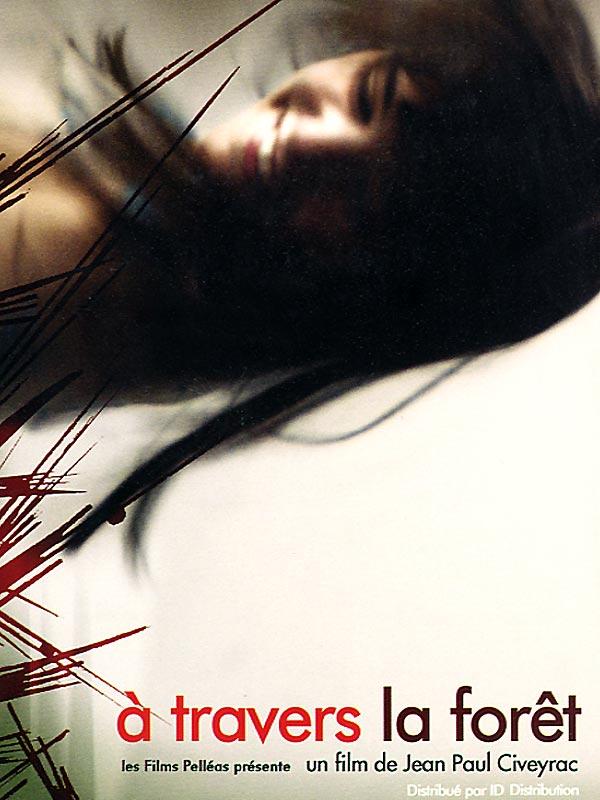
  • Céline Bozon for A travers la forêt (Jean-Paul Civeyrac/France)
  • Harris Savides for Last Days (Gus Van Sant/USA)

Best Image : William Lubtchansky for Les Amants Réguliers (Philippe Garrel/France)
Other Contenders:

  • Channa Deshapriya for The Forsaken Land (Vimukthi Jayasundara/Sri-Lanka)
  • Adrian Tan for Be With Me (Eric Khoo/Singapour)
  • Sharunas Bartas for Seven Invisible Men (Sharunas Bartas/Lithuania)
  • Ryszard Lenczewski for My Summer of Love (Pawel Pavlikovsky/UK)

Best Inspiration : Me and You and Everybody We Know (Miranda July/USA)
Other Contenders:

  • Three Times (Hou Hsiao-hsien/Taiwan)
  • The Wayward Cloud (Tsai Ming-liang/Taiwan)
  • Résfilm / Slitfilm (Sandor Kardos/Hungary)
  • Wallace & Gromit : The Curse of the Wererabbit (Box/Park/UK)

Stronger Content : Le Malentendu Colonial (Jean-Marie Téno/Cameroon)
Other Contenders:

  • Avenge but one of my two eyes (Avi Mograbi/Israel)
  • Un Silenzio Particulare (Stefano Rulli/Italy)
  • Manderlay (Lars Von Trier/Denmark)
  • Profils Paysans: Le Quotidien (Raymond Depardon/France)

26 décembre 2005

The Wayward Cloud (1/4)

The Wayward Cloud / Tian bian yi duo yun (2005/Tsai Ming-liang/France/Taiwan) ++++


OPENING SEQUENCE


High angle stationary camera (wide angle lens) at the crossing of perpendicular underground tunnels. Dirty cement, artificial neon lights. Distant sound of heels resonates. Real-time crossing (90") of 2 women from opposite sides of the screen to the other. A long plan-sequence shot like a closed-circuit surveillance camera (repeated motif in the rest of the film). Faces are too small to be identified, although one wears a nurse uniform and carry a watermelon: the porn actress (Sumomo Yozakura) of the following sequence.

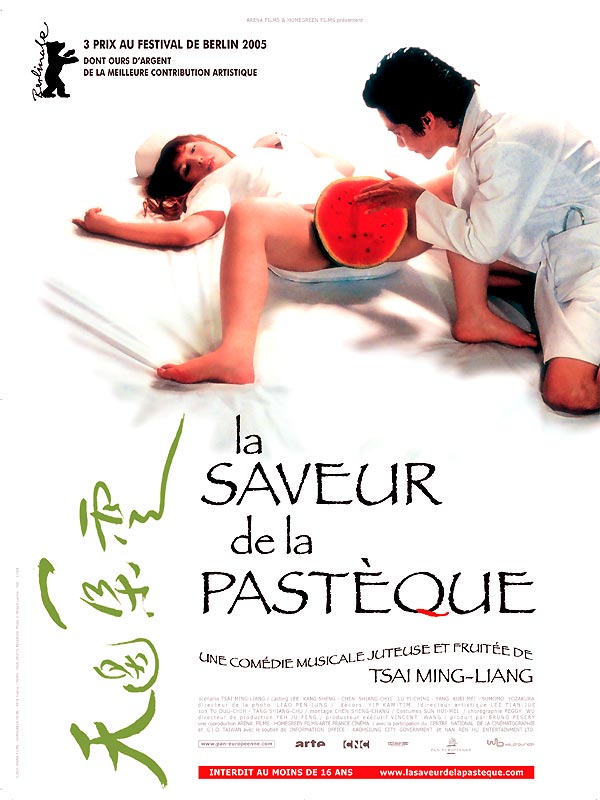
Cutaway to an actual erotic videotape involving nurse, doctor and watermelon, much more colorful, soft lit, activity cadenced by a faster editing.
Tsai clashes a slow paced impressionistic moment of wordless cinema (to the extant of boredom) with the most diverting excitment (porno) that provokes a reflective conflict to the audience's expectations. A dichotomy of form and content, suppression and debauchery (porn/musical) alternated throughout the film, escalating in degrees until they merge at once, an uncensored disillusioned crude reality.

Almost a satire of the classic vaudeville tragedy opposing "wife" and "mistress" rivals, legal love and physical satisfaction. In fact they represent the existential dilemma of the central character [HE] (Lee Kang-Sheng) between faltering platonic romance and oblivious hardcore activity, two ways out of an overbearing aloof routine. The sexual triangle at the heart of the story : the innocent love interest, museum guide [SHE] (Chen Shiang-Chyi), and the pornstar live nextdoor, unaware of eachother.
Although unmarried in this fable, the protagonists engage in a very tender but passionless, attentionate and indifferent, hide-and-seek juvenile flirtatious game, unable or unwilling to attach one-another. Surreal/discontinuous atmospherical romance like in 2046 (2004/Wong).

note: the 2 lead protagonists will be refered in my text as "HE" and "SHE" for clarity.

FORM

Repeating a gimmick used in The Hole (1998) both a tender homage and burelesque mockery of cheesy Hollywood/Asian musicals, Tsai collides his "boring contemplative style" with its total opposite, a deviant entertainment. Sentimental cover songs of the 50ies moraly-correct era are lip-synched by his actors disguised with ridiculous home-made costumes, no choreography, kitsch design and sexualized imagery to pervert their original meaning.
Five musical numbers, clash of cultures and times, substitute to the words unspoken in the film with dream sequences revealing a little more about their emotional load. They are more populated than the city, maybe to emphasize the sensation of isolation of these characters.
"There’s still some incredible imagery on display here from time to time, such as when shampoo seems to enclose Lee’s head in the titular cloud or when we see him sleeping suspended over a vertiginous stairwell, but these moments are just isolated moments. Throughout, the imposing landscape of the city makes the few people that move throughout it almost feel like afterthoughts, and Tsai’s decision to frame his leads so that even when they share a frame one’s usually leaving or sleeping pays off thematically, but not really emotionally."
Jeremy Heilman
Tsai says in an interview that people are only their true self (no pretention, no dissimulation) when they are on their own, without people observing/judging, or during sex. Like in his previous films, this one effectively focuses on the protagonists when they are alone, even after their romance has begun. And when they are in presence of someone else, they do not speak, or one of them is asleep, or isolated in side of the room.

They live in the same housing project (uniformized/anti-socialization) without ever crossing path. Only outdoor could they see eachother. The clever mise-en-scene of their meeting allows to observe each of them before the other has aknowledged their presence :
She recognizes HE sleeping on the swing. SHE falls asleep waiting for him to wake up. HE wakes up and doesn't recognize her. Then SHE wakes up : uncomfortable silence. Bad timing, their disposition to open up are not coordinated and makes the relationship impossible (just like the distance between Taipei and Paris materialized this ambiguous incompatible attraction). SHE asks if he still sells watches, refering in a one-liner to the two precedent episodes of the trilogy featuring these characters (What Time is it There? 2001/The Skywalk is Gone, 2002)
Tsai initiates the dissolution of the cinema illusion, the actors we recognized as Tsai's recurrant partners are not playing a new fictional character but they are in fact coming out of a previous story. The character of the new film is surprised to meet again a character of another film, so are we. First distanciation with the fiction, Tsai distracts the audience from the conventions that the actor is not himself but a character invented by the screenwriter.

CONTEXT

The project was originally meant to study the double-life of South Asian foreign labor, abused and exploited like under-citizens without visa, lost in a stateless limbo, confined to a marginal existence, selling soul and body for survival. They belong nowhere, incapable to return home, unwelcomed to fit in. If later extrapolated to the milieu of pornography, deviant love and perversity, which suggests a caricature of society, Tsai's latest provocation immerses a seemingly superficial romance in a social environment with comparable issues. In the first script, an aunt uncovered her nephew was a porno actor. Changed to a girlfriend due to casting problems, the role commits to a more intimate humiliation, adding jealousy to shame. She must swallow her pride to forgive if she wants to save their relationship, but is it that simple?

PREMISE / DROUGHT

In the near-abstracted social anticipation, an exceptionally dry season in Taiwan drained rivers and water supplies, the price of bottled water skyrocketed, and the population fell in an arrested languor. An idealized hot dry summer. Deserted streets instill a sense of suspended apocalypse. This sunshinier weather shows the wealthy areas of an idyllic Taipei in contrast with the usual trademarks of Tsai Ming-Liang's previous films: poor, overcrowded, dirty, polluted, and derelict city with non-stop pouring rain, water leaks or overflows.
We are invited to ponder over the effects of shortage (instead of affluence) on human behavior and vital nervous functions. Tsai internalizes the cycle of water. The various overwhelming watery phenomena that drenched the body in a damp macrocosm, now simmers inside the microcosm of the body itself, like a humanly cloud. Debilitating fluid exchanges with a depleted environment cause awkward, uneasy sensations and a craving to quench desirs. The vital needs of the body are out of control like the natural elements in the sky.
Surprisingly the cinematography does not show off hot colors, sweating skins, suffocating rooms and the sound design does not resort to the clichés of omnipresent ceiling fans, noisy insects or drying/melting material. Tsai prefers to insist on the amusing everyday activity/economy to find/keep water anyplace and the slowish pace of a thirsty person. Exausted people seek a rarefied liquid inside fruits, the precious watermelon juice is cherished.

SYMBOLISM OF WATER

The theme of essential substitution proves particularly metaphoric (and revelatory) in light of Tsai Ming Liang's own comments on the symbolism of water in his films (as transcribed in the Editions Dis Voir publication, Tsai Ming Liang): "...I always regard the characters in my films as plants which are short of water, which are almost on the point of dying from lack of water. Actually, water for me is love, that's what they lack. What I'm trying to show is very symbolic, it's their need for love." acquarello
This clue helps greatly to decypher the symbolism and gives a whole new reading to the events in the film. Considering this equation (water = love) the body language that replaces verbalization in the film becomes more evident.
  • Thirst = desir: incarnation of an immaterial feeling into a vital physical need.
  • Water bottle = human body either filled with love or emptied, either topped with a cap or parted from a soul-mate.
  • Watermelon juice = romantism, love stream, fun, bodily fluids.
  • Full Watermelon (green, dry) = emotion, feeling, baby.
  • Cut open watermelon (red, wet) = vagina, sex.
  • Food = sex, sensuous appetite, sexual fantasy.
SHE picks up empty bottles in trash cans and steals water from the public toilet flush! She also finds a watermelon in a dirty canal. It tells about her desperate craving for love... She capitalizes/stockpiles water bottles in her fridge like in a safe/incubator.
Unlike HE who doesn't seem to worry about water conservation (love is not a concern to him).


"she forces glasses of watermelon juice on him, despite her overstock of bottled
water. " Adam Balz
This scene uses a faux "split-screen" mise-en-scene, showing the kitchen with SHE, delighted, making watermelon juice on one side and the living room with HE on the other side, trying to open the suitcase, indifferent. Again a clever way to show the protagonists on their own, while both on screen. Fed up with the watermelon overused in his porn movie, HE disposes of the juice through the window while SHE is not looking. An uncomfortable moment when HE cannot refuse the generous offer, he cannot tell why either.

In opposition to the wet orgasm of Warm Water Under a Red Bridge (2001/Imamura), illustrated by an hyperbolic water leak from the woman's body, the porn actress from the same country plays here with an empty bottle striving to simulate a mechanical excitation. In this scene, the mislaid cap is separated from the bottle.
A metaphor of disconnectedness, unrequited love echoed in a later scene when HE hides away from SHE in the staircase. SHE goes down and sees an opened bottle full of water abandonned (by HE), then finds a cap on the stairs below. SHE comes back to put the cap back on the bottle but the bottle has disappeared in the meantime (retrieved by HE who didn't want to be seen near where he films porno). HE hides away upstairs again, and finally throws the bottle to cut short her curiosity. The bottle spills out its precious content. The symbolic meaning is all the more interesting since it was precedented by another scene when SHE pretended to deliver a child with a watermelon hidden under her shirt. Does it mean she asks for a baby and he's scared off? It's certainly one of the reasons that hinders their relationship to a stale.

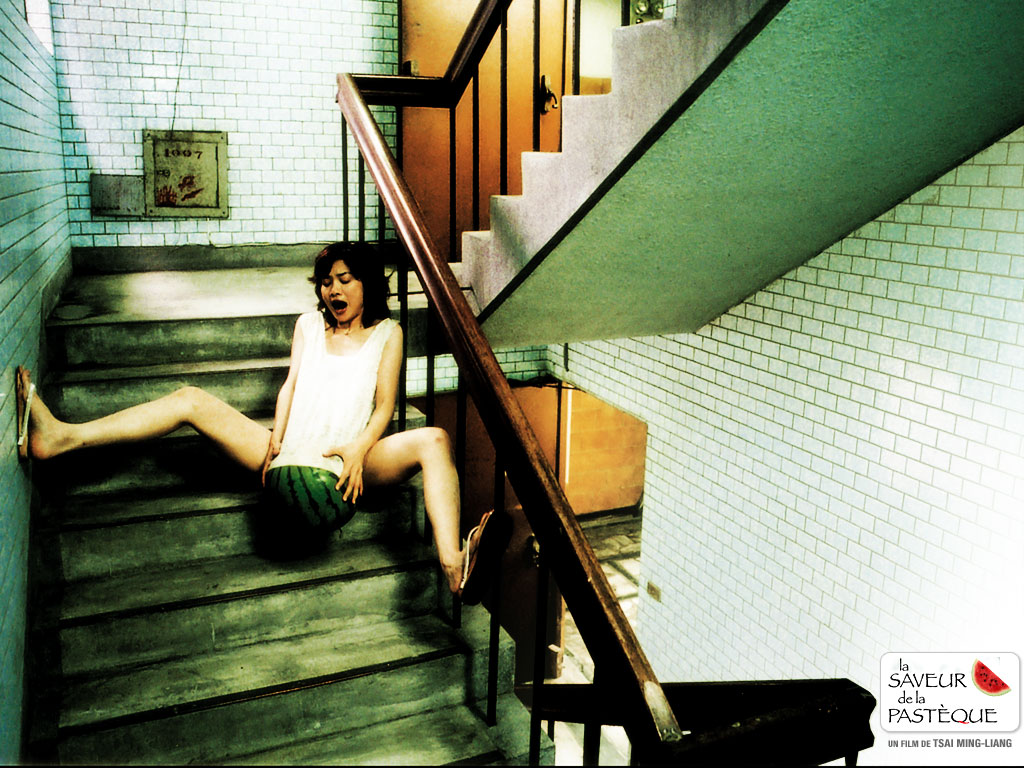
The first porn scene overtly identifies the watermelon half with sexual symbolism. The foreplay in the flesh of the fruit triggers pleasure to the nurse. Directly paralleled by SHE watching TV in a lascivious position with an opened watermelon squeezed between her thighs too, scooping it up with a spoon. Thus before they even met, both on their own. The parallel montage suggests the two actions are simulatenous as if the fantasy of SHE was enacted by HE. They are in the mood for sex, each on their own way.
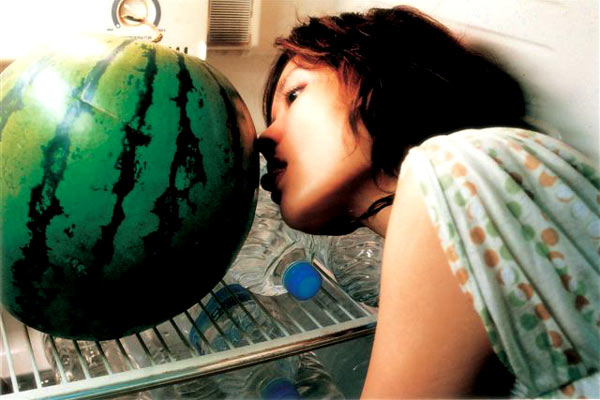
SHE later licks sensuously the full watermelon in the fridge. All this food fetishism is reminiscent of the infamous Kika (1993/Almodovar) where the man sexually attrated by her eats a mandarin orange off her genitalia.

In a memorable scene, HE and SHE eat crabs they cooked together, we do not see them but their shadows on the wall (like the ghost dance in Dreyer's Vampyr, 1932), illustrated by loud suction noises and laughters (echoes of the squishy noises of the first porn scene). Visually self-censored like in erotic scenes from the Hays code era. A strong symbol of sexual intercourse through voluptuous appetite, followed by the scene underneath the table, both lying sleepy smoking a cigarette (like after making love).


(s) ++ (w) +++ (m) ++++ (i) +++ (c) +++

Berlin 2005:
Silver Bear (Outstanding Artistic Achievement) + FIPRESCI Prize
Alfred Bauer Prize for Cinematographic inovation

Official Website (french, 2 musical clips, trailer, 3 scene clips)

Coming up next :

15 décembre 2005

2005 Top10

Year-end lists (acquarello, Girish, Darren Hughes) are a great opportunity to look back on the 2005 production and compare it to the 2005 distribution which seldom overlap. Also very useful to note down the gems that we might have missed or that we can still look forward to and build a wish list anticipating the future releases of 2006.
I realize I don't even write the reviews of my favorite films... probably because they are loaded with emotion and content hard to define, harder to explain, for me anyway. Expect updates before January.

Top10 of 2005 (ordered arbitrarily by personal taste) :

  1. Me and You and Everyone We Know (Miranda July/USA) Sundance 2005
  2. Three Times (Hou Hsiao-hsien/Taiwan) Cannes 2005
  3. The Wayward Cloud (Tsai Ming-liang/Taiwan) Berlin 2005
  4. Caché / Hidden (Haneke/France) Cannes 2005
  5. Battala en el Cielo / Battle in Heaven (Reygadas/Mexico) Cannes 2005
  6. Solntse / The Sun (Sokurov/Russia) Venice 2005
  7. The Forsaken Land (Jayasundara/SriLanka) Cannes 2005 - Un Certain Regard
  8. The Death of Mr. Lazarescu (Puiu/Romania) Cannes 2005 - Un Certain Regard
  9. Tale of Cinema (Hong Sang-soo/Korea) Cannes 2005
  10. Manderlay (Lars Von Trier/Denmark) Cannes 2005

Honorable mention : L'Enfant (Dardenne); Be With Me (Khoo); The Hand (Wong) in Eros; Les Amants Réguliers (Garrel); Les Yeux Clairs (Bonnell); Johanna (Mundruczo); Le Promeneur du Champs de Mars (Guédiguian);

Films that made my favorite list in the past: 2046; La Blessure; The World; Café Lumière; Comme une Image; 3-iron; The Holy Girl; Nobody Knows; L'esquive; Tropical Malady...

Documentaries (ordered by preference):

  1. Estamira (Marcos Prado/Brazil) Rio 2004
  2. Profils Paysans: Le Quotidien (Depardon/France)
  3. Un Silenzio Particulare (Stefano Rulli/Italy)
  4. Le Malentendu Colonial / The Colonial Misunderstanding (Téno/Cameroon) NY HRW 2005
  5. Les Artistes du Théatre Brûlé (Rithy Panh/Cambodia) Cannes 2005 - Off
  6. Grizzly Man (Herzog/USA) Sundance 2005
  7. El Cielo Gira (Mercedes Álvarez/Spain) Valladolid 2004
  8. La Peau Trouée (Samani/France) Nyon 2004
  9. Born into brothels (Briski/Kauffman/India/USA) Sundance 2004
  10. Avenge but one of my two eyes (Mograbi/France/Israel) Cannes 2005 - Off


I still need to see:

State of Fear (Yates); The Squid and the Whale (Baumbach); Seoul Train (Butterworth/Lubarsky); Funny Ha Ha (Bujalski); Un Couple parfait (Suwa); Pin Boy (Poliak); Something Like Happiness (Slama); Mary (Ferrara); Where the truth lies (Egoyan); Vers le sud (Cantet); Tony Takitani (J. Ichikawa); The Blue Younder (Herzog); Darwin's Nightmare (Sauper); Los Angeles PLays Itself (Andersen); Code 46 (Winterbottom); Who's Camus anyway (Yanagimachi); Le Filmeur (Cavalier);

What about you? Comments, questions, recommendations welcomed!


09 décembre 2005

Grizzly Man (2005/Herzog)

Grizzly Man (2005/Werner Herzog/USA) DOC +++

Herzog watches lovingly the footage filmed by this self-made actor-director, Timothy Treadwell, ecolo-activist who felt invested in the mission to protect Grizzly bears against the evil of civilisation in the remote wilderness of Alaska. A captivating posthumous biopic documentary put together with the video remains of a reckless solitary adventure.
Citing his diary and interviewing his relatives isn't as powerful as watching the video segments he himself directed and dramatized a few feets away from fierce animals on their very territory. Stitching together all the takes of his reportage, that were made for the editing table, is like assembling a puzzle with missing pieces. A one-man-made TV reality show.

The man is a frustrated actor showing off not a scientist, he's naive or maybe just nuts. The exploration of his upbringing and addiction background comfirms. Nobody could dispute however his passion for nature, his sincere interest and understanding of animals behavior, and most of all his confident bravery! I say this man is a hero, even if a reasonable society thinks he's out of his mind. He's one of these lunatic pioneers on the edge of charted maps who are always criticized for going too far. There are more stupid ways to die than that. And he knew exactly the risks. which he repeats on and on in his videos to educate children. The crude details of a violent death were endlessly running through his head as he spells out the words decapitation, disembowelment, slashes...
One could argue there is no obvious redeeming value to get in arm's way as such, unlike a war reporter for example, but that would be overlooking the existential dimension of this life lived fully to the limits as an art.

Herzog's narrator voiceover sounds a little judgemental, as he seeks to parallel with his relationship with Klaus Kinski on Aguirre. But he doesn't make the mistake to postpone the revelation of Treadwell's death for a final climax. He also makes obvious we're not going to ear the soundtrack of his death. At the same time he merely conceals the manipulation to get his interviewees to say what he wants: the travelling backward interrupting the coroner's speech, the staging of Timmy's watch handed out to Gizzly People president, the scene when Herzog appears on screen while listening to the death tape. This might be a conscious critique of how far TV/Cinema can exploit the desir of people to be filmed.

I didn't like when Herzog silence Timmy's curse words with a moralizing speech that misses the spark of truth revealed right there by this outburst of rage. Herzog wastes his time on the "what" instead of analyzing the "why". We don't care if Treadwell is right or not in insulting the National Park guards... What's taking place here is a genuine "moment" of symbolic pride.
This is the end of the summer, his expedition is over, he is unarmed and alive for the twelveth or thirteenth time in an everyday life-threatening journey. It's not a one-strike fluke, he challenged and proved it every year.This intensity of survival instinct drains a lot of energy to constantly prevent an imminent hazard. Imagine the level of controlled fear when he frequently glances back at the bear standing right behind him as he talks to the camera. His eyes and mind are always on watch. Thus when the season is done, and the danger is gone, the adrenaline rush falls dramatically, and lets out of his chest this puerile ressentment towards people who didn't believe in him and underestimated his challenge.
Treadwell acts out in front of his own camera, speaks to the world for the record, and shares his frightening promiscuity with death, be it clumsy or misplaced. In another take he say it out loud, nobody has ever faced human predators this close and for so long. I believe he has the right to brag about it.

Treadwell is not an isolated case. Dian Fossey with gorillas, Sigfried & Roy with tigers, people living with wolves, people who mingle with sharks or alligators, snake charmers... Wild life is a fascinating attraction to humans and some want to cross the safety fences.
There was this freaky video on the net where a guy jumped into the lions compound at the zoo to tell them to accept Jesus as a savior. The guy was clearly deranged, so totally fearless, he didn't even back off when the claws hit his leg. He kept an authoritative voice and a finger pointing dominant posture, just like Treadwell with his teasing bears. This is probably what made the lion think twice before eating him up.
So Treadwell was onto something with his "kind warrior" theory. The mind confidence replaces the physical superiority in a territorial face-off. That's how the little mongoose defy the mighty cobra. As long as there is no provocation fierce animals prefer to avoid contact especially if the opponent shows no fear to intimidative postures. Maybe animals sense the intellectual ascendant of humans even though they are no match to their jaws. But it takes serious guts to believe in this theory with a bear growling in your face.

In the light of his personal history, I see this reportage as a setup for an exit with panache.
He fancies himself a public enemy, victim of an fantasized manhunt, pursued by friendly tourists who leave smiley faces on his campsite. I wonder what was the detterence of his presence among the grizzlies if he hid away as soon as people came in and threw stones at his bears. He did nothing to stop them just to preserve the mystery of his legend. Real people afraid him more than bears! The clash of titans sequence between two males competing for a female and the aftermath debriefed by Timmy full of empathy for the defeated bear is quite telling.
He refused the mediocre death of an everyday-man, or to be caught and condemned by the justice of humans. The frustrated actor who almost passed out on O.D., and watched in the eye the criminals sentenced to death at the courthouse had a repressed ego-trip that couldn't express itself and found the most tragic way to claim his need for fame and grandeur. It's most unusual for a biologist to share intimate love-life issues during a field study. Maybe he was afraid to leave life, and truly enjoyed this sympathetic indifference of animals, for the liberty civilisation didn't allow him.

I think Timothy Treadwell wanted to stage his own death, to pick his executioner, an adversary of his stature. When the Ripper came to take him he made sure the camera was recording, and we know he met his expected fate with honor and courage like he always lived in this inhospitable environment. Meanwhile the secret role of his last girlfriend, Amie Huguenard, who was crazy enough to follow him to the heart of danger, gives a truly romantic, passionate ending to this tragedy, almost creating a universal myth bigger than fiction.

(s) +++ (w) ++ (m) +++ (i) +++ (c) ++

http://www.grizzlymanmovie.com/

08 décembre 2005

Il vento del cinema

The Wind of Cinema
website (italian)
Seminary of philosophy thought out by cinema
June 2005 - Procida (Italy) near Stromboli

Seminary of Jam Sessions with
  • Filmmakers : Alexandre Sokourov, Manoel de Oliveira, Abel Ferrara, Dario Argento, Herz Frank, Yervant Gianikiann, Philippe Garrel, Vincent Dieutre, Angela Ricchi Lucchi, Enrico Ghezzi, Mario Franco, Francesco Alliata, Nello Correale, Dino Mele...
  • Philosophers: Gilles Deleuze, Jacques Derida, Peter Sloterdijk, Emanuele Severino, Massimo Donà...

Last week on french radio was 5 broadcasts of 1h30 recounting the lectures and discussions. L’île du docteur Plateau, ou la philosophie pensée par le cinéma (available online, in french)

The highlight of this festival was the projection of a 30h long footage of the lectures of Gilles Deleuze recorded on video at the Vincennes University masterclasses during the 4 years when he conceived his theory of Cinema (The Time-Image, The Mouvement-Image) in the 70ies. Deleuze even had edited out 5h of these images into a "film", also restored for the occasion.

Films Projected :

  • Je t’aime, je t’aime (1968/Alain Resnais/France)
  • Terrore nello spazio / Terror in Space (1965/Mario Bava/Italy)
  • Les Enfants désaccordés (1964/Philippe Garrel/France)
  • Les Hautes solitudes (1974/Philippe Garrel/France)
  • La naissance de l’amour (1993/Philippe Garrel/France)
  • Silent Running (1972/Douglas Trumbull)
  • Ghost in the Shell 2: Innocence (2004/Mamoru Oshii/Japan)
  • Il mare / The Sea (1963/Giuseppe Patroni Griffi/Italy)
  • Armageddon (1998/Michael Bay/USA)
  • I ragazzi della Panaria (2004/Nello Correale/Italy)
  • Il monologo de «l’altro sguardo» (1996/Rossella Ragazzi/Italy)
  • Napoli e il cinema, storia e prospettive (2005/Mario Franco/Italy)
  • Out of the present (1995/Andrei Ujica/Germany)
  • Venerdì Santo (2005/Herz Frank/Italy-Lettonia)
  • Diagnosi (1975)
  • Dieci minuti più vecchio (1978/USSR)
  • The Last Judgement (1987)
  • Il Cantico dei Cantici (1989/USSR)
  • Centauro (1973/USSR)
  • La gioia di essere (1974/USSR)
  • Arte (1975/USSR)
  • Risveglio (1979/Herz Frank/USSR)
  • Platone e l’opera dei pupi (2005/Nello Correale/Italy)

I wish I was there to listen.

21 octobre 2005

A travers la foret (2005/Civeyrac)

A travers la forêt / Through the forest (2005/Jean-Paul Civeyrac/France) ++
Odd very odd, oddly cute though. A conceptual movie constructed in a rigorous formalism, 10 plan sequences of even timing tally a little over one hour, few protagonists, a narrow set and a soft accoustic soundtrack.

Opening sequence:
A young girl wakes up naked next to her lover in bed, walks up to a bright window and sings an english song. She hates her morning hair so asks him which hairdo would go well if she joined him on a trip to the USA. They joke about it and suddenly the sky goes dark, a storm has obstructed the horizon. The camera tracks her around the bedroom as she looks for her boyfriend who has disappeared, reframing from extreme close up to wide shot, back and forth, from bright light to dark corners, looking into reflecting surfaces or passing behind a flower bouquet, single-handedly commented by the girl's voice modulated accordingly through mood shifts. The light tone of a lovely morning has faded seamlessly into an anguishing evening, the playful game has turned into a bad dream. She's alone, distraught.


Armelle lost her boyfriend Renaud in a motorcycle wreck a couple months ago. He comes back in her dreams to make love to her like if nothing happened. Her two sisters strive to talk her out of this difficult mourning, either with an austere sermon or introducing her to spiritualism. Now she's convinced Renaud wants to come back and she interpretates omens anywhere. Hyppolite, a boy with a motorcycle leather jacket at her university shows a disturbing resemblance with Renaud. Armelle fantasizes a bound with the undead, like Orpheus she wishes to join Renaud in the afterlife and bring him back. The film even hints with subtle touches to the magical spells of her broken heart, mindbinding influence on the people around her. These compartmented tableaux passively observe slices of life unintrusively. The absence of reverse shots confine a 6 minutes lapse with the characters, like a micro theatrical scene. Since Armelle is almost always onscreen, the camera scrutinizes her face, and follows her steps, rarely lingering on the offscreen context wherein she evolves, plainly illustrated by distant noises. A claustrophobic camerawork leading the eye, essentialy focused on the actress(es), leaving no room to breath. Although the self-conscious enunciation seems theatrical, the scarce dialogue is mostly non-narrative, as if the girls-talk verbalization was a way to fill the silence and divert attention from contained inner conflicts. Thus establishing a dichotomy between images and words. Suggestive choreographed mise-en-scene that evokes ties to intangible presences. Aimless discussions around the vanity of human lives, like an ideal marriage to secure fate.
The premise confronts an imagined ghost or a representation of a spiritual quest, but far too straight forward and terribly naive. A style exercice that lacks some depth, unfortunately, to found the need for such ascetic mannerism. However the photography is the most developped aspect of the film, the ambiant lighting and the clashing colors.
Jean-Paul Civeyrac met Camille Berthomier at a theatre school and wrote her a film within a month. The debuting actress wrote all the songs she sings in the film.
Premiered at Toronto 2005
trailer (french)
(s) ++ (w) ++ (m) +++ (i) ++ (c) +++

17 octobre 2005

Haneke on Hidden

October 17th 1961 : 44 years ago today, before I was born, the french police, under the command of infamous officer Maurice Papon, beat up and pushed into the river the pro-Algeria-independance FLN protesters, with women and children, under the presidency of General De Gaulle. 200 activists died. The french press overlooked the tragedy. The OAS terrorist bomb attacks continued. Nonetheless the independance was signed on july the 3rd 1962.

Earlier this week, the senate voted a law to promote the "good sides" of the french colonialism to the dismay of the french-algerian community...
Note: A fiction documenting this protest is released on October 19th 2005 : Nuit noire 17 octobre 1961 (2005/Alain Tasma/France), I haven't seen it yet.

This is the event reported in the film:

Caché / Hidden (2005/Michael Haneke/France) ++++

I know I still haven't got around reviewing it, but I need to watch it a second time. It opened last week (historical timing apparently), so I will soon. Best Director award at Cannes 2005 !
(s) +++ (w) +++ (m) ++++ (i) +++ (c) ++


Notes from a radio interview of Michael Haneke by Michel Ciment (critic at Positif)

Apparently Haneke sent out a note to all french critics begging not to reveal end spoilers. Interesting to see how conservative he is with the plot suspense, like any single-serving end-twister in Hollywood, as he's precisely working on the mechanism of genre manipulation to make the audience aware of the fallacies. Images have the power to influence the mind, says he, like the fascist propaganda, and the audience ought to be educated to be wary.
He shows every year the movie Air Force One to his film students, because it's the archetype of conscious american imperialist propaganda.

Reference to TV industry methods : the editing work of the literary talk show in the film (by Daniel Auteuil), cliping out the boring arts and going straight to the juicy bits, as Haneke learnt in his 20 years long TV director career. Relationship between the audience and the TV reality, like in Benny's Video and Funny Games. (Same obsession Atom Egoyan has with video and TV screens).
Opposition of fixed plans and plan-sequences, either to emphasize the self-consciousness of a voyeur-cameraman, or the unedited drama of a tensed relationship between 2 characters.

Cinema HD : specific texture suited for the ambivalence wanted by the film, so we cannot tell whether the scene is live or from a video tape. The widescreen format was picked to mimic the 16/9 TV screen seen in the film. Likewise he used an academic format for Benny's Video to be able to fit a TV set full screen and play on the fiction/reality ambiguity. But to work with HD was dreadful, he said, the lenses, focus, depth of field, light... the cameras aren't good enough yet to replace film. Thanksfully he doesn't plan to switch to HD like many auteurs did lately. Haneke checks every shot on the combo monitor because the acting performance is more powerful emotionaly when experienced live on set. The camera frame doesn't record the magnetic physical presence that seriously biases the witness' perception., so he must take this missing element when appreciating teh success of a scene, coldly watched on a TV screen.

La Pianiste / The Piano Teacher was written 10 years ago for another director, a friend of his who couldn't find a producer, Haneke hadn't planned to adapt it for the cinema himself. Le Temps du Loup / Time of the Wolf was written right after The 7th Continent. Both old work, clashing with his austrian films period.

Haneke, great melomane, will make Don Giovanni at the Opéra Garnier in Paris in january 2006, a real opera, not a film, after 20 years directing theatre.

Next project, a 3h long film in german, on the danger of childhood education dealing with the nazi generation, 1914-1939.

Ballad of Narayama (1983/Imamura)

Ballad of Narayama / Narayama bushiko (1983/Shohei Imamura/Japan) ++
Great rendition of primitive social life in a remote community struggling to survive amidst an ungrateful Nature. Morality becomes meaningless when confronted to the call of starvation, primal instincts take over and balance quickly between murder, infanticide, trade of babies, rape and survival of the fittest. Shots of animals hunting, eating, mating and giving birth are recurrently inserted to illustrate the close parallel between these humans and the soulless behavior in the wilderness. Personally I thought these naturalists pictures came of as a naive cliché after a while, especially because of the abrupt editing that fails to incorporate them fully in an aesthetic unity.
A small village of a dozen families lost in the mountains is confronted to many moral decisions around the year, as the harvest go thiner and the neighborhood overcrowded. Baby girls are sold for food. Baby boys are killed at birth, and if they live out they are paria, treated as underdogs by their own family because only the first born son will inherit the ancestral property thus be able to mary. Eldery reaching 70 yold are kindly transported to the snowy mountain top comes winter to spare the burden of feeding people who can't work in the field. Superstition and fear of the dead spirits overwhelm their daily activity, paying homage to ancesters with prayers and begging for mercy. It's the ideal freudian field study: one takes out father and mother, one wishes his elder's death to climb the hierarchy, one asks his daughter to be a whore, one sleeps with the neighbor's mother...
Onin, a 69 yold grandmother is at the head of a large family shamed by too many humiliations... Her husband refused to abandon his mother in the Narayama mountain and deserted his family. Her elder son's wife died giving birth to a baby girl. The heir son isn't married yet. And she has all her teeth in healthy shape, which is a shame for old people, like if they pacted with the devil not to die, which means they remain a burden longer than normal.
Unfortunately only the story is strong, the performances are exaggerated, theatrical, often too grotesque while they should have been more interior and instinctive. Towards the end the film becomes interesting aestheticaly, with a few unspoken scenes as life goes on after a serie of inhumane tragedies. I'm probably most disappointed because of the recommendations I had heard. A weak Imamura in my opinion, style-wise, the direction is rather flat. Palme d'Or at Cannes 1983 anyway...
This depiction of humanity dregs simmering in a closed environment reminds Kurosawa's Lower Depths (1957) and Dodesukaden (1970). Recently a first time japanese director, Hiroshi Toda, developped this theme of the multigenerational nucleus family in Snow in spring / Shunsetsu (2004), taking place in today's Tokyo and abandonning the senile father in the mountain top is also a cultural solution for this middle class urban family. This film however is commendable.
(s) +++ (w) ++ (m) + (i) ++ (c) ++

16 octobre 2005

NYFF 2005

43rd New York Film Festival
September 23 - October 9, 2005

Website : Film Society of the Lincoln Center

Great line up issued from the best of Cannes, Venice and Toronto. A festival without competition nor awards...
And a Japanese retrospective with a tribute to Shochiku (entirely reviewed by acquarello)

My favorites:
A report on Reverse shot for the Q&A's of Haneke and Chereau for their films Caché and Gabrielle.
Greencine daily dispatches by David D'Arcy

Haze, latest film of Shinya Tsukamoto (Tetsuo the iron man) recommended by filmbrain. Sounds fantastic! This feature length film is the director's cut of a 28' segment contained in an asian omnibus put together by the Jeonju International Festival, along with fellow filmmakers Song Il-gon and Apichatpong Weerasethakul (maybe the short film included at NYFF?)
Note: this film is presented coupled with a 30' short of the same filmmaker, Tamamushi, at the Festival of Asian cinema in Lyon (France), which is a segment of another omnibus triptych titled Jam Films - FEMALE.

I like all these omnibus/portemanteau projects coming out recently, gathering various filmmakers around the same topic, to develop the resources of an overlooked film form, the short film. A "genre" or stylistic exercice I'm fond of, and I've been tracking down all omnibus instances (let me know if you can think of other examples), and look forward the upcoming Paris, je t'aime, 20 shorts for 20 districts in Paris by international auteurs.

13 octobre 2005

Secondary Currents (1983/Peter Rose)

More From the retrospective "La Pellicule du Chaos"

Secondary Currents (1983/Peter Rose/USA) 16' +++

"I'm an escape artist. I aspire to travel in the fifth dimension, to speak
unknown languages, to discover the next stage in the evolution of thought. I
construct structural parables that allude to the possibility of there being more
to the universe than is permitted by our explanations." Peter Rose

A strange narrator speaks an imaginary language, an unidentified voiceover subtitled in English on a black screen. Several voices overheard staging the verbal exchanges between a few characters, exposing with lyrical vocabulary the alienation of a foreigner arriving in a conservative community. The absence of images shifts the attention on the sonority of language, a sort of Esperanto sounding like Finnish or Native American Indian, sometimes Chinese or just freestyle gibberish, reminiscent of Dada poetry. Abandonned in the dark and missing the meaning of this language, the auditory experience focuses us on the intonations, the accentuations, the mood of the protagonists from their voice only. The subtitles, only graphic element shown on screen, become the center of the action. The traditional lower line of text translating the dialogue in a very neutral manner, takes liberties progressively, playing on the text format, alignment, verse composition, punctuation... As the quirky verbalisation we are listening to is futher complicated, soon the letters occupy the full space of the screen, and form disturbing mathematical equations where numbers are replaced by letters. Using all possible variation of a typeface, exponent, indice... When the furious cacophony is barely discernible the letters make a blinking canvas of textual matrix and words of a bigger scale appear against the background noise : "I destroy the language" "non-sense"...
An interesting reflexion on the operational mode of the soundtrack and our ambiguous relation to the onscreen information dephased or not with the audio content. It challenges the visual concentration and perverts the logic of language in our brains connections. It's mental sport!
Watching a lot of subtitled movies myself, I thought this little style exercice was particularly thought provocative and ironic. An experimentation related to the lettrist movement of Maurice Lemaître who used to distract annoyingly his audience with such visual mind-games in the 60ies.

Sample The other video clips on the site look great!

(s) ++ (w) +++ (m) 0 (i) +++ (c) ++

06 octobre 2005

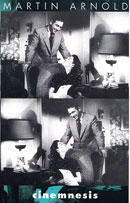
Martin Arnold's cinematic stutter

From the retrospective "La Pellicule du Chaos" at the Centre Pompidou MoMA, a handful of Avant-Garde shorts under the theme of Deconstruction.

Pièce Touché (1989/Martin Arnold/Austria) 15' ++++

Everybody likes to play around with the backward/forward slo-mo wheel on a video editing table, but Martin Arnold, genius of the Austrian experimental scene, takes it to sublimation on a custom optical printer of his own making. He works with foundfootage in B&W, here it's a clip of 18 seconds from Joseph Newman's The Human Jungle (1954), decomposed in a back and forth stop motion increments, stretched out to 15 minutes. Unlike his later masterpiece Alone. Life Wastes Andy Hardy (1998), this first experiment doesn't distort the original voices of the onscreen characters, the soundtrack emits a locomotive beat resulting from the sequential interspreced frames. Thus the manipulation is purely visual in this piece, dealing with the fluidity of motions, either existing in the original continuity or created by means of mirroring, loops, reverse and any combination of all three.

The base material is a classic plan of an american middle class family: a woman sits in an armchair back to the door and reads a magazine as her husband comes home, kisses her and walks across the room in one pan. With his scientific system of frame duplication, "one step back / two steps forward", Arnold slightly animates a freeze frame with impersceptible movement. The woman starts to tremble in an epileptic convulsion as the door freneticaly opens and closes by itself. The slow motion decomposes every little expressions on her face, and the delayed loops trap the husband between doors unable to stop from banging the door like an obsessive-compulsive disorder. By a clever manipulation of adjacent frames that are the secret of the motion picture illusion, Arnold preserves the continuity of the moves originally filmed, therefore insuring the credibility and coherence of the seamless alterations. The two characters immortalized on film in a given scene become the helpless puppets of a machiavellian demiurge controlling the normal flow of time. Like for the door episode, the kiss is the center of attention and the mouths repeat an approach that seems bound to be repulsed until it explodes into a strobing flurry of electric shocks. Taking advantage of a certain symetry in the plan composition, a mirrored footage, horizontally then vertically, is also interlaced in the cataractous loops, which cleverly allows to double an apparent motion, started on one side, and pursued by a mirrored copy in reverse. This manipulation of pure motion reaches abstraction according to the duration of the loop. On a brief loop with a double mirror on a one-character medium shot, the kaleidoscope deceptively makes coexist alternate realities in one place, at a 24 frames per second rate, in the form of a 4-faced, 8-armed monster.

What is just a fun game of editor explores the microcosme of repressed possibilities contained in a banal plan and its 400 frames, ridiculing cinema conventions through a critique of the classic narrative form. The editing manipulation opens a whole potential of subverted meanings from the same footage, altering the impressions we get from images we are subjected to. It's like an extrapolation of the Soviet Montage theory adaptated to micro motion continuity, where the juxtaposition of frames with a common internal dynamic issue a different action according to the order of association: linear or alternative, successive or discontinued, backward or forward, confrontation of reflective directions. This little style exercice proves how easy it is to generate a language from any given footage, creating new shots, new camerawork, new stories without filming new material. Somehow negating the role of performances overwhelmed by a dominating montage.

(s) ++ (w) 0 (m) +++ (i) ++++ (c) ++++

04 octobre 2005

Kilometre Zero (2005/Saleem)

Kilometre zero (2005/Hiner Saleem/France/Iraq/Finland) +

First movie shot in Iraq since GulfWar 2, Hiner Saleem (Vodka Lemon), exiled kurd in Paris, films a burelesque road movie in the backdrop of the Iran-Iraq war in 1988, coupling up together a kurd with an iraqi to highlight the absurd contradictions of a disparate people undermined by ancestral hatred. The film opens on a couple in a car driving in a country road of France, captivated by the radio announcing the laungh of the war in Iraq by president Bush in 2003. Cut to Iraq in 1988.
Ako is a young kurd married to a beautiful woman who refuse to leave the country without her dying father when the war is announced. They live in northern Iraq, in Kurdistan, bordering Turkey. Facing the dilemma of enrolling in the kurd resistance up in the mountains, or fleeing to Turkey, Saddam Hussein's army drafts him by force in the street, leaving him no choice to agonize over. Then sent directly on the frontline to the extreme south of Iraq, in Bassora, away from the Iranian Kurdistan. The film gets started when Ako is assigned the task to bring home in his Kurdistan the corpse of a martyr. His taxi driver with the coffin on the roof, is an taciturn arab, reduced to obey to a kurd by this ironic reversed situation where Ako is the one with the gun. Like in his previous film Saleem uses his trademark motif of a bed on wheels for comical relief, or the recurrant apparition of a giant bronze statue of Saddam on a truck. The hearses convoy can only use main roads or cross cities at night to save the population morale. Meanwhile the body decays and the 2 protagonists failed to connect in any way.
Desperately trying to reach the lightness of Kusturica when he introduces black humour in wartimes, Saleem poses a few staged situations to illustrate symbolically all the complexity of the tension in Iraq without ever showing it. The kurd genocide is briefly told through a radio speaker, fighter bombers only heard on the soundtrack, and smoke explosions on the front. This much minimalism could make good suggestive cinema if the scenes were less rushed and more sophisticated. The non-actor cast lacks the meaningful direction. The good ideas of mise-en-scène are clumsy and underdevelopped. Honorable intentions and limited means, but more jokes than actual inspiration.
This recreation of history is so disturbingly detached, brought to an intellectualisation of humiliation and suffering, that it's difficult to even believe in the fiction. Probably a lot of the subtext didn't hit me how it should have. A kurd saying concludes, as Ako and his wife are in a tiny rooftop appartement in Paris when Iraq is liberated by the coalition : "Our past is sad, our present is a tragedy, but fortunately we have no future."
Selected in Cannes 2005 (Official Competition)

(s) ++ (w) + (m) - (i) + (c) +

29 septembre 2005

El Perro (2004/Sorin)

Bombon El Chien / El Perro / The dog (2004/Carlos Sorin/Argentina) ++

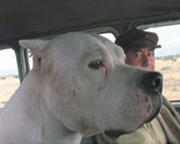
Carlos Sorin (Historias Minimas) repeats once more the minimalism of uneventful lives with non-actors who give the full emotional truth to this picture. Characters are named after the real people playing them, even if their conditions are slightly fictionized. Juan Villegas, in the film, ends up unemployed at 52 after 30 years spent as a gas station helper. This lonely widower sells hand-carved knives and lives in the house of his married daughter. Illiterate and introverted his social obligated reinsertion is difficult to deal with. After a couple of friendly encounters on the road, rural portraits of argentine faces, one good deed of his adds company to his solitude. Helping a woman stranded with a broken car in the middle of nowhere, he's granted a large purebred Argentinian Mastiff, Bombon, el chien, el perro. This odd, unexpected present is a problematic burden that will make him feel more important overnight. Everybody notices him in the street now, he's admired and considered. Soon introduced to a circle of dog breeders, he will try his luck with the dog show/semen business. Juan teams up with Walter Donado, an enthusiastic dog educator who takes him to his first show. A road-movie visiting the back country and exposing the untold existentialist errance of little people secretly waiting for good fortune.This understated non-actor, dwarfed by his immense dog, successfuly conveys genuine states of mind because they are his very reactions on the shooting location. The allegory of dog training routine echoes with the access of this simple man to a higher society, and maybe to the big city. Juan instantly transfers on his companion who talks as little and express his mood through faces and postures, both discomfit with romance and instinctive.

(s) ++ (w) ++ (m) ++ (i) ++ (c) +++

Keane (2004/Kerrigan)

Keane (2004/Lodge Kerrigan/USA) +++

William Keane is shook up, erring in a coach station, looking for his 6 yold daughter, lost a few months ago. Divorced, unemployed, he's on his own in a cheap hotel room, walking all night through the streets of NYC, always hyper, talking to himself, feeling persecuted by people around him. The abductor of his daughter has become a mythic figure he converses with like if connected through space and time as an indivisible duet or duel. This desperate woman Keane meets has a daughter, Kira, who recalls sore memories. The instability of his behavior, commanded by a profoundly burried emotional violence, will challenge the right intentions of his disinterested help for Kira and his mother: this is the node of tension and worry explored here between two strangers forced to blind trust. The film cleverly passes beyond the traditional Hollywood conditioning for inalienable evilness, and teaches how to understand better the aggravating circumpstances explaining the social madness of a marginal population. A mysterious journey down NY backstreets. A humanistic documentation of public paranoia.
An hand-held camera follows his footsteps everywhere he goes, like a fly on the wall, making an intense psychological portrait of one individual and only one. This cinéma-vérité-like direction of the action, like an uninterrupted thread of existence, from patrolling the public space to sleeping on the shoulder of a speedway, from a public washroom to a nightclub, from a fastfood to an ice rink. A serie of scenes from his disorganised daily life needs no further commentary to sketch out the borderline life of this man living of a disability healthcare check. The very linear narration, devoid of informational flashbacks, never corroborates or balance the protagonist's understanding by alternate perspectives of side characters for a reality check. We are immersed all along with Keane although we gradually get chances to suspect the sanity of his story.
A compasionate camera, rid of prejudice and judgemental conclusions, remains however bound to an external periphery, outside his mind where the trauma undermines his personality. This basket case confronting abduction phobia, which is the most dreadful fear a parent could experience, with the unspoken, undescribed contemplation of a schizophrenic influence on a persona contradicted by his acts. The role of a naive child attached by his overacted care and frightened by his sudden surge of infinite sadness puts a comfortable distance between the man and his unintentional intemperance.The shortended last shot, before denouement is regretable though, even if it leaves the imagination suspended at a T junction where the inner spiralling isn't totally safe yet.
Selected in Toronto in 2004 and in Cannes in 2005 (Director's Fortnight). Just released here in France nationwide last week.

(s) +++ (w) ++ (m) +++ (i) +++ (c) +++

23 septembre 2005

Fasel's memoir on Paris

Seen on the Web screen : A Girl and A Gun (George Fasel)


I've discovered George Fasel's cinephiliac blog only recently and too late. He passed away on August 20th 2005. RIP. His family keeps his blog going and here are his notes on a project of Memoir dedicated to his visits in Paris during 40 years. A very interesting read. Both for his passion for the city, mainly through cinema, history and politics, and for the pre-production aspect of this interrupted project, like a preparatory sketch, with a suggested plan, questions raised, doubts and awareness of a need for originality in this form of writing.
I've only been living in Paris for 13 years, though I'm french so the icon of our capital had a strong influence on me from my southern town. Nonetheless I understand how his constant connection to the spirit of the city could develop a more acurate sense of observation than any parisian living there all year long. It's only when we're away from what or who we love we fully grasp the personality we cherish. The foreigner's judgement has also a certain truth it takes decades for the native society to assume. That's how the Cahiers critics discovered a neglected side of American cinema for example.
I like his topical partition in chapters leaping through time anachronisticaly, to put together various cultural bricks that built the social identity of parisians. This multicultural approach echoes one of Bazinian essays.
This is a book I wish I could read. Maybe we'll get more drafts of this project published on his blog.
I'm not familiar with this Richard Cobb he cites though... any book on Paris he wrote I should read?

22 septembre 2005

Dossier 51 (1978/Deville)

Dossier 51 (1978/Michel Deville/France/Germany) ++++

Adaptated from Gilles Perrault's most original spy novel (eponymous, 1969), which discontinuous storyline unfolds in a serie of classified administrative memos from various departments of an anonymous foreign intelligence agency. This alone is a groundbreaking narrative development and remarkably transcripted on film with extensive use of anonymous voiceover and subjective camera. An "anti-James Bond movie" as Deville puts it, more like the real thing, a boring, meticulous, chancy, speculative job of a gang of little bureaucrats who research in the shadow like tireless ants. An investigation spanning across half a dozen years.

On a computer screen, a news telex announces the iminent replacement of a diplomat in an international economy organisation linking Europe and Africa. Dominique Auphal, will be refered as File #51, a small politician freshly promoted to this minor position at the bottom of the ladder. Not a very exciting information. Although the first incoming memo from the powers-that-be orders a complete investigation on this individual, scanning his personal life and past inside out to find the weakness allowing for political manipulation later in case 51 reaches an important position in this key organisation. The espionnage atmosphere is catchy right away.

Given access to the confidential correspondance between resourceful agents, the audience is introduced to the forbidden sancturary of this invisible shapeless branch of the government, without ever knowing who they are. Mars is the codename of the field agents tailing the target. Minerve is the brainstorming dispatcher. Esculape is the psychology unit. Venus the seduction unit. 52 will be 51's wife, 53 and 54 his children. Following a scientific and clinical procedure we are fed with each step of the process, for eyes only. Evidences are laid in full display under many forms, with highlighting and comments, suggestions of new angles of attack and closure of dead-end tracks. Agents remain hidden in subjective camera, only identified by their codename and a familiar tone of voice. Their personality and personal agenda surface in the way they file their reports.
First unknown and faceless, this character-target will become our obsession. Old archive photographs, then grainy tele lens snapshots, and eventually film footage of a distant sighting. But the man's whereabout are the least of their concerns. This service deals with information retrieval, not political influence yet. The objective is to gather compromising datas without him or the french counter-espionnage to suspect anything. Instead anybody in his entourage is a potential source for intelligence. From moving in with his maid to interviewing his mother on false pretense, tailing his wife's adultary lover, tracking down his former classmates, and of course bugging and searching his appartment. Each note is a cynical mockery, perversly abusing their power knowing no limits, defying legality, privacy and decency. This mercyless investigation shockingly scrutinizes every aspect of a man's life to his most intimate psychology, analyzed like a guinea pig by a conference of amoral administratives.Revealing as much the wrong leads than the successful hits makes it all real and compelling. Instead of the one-man-show in most spy movies, where the hero is a multitalented superman, here each tasked is assigned to the competent service, uncovering an unsuspected network of anonymous dormant part-time agents living as normal french citizens, with a regular job, and many intimate connections. A realistic depiction developped also in Coppola's The Conversation, althougth without any case of conscience of a subordinate questioning the ethics of his job. Almost no wellknown actors, or at least were unseen on teh big screen at the time, to save this impression of inconspicuousness.

The victim is a nobody, like you and me, only picked out of the crowd because it fits a profile that might be proved useful if speculation plays out well. This perspective somehow relativizes all the energy and resources wasted on one hypothetical pawn for a giant political chessboard. How many files out there? The film denounces the objectionable methods of contemporean secret services. Cruising through many aspects of french politics, abroad and at home, refering to political events and institutions in the backdrop of this very focused examination creates a powerful sense of proximity with real life. Whoever is behind this, and this type of surveillance is probably duplicated by as many world intelligence agency, they are paying attention to everything we are and thinking too much about it could get us really paranoid!
Won the French Critics Award for Best Picture.

(s) +++ (w) ++++ (M) +++ (i) +++ (c) +++

21 septembre 2005

TIFF 2005 : Toronto Festival

Toronto's 30th International Film Festival, took place from 8th to 17th September 2005, competing for the award of best world festival with Cannes, Venice and Berlin, certainly the largest with a maddening 335 films in only 10 days, including 109 world premieres. Can you believe it?
A well designed website with daily news published in a PDF newspaper!

From the line-up I recommended:
Battle in Heaven (Carlos Reygadas); The Death of Mister Lazarescu (Cristi Puiu); Caché/Hidden (Michael Haneke); Manderlay (Lars von Trier); The Sun (Alexander Sokurov); Three Times (Hou Hsiao-Hsien); The Forsaken Land (Vimukthi Jayasundara) all are Cannes greatest discoveries this year, that I watched in Paris.

And would have liked to be able to see there:
Shanghai Dreams (Wang Xiaoshuai); L' Enfant (Jean-Pierre Dardenne, Luc Dardenne); The Wayward Cloud (Tsai Ming-liang); All the Invisible Children (Mehdi Charef, Emir Kusturica, Spike Lee, Kátia Lund, Jordan and Ridley Scott, Stefano Veneruso, John Woo); L' Enfer (Danis Tanovic); Where the Truth Lies (Atom Egoyan); Mary (Abel Ferrara); Be With Me (Eric Khoo)... as well as the new film of Michael Snow, Matthias Müller, Patrice Chéreau, Matthew Barney, Nick Park, Josef Fares, Tim Burton, Terry Gilliam, John Turturro, Roman Polanski, Michel Gondry, Takeshi Kitano.

Doug Cummings (FilmJourney), Darren Hughes (Long Pauses), Girish Shambu (Girish), J. Robert Parks (on Long Pauses), Robert Davies (Errata) were lucky to be there on site. Don't miss their recommendations and reviews from their blogs, new films to look up to: The Quiet (Jamie Babbit, USA), Les Amants Réguliers (Philippe Garrel, France), Entre la mer et l'eau douce (Michel Brault, Canada); A travers la forêt (Jean-Paul Civeyrac, France); Vers le Sud (Laurent Cantet, France); My Dad is 100 years old (Guy Maddin, Canada); Why we fight (Eugene Jarecki, USA), Sketches of Frank Gehry (Pollack, USA); Marock (Laila Marrakchi , France); Into Great Silence (Groening, Germany), Sa-Kwa (Kang Yi-kwa, Korea), Sunflower (Zhang Yang , China), Un Couple Parfait (Nobuhiro Suwa , Japan). Hopefully I'll get to see these french films sometime soon... what irony!

Dispatches also available on GreenCine.

Awards anounced:
  • Gavin Hood's TSOTSI (UK/South Africa) - People’s Choice Award
  • LOOK BOTH WAYS (Australia) - Discovery Award
  • SA-KWA (South Korea) - Fipresci Prize
  • Jean-Marc Vallée's C.R.A.Z.Y. - Best Canadian Feature Film
  • Louise Archambault's FAMILIA + Michael Mabbott's THE LIFE AND HARD TIMES OF GUY TERRIFICO - Best Canadian Debut (tie)