23 août 2011

Gorilla attention deficit 1 (Chabris/Simons)

Where is Waldo?
You found Waldo? (squint your eyes and it's the darkest spot on the beach) But did you spot the cactus? did you notice there was not a single shadow? did you notice there was no lifeguard? did you spot the guy with polka dots sunburn? Chances are you didn't, because given a limited amount of time, you probably tried to skim through this picture containing a flurry of details with only one thing in mind, the red-stripped shirt pattern : Waldo (the implicit mission of this picture).

The invisible gorilla experiment is very funny, but it's a "gotcha" trick and it only surprises you once (with 50% success! no bragging rights there). Like when you point away to turn someone's head for an instant, and take advantage of their distraction to slap them in the face... It's a joke requiring the willing trust of the person.

- Hey, look away! ... Ah-ha, gotcha!
- But you told me to look away...
- Exactly.

 That's basically what this "scientific" test comes down to. They test our attention, we kindly obey to the directives... only to learn the directives themselves were lies. This breaks the pupil-professor social contract. How cheap is it to catch someone off-guard through a deceptive premise? Anything goes in the realm of jokes, but as a scientific procedure it's pretty sloppy.

They don't ask you to spot a gorilla, they divert your attention to something else (count the passes of the team in white) and then blaming you for not noticing something else (which they implicitly ordered you not to pay attention to). That's what illusionists do : misdirection. Granted, the gorilla is a big detail to miss, but it was concealed carefully... Is it a coincidence if the gorilla is black (just like the team you are specifically asked to ignore), the same size as all the players, and moving across the screen at a comparable speed? Of course not. It's part of the strategy to avoid attracting your attention. The gorilla suit is only there to ridicule you, but it's merely the irruption of a random intruder within a scene we have no business keeping track of, except for the ball.


 The center of gaze (corresponding to an area of the retina called the fovea), sees only a cone of vision of 2 degrees wide. This is what we use to decipher letters and read for instance. The rest of the field of vision (peripheral vision) is more blurry, unfocused and less acute. What this "awareness test" does is monopolize the attention of the fovea exclusively onto the white team players (and more precisely on the white players holding the ball), leaving the black team players in the peripheral vision. This is why, in the peripheral vision (less competent for subtle details, more competent in tracking motion), the gorilla can easily pass as a shape and behaviour resembling a black-team player without raising enough attention to the brains to require a fovea double-check (which would identify the difference in a fraction of a second). To make this trick work, the fovea must stay away from the gorilla at all time. Which is why you are asked to concentrate on a moving ball.

 If a real gorilla was to pop in the scene, several details would have alerted our peripheral vision : abnormal posture and displacement of one of the "black-team player", animal sounds one would assume, different ground vibrations, and first of all, the panic of all players and the end of the passes. The delimited frame of the video also removes important aspects of our environment. The fact a gorilla moves in up-close, amongst a group of people without causing mayhem, keeps our senses quiet. Noticing and reacting to the panic in somebody's eyes, face or unusual gestures is part of our defense system. Even if these scientists like to make fun of our blind spots, we still have a pretty good instinct for survival, notably to spot danger in a familiar setting before it arrives, with all our senses, even if it is not under the direct scrutiny of the fovea. I guarantee you that if someone rushed in on screen, bouncing up and down, in a gorilla suit or not, even in the corner of the screen, 100% of spectators would be able to say they noticed something odd during the counting, even without looking at it.

In fact, Derren Brown makes use of this gorilla awareness test in one of his shows (Evening of Wonders, 2007). 
Daniel Simons created another version (The Monkey business Illusion) destined to catch off guard the people who already heard about the gorilla. While viewers will be content spotting the gorilla, other subtle changes have been added to trick them. The fake curtain (added on green screen) changes from a red hue to an orange hue (without altering the general luminosity of the scene, which would otherwise alert our peripheral vision), and they use the entrance of the gorilla to exit one of the black-team player by the same side of the screen at the exact same moment (which is also the moment the curtain colour changes, for maximizing confusion and stealth), which easily fools the peripheral vision in thinking the black shape moving offscreen is the same as the lookalike black shape coming back on screen from the same spot.

In fact the gorilla didn't go unnoticed. We just didn't register its presence at the top level of our waking consciousness. If we are not told about the gorilla at the end of the test, we could easily retrieve this information under hypnosis. Under a state of trance (or focused concentration) we could revisit our memories of the video, even the details that we are not capable to access/verbalize consciously. This demonstrates that the center of gaze is not the only area that sees and remembers. (see Derren Brown's Trick or Treat Season 2 Episode 1; May 2008) We see more than what we are able to recall/spell out, because most details are relegated to low-level priorities and removed from verbalizable memory.

Again this is a trick only possible because of the offscreen suspension of disbelief. They use the off-screen space to sneak in/out, thus creating a false environment. Theatre uses the curtains to facilitate a live performance on stage, but if they started to abuse this convention to sneak in gorillas, spectators would give up disbelief and suspect everything going on, which would kill the necessary immersion in the narrative universe. The camera frame is likewise a convention we accept as long as it is not turned against us, to expose the blindspots created by our suspension of disbelief. For the benefit of the narrative plausibility, filmmakers don't need spectators to become suspicious of the non-diegetic space, behind the camera, or in the off-screen wings.

 This is a valid experiment in the field of psychology, to test the compliance to a procedure, regardless for its irrelevance. I'm not sure it is as pertinent to the field of neurology, since the attention deficit is caused by the suppression of information in the fabric of the test itself. Seriously, it doesn't prove anything, and certainly not what it says it does. The two guys, Christopher Chabris and Daniel Simons, interviewed on a radio show (CJAD radio) are more ambivalent/measured about the conclusions, when given a chance to expand on it.

On a short term prospect, the brains intentionally ignores certain elements (that are kept in check by the familiar permanence of the context) in order to become more efficient with a very specific task. But if there really was something fishy going on, the correlation of other signals (ear, feeling of vibrations, disorder of the environment...) would abort the silly task at hand (counting passes because we were asked to) and assess the general situation with all our senses, even for a second, until the suspicion is cleared up. At the cinema, we are dependent on what the filmmaker decides to reveal, visually on the screen, and aurally in the speakers.

That's why jump scenes are the easiest tricks in movies, and the cheapest (artistically speaking) effects. Like shouting "boo" in the back of an unsuspecting friend. Everyone falls for it. If we are in a safe environment, we never double check on everyone passing behind our back. We let ourselves betrayed by an excess of confidence with familiarity. In an unfamiliar place, we are on our guard, and would less likely let something fishy happen behind our back without double checking. The illusion of such tests is to pretend that the delimited diegetic world contained in a brief video sequence (to which we willingly grant the proverbial "suspension of disbelief") makes any claim on our real world perception. There are a lot of elements we take for granted in reality, that could fool us eventually, without checking them time and again, especially not more than once.

The Movie Perception Tests (Levin/Simons); Whodunnit? (WCRS&Co); Evolution of Games (MysteryGuitarMan)
Did you notice all the changes?

They play a brief clip from an unfamiliar scene where everything is new to us. We have to make sense of the context, while listening to a dialogue. And they ask us to pick up on gotcha changes that happen against the very logic of the scene and unbeknownst to us... In a real world environment we know what elements are unknown and which ones are known, because we've tested them before, we also assume that things stay the way they are. We also have a good sense of which elements are most likely to change in certain circumstances. A sudden change from the corner of our eyes or an atypical noise from the ambiance might make us reassess the permanence of things and check things again as if new. But when the edit ellipsis of a shot-countershot convention abuses our trust to slip in prop changes, it is not something we would naturally pay attention to, nor would such trivial details (fork switch, arm positions...) prove to be interesting at all. The Whodunnit clip abuses the offscreen space left by the close-up panoramic, to alter props that the main character (a detective of all characters) can see in plain sight. At the movies, we suspend disbelief for the editing shorthands and other camerawork tricks, provided the ellipsis maintains the coherence of the whole. We also rely heavily on the knowledge of the onscreen characters (even if some of them may lie purposefuly for the benefit of the story). But if ALL characters play pretend changes that occur in the diegetic world didn't happen (however we do expect them to ignore the technical staff from the non-diegetic world of course), then the narrative has no foundation to build on. And that's this loophole (the willingness of spectators to give credit to stage artifices) that these gotcha test exploit, which is a low blow to the suspension of disbelief. 

Applying this observation directly the movie narrative is rather abrupt and pointless. Comparing a chess master memory of checker conformations to reading the content of a movie is ludicrous. Of course, we let a lot of details pass by unchecked, especially when the talking and editing is accelerated. Just like in reality we could be fooled by something or someone we didn't go check out and assess firsthand, because details are too many around us, and because only a few of them will have any importance/influence in our life. When someone with an uniform on introduces herself as a nurse, we assume the hospital didn't let her enter and work there without qualifications. We don't verify her resume ourselves. Maybe we should. When someone walking in the park with a dog in leash says "this is my dog", we believe it without running a thorough administrative check up. Yet it could be another occasion to fool us. Another loophole of the "inattentional blindness" (an half-empty glass way of looking at the admirable evolution of one of our vital sense). Just like we assume that in a scientific video that unfolds very calmly, without scream or laughter  everyone on screen was put there on purpose by the scientists, and we have no reason to suspect anything tricky in this department, nor the directives ordered onto us.

Source: The Invisible Gorilla (Chabris/Simons)
 What You See Is What You Get (Manohla Dargis; NYT; 8 July 2011)
Good and good for you (David Bordwell; 10 July 2011) 


To be continued...


Related:

16 août 2011

France supports the big screen


Cinema Pass to watch unlimited films all year round (for people who watch more than 2 films per month) :
19.80€/month (2.3 x regular admission fee) = unlimited access to all theatres from the UGC-MK2 exhibition circuit (610 screens) nationwide.
35€/month (4 x regular admission fee) = same pass, for 2 people.

20.50€/month (2.4 x regular admission fee) = unlimited access to all theatres from the Gaumont-Pathé exhibition circuit (over 800 screens) nationwide (over 40 cities).

* * *

Yearly membership : 10€ / month (1.2 x regular admission fee) = unlimited access to all projections (up to 50-60 screenings / week) + weekly ciné club, conferences, museum, exhibition, videothèque, library

Membership fee : 3€ / screening = 15 screenings a week + ciné club, exhibition, library

Membership fee: 4.30€ / screening = 16 screenings a week + ciné club, conferences, museum, exhibition, library

* * *


Annual calendar of events for the promotion of big screen projections :
Festival Cinéma Télérama
(France) /3€/ 19-25 janvier 
At the end of January, every year, the magazine Télérama organise the projection of some 15 of the best films of the year, giving them a re-run during a week in selected theatres (210 theatres) in major cities throughout France. Every admission is 3€ instead of 9€ (after buying the current issue of Télérama). For everyone. We may revisit or catch up with the major films of the previous year if we missed them during a short distribution. Since 1997.

* * *

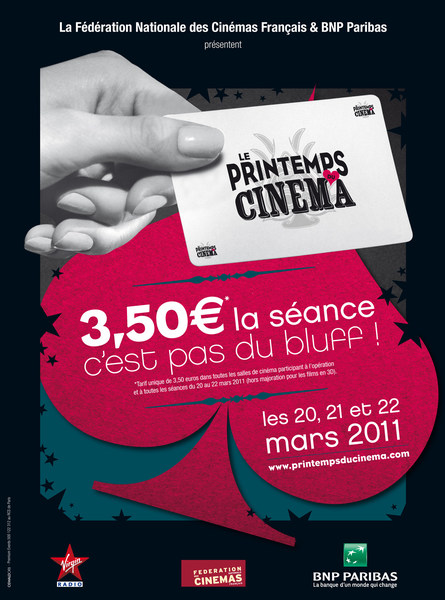
(France) /3.50€/ 20-22 mars
3 days every March, all admissions are 3.50€ instead of 9€, nationwide. For everyone. For all films available in commercial theatres.

* * *


Où va le cinéma? "L'Industrie du rêve
(Paris région) // 30 mars - 3 avril [MP3
Every year, a colloque about the state of cinema, with numerous guests, roundtables, masterclasses, exhibitions, projections. Since 1999.

* * * 

(France) /8€+3€/ 25 juin - 1er juillet 
Every year at the end of June, all admission fees are 3€ for a week, in every theatres nationwide, after buying the first admission (pass) at normal price (9€). For all films available in commercial theatres. Since 1985 (back when the regular admission was 18Francs=2.5€, and the event fee was 1Franc=15 cents of €). 

* * *

(Paris) /5€/ 2-13 juillet [PDF films selection]
Competitive festival in Paris showing a best of from the festival circuit, plus several comprehensive retrospectives, masterclasses, flea market, night-long projection marathons, exhibitions, roundtables. All admissions : 5€. No "gala" pricing. Pass for 10 days : 30€ (price of 6 films). Some events are free. Selected films (250) in selected parisian theatres (16). Since 2002.

* * *
(Paris) /FREE/ 17 Juin-2 Septembre [PDF selection of films]
Every year in Paris (11th district), 5 open air screenings of older feature films + short film. For everyone. FREE.

* * *

(Paris) 23-25 juin /FREE
Every summer, one weekend of June, in Saint-Cloud, 8 films, projected for free. Since 2003

* * *

(Paris) /FREE/ 17 juillet - 22 août [PDF films selection]
Every summer, during 30 days, 40-some feature length and shorts are projected in a park when night falls (weather permiting), for FREE. Thematic selection of films not in current commercial distribution. An average of a couple thousands spectators at each screening. Nearly ten or twelve thousands people can lay on the grass at peak attendance.

* * *

(Paris) /FREE/ 3-21 Août [PDF films selection]
Every august, a dozen of films shot in Paris are projected in situ, in the general neighborhood where the story takes place, on open air screens. Free entrance. Since 2000.

* * *

Festival Silhouettes
(Paris) /FREE/ 27 août-4 Septembre [PDF selection of films]
Every summer, 1 week at the end of august, open air projection of short films and a competition. Since 2001.

* * *
1Max2Ciné (La rentrée du cinéma)
(France) 1 place acheté = 1 offerte Tous les samedis de septembre

Every saturdays of September, in every theatres nationwide, spectators under 27 yold get 1 free ticket for 1 admission purchased.

* * * 

(Dijon) 20-22 Octobre 

Every Octobre, a weekend of conférence, roundtable, projections. Since 2008


11 août 2011

France Market Shares - World Cinema Stats (22)

Admission share (%) 2010
  • Domestic (French) films = 36.2%
  • Non-domestic (all-foreign) films = 63.8%
    • American films = 48.2%
    • Non-American foreign films = 15.6%
      • European films = 14%
      • Rest of the world = 1.6%


Source: CNC / Focus 2010 / OES


Related:

10 août 2011

Avatar better than literature??? (McCormack)

Tom McCormack: One could think of contemporary narrative cinema as having two horizon points, the first related to wall-to-wall CGI, the second to epic long shots and the blurring of distinctions between documentary and fiction.
The Two Horizons (9 August 2011)
At least, for once, the landscape of contemporary cinema is not defined by the slow-fast polarities! But this new schema is still Manichean and remarkably absurd. At the bottom of which hypothetical cave do you have to stand to see the horizon divided between CGI and long shots, Avatar and Juventud em marcha? They are not polar opposites of the same theme. These are bad stereotypes. He assumes that CGI and long shots are mutually exclusive (The Abyss; Wall-E, Enter The Void??), that the documentary-fiction frontier is CGI-free (Waking Life; Waltz With Bashir??)... Yeah I don't think these poles are that much clear cut.
Let's ignore the bullshit about "subjectivity"... nothing insightful is expected from someone who believes that comics book nerds' obsession with fictitious-fact checking (anti-auteurism : customers are always right, the auteur shall comply) is what redefines the relation to actual Reality for the rest of the world.

By convoluting film's indexical relationship to its subjects, CGI potentially liberates cinema from an assumed truth-value [..] Avatar really is something new; it renegotiates the tripleness of movies in a revolutionary way. [..] One of Avatar's achievements is that is has no accidental surplus of description—or at least very little—while seeming to. Every shot overwhelms the visual field with a too-muchness of information, like old-fashioned movies, but the effect isn't automated but calculated. It's unprecedented and quite dazzling.
Apparently this guy never watched an animated movie. Animation (Emile Cohl; McCay; Disney...) is exactly that : producing a "motion picture" where all details are designed, not merely recorded from reality. CGI is just a fancy way to generate animation without pencils, but the principle is strictly identical. Pixels are not the equivalent of words for the simple reason that we never see pixels with a naked eye, we cannot parse them from the big picture, and that makes all the difference.
Avatar is the first time you realized that you're watching a universe that was entirely created by the designer? Well, first-off, this is not an all-CGI movie (unlike Toy Story, Ice Age, Finding Nemo, Wall-E, Cars...), there are scenes with REAL LIFE actors in set pieces. Secondly, there ARE precedents of CGI-live action hybrids that generated as much of an ex-nihilo CGI world (Tron, 1982; Total Recall, 1990; Jurassic Park, 1993; Star Wars I, 1999; King Kong, 2005; Inception, 2009...). What did Avatar do that these didn't before? Nothing. 3D is not new, CGI is not new, motion-capture is not new, animation is not new. If we can empathize with Mickey Mouse (a vague caricature of an anthropomorphic animal, badly animated), believing in half-credible CGI characters is an easy task. CGI doesn't only work on our imagination because it looks "real"... the stretch of human imagination is boundless, we'd believe in anything because we want to. We even lend life and meaning to inanimate objects or imaginary friends.  

If one of the pleasures of literary fiction—of, say, Tolstoy—is simply the wow factor, delighting in watching objects conjured by means that are in some essential way alien to them (words), Avatar makes a serious claim that cinema can compete with, and maybe best, literature on these terms. Films have never offered much competition in this area because their tools for describing the world are automated, and of the world, not essentially alien like words. 
No. Sorry. I agree that cinema is far from the accomplishments of literature in the domain of pure narration. Still in its infancy. But if one film nears this level of maturity... it's certainly not Avatar, all technological inventions included. Take a step back from the 3D craze and the marketing buzz... this is just cheap storytelling.
Is it the first film of the entire history of cinema that transcends photorealism to you? Really??? You never watched Kino-glass (Brick); The General Line (Eisenstein); Un Chien Andalou (Buñuel/Dali); Je t'aime, je t'aime (Resnais); Film (Beckett); Le Camion (Duras); In girum imus nocte et consumimur igni (Debord); La Jetée (Marker); Outer Space (Tscherkassky)...? Not to mention David Lynch, Stan Brakhage, Andrei Tarkovsky, Robert Bresson. Cinema at its best does transcend the basic face-value of images and their zero-degree illustrative content.

We watch, as it were, with three eyes: 1) attuned to the proceedings as artifice, as projected light arranged in patterns that tell a story; 2) attuned to the proceedings of the story; and 3) attuned to the proceedings as their own reality, as documents of events that actually took place. When we watch the opening of The Searchers, we simultaneously see: A) a human cipher made of light approach a house made of the same; B) Ethan Edwards return from the Civil War; and C) John Wayne ride a horse up to a solid-seeming building.
So he equates the huge divide there is in Literature between signifiers and signifiants, with the closest analogy there could be between a screen image and its corresponding mental image. The nature of the "artifice" (if you call language that...) is of a very different degree there! Think about it. The film image is a contact stamp of reality, an analogue for all purpose and intent. We could almost believe we are looking at a scene happening behind a window. The patterns of letters, words, grammar, sentences, paragraphs, chapters... is incredibly more alienated from the reality it represents than a simple image or the montage of successive scenes (be it live action, CGI or hand-drawn!). This is a grave perversion of Bazin's ontology of the photographic image. 

Looked at one way, Freud's ideas are the Literary Agent Hypothesis writ large: Your life is Inspired By real events. The person listed as the author—you—is just the literary agent for the unconscious who's writing it.
This is a grave perversion of Freud's theory of the Id. The childhood subconscious might be a blue-print for the adult life... but it's not more real than life itself. The subconscious merely draws general directions, we are still authors (and responsible) of our everyday life! It would be too easy to blame an hypothetical "subconscious" for all our mistakes. 

From Warhol there's a love of solid time, erotically extended durations
There is nothing intrinsicaly "erotic" in long shots... you're confusing the content of Warhol's films, with the form it happened to take.

The shots [of Pedro Costa] are delicately composed and daubed with deep blacks, with both elements accenting their artificiality. But their length undercuts this artifice. Reality becomes distended, and the first effect of this is to divorce the individual shots from the narrative. We begin looking for the surplus, becoming connoisseurs of the accidental or impossible to plan. 
Careful composition and deep black hardly distract the eye from the photographic realism, they are part of it.  
Earlier on, you list the projected light on a screen as the artifice of filmic image, and now you say that a long take (thus more of that artificial image) is what make us forget the artifice...? WTF? 
The divorce of the long take from the narrative would require a longer development.
If you're looking for the non-diegetic accident in a diegetic film, you're the fool who stares at the golden frame instead of the painting it surrounds... like people who watch Ed Wood's failed films for their unintentional humour. That's your personal usage of cinema.  


Hollywood (fake) memo to modernize Disney's script for Pocahontas into a futuristic tale in 3D 


Related:

02 août 2011

La Commune de Watkins (Layerle)

Entièrement tourné en studio, le film de Peter Watkins, expérience cinématographique et télévisuelle hors norme, bouscule les codes de représentation de la fiction historique. Donnant à l’événement une forte résonance contemporaine, il s’impose en outre comme un modèle de création collective qui en appelle au sens critique et vise “l’éveil des consciences”. (Sébastien Layerle)

Dans ce monologue qui nous est directement adressé, Peter Watkins nous parle de son travail sur son film "la Commune (Paris 1871)". Il nous invite notament a réfélchir sur la façon "monoforme" de faire du cinéma ou de la télévision, employant des procédés de narration formaté pour capter le spectateur le contraignant dans un rapport hiérarchique et de passivité face au message. Il adresse une sévère et louable critique aux médias de masse, au système éducatif qui l'encourage, à la façon dont ils propagent une mono culture dans un monde globalisé contribuant à détruire les liens qu'ont les citoyens avec leur propre histoire et notamment les jeunes.
Gardons nous du danger d'un média fascinant, discutons le, changer les formes de narrations en donnant la possibilité au spectateur de redevenir un sujet actant et réfléchissant le message.
Vilnius, Lituanie, 2001

22 juillet 2011

Weak's Cutoff : No Cinephilia

Mick LaSalle (San Francisco Chronicle, 17 April 2011): "Meek's Cutoff [..] Of course, it had to be as director Kelly Reichardt presents it here: quiet. Nothing around for miles. And boring. Ay, there's the rub. Boring. Probably no more realistic film has ever been made about Americans off to settle the West, and so "Meek's Cutoff" cannot be dismissed. But oh, if only there were a story here to latch onto, something, anything. [..] Lacking that, for all the integrity of its details and a good central performance by Michelle Williams, this film becomes excruciatingly, brain-fryingly and consciousness-losingly dull. [..] [Reichardt] She has the setting, the approach, the attitude and the vision, but she ducks the most difficult and necessary requirement of narrative art, which is the narrative itself. As it stands, "Meek's Cutoff" could have made a brilliant 12-minute short." [see Europe is too different]
Dan Kois (NYT; 1st May 2011): "As a viewing experience, “Meek’s Cutoff” is as closed off and stubborn as the devout settlers who populate it. (“Pleasureless,” raved David Denby of The New Yorker! “There is not much action,” noted A. O. Scott of The Times!) By the end, I could sympathize with the settlers’ exhaustion; I felt as if I’d been through a similarly grueling experience. Which is to say, it affected me viscerally, and I’ve found myself thinking about it over and over since. But during the time I actually watched the film, I had trouble staying planted in my seat with my attention focused on the screen, as the long dissolves from one wind-blasted plateau to another sent my thoughts blowing in a dozen directions.
As a viewer whose default mode of interaction with images has consisted, for as long as I can remember, of intense, rapid-fire decoding of text, subtext, metatext and hypertext, I’ve long had a queasy fascination with slow-moving, meditative drama. [..]
But while I’m grateful to have watched “Solaris” and “Blue” and “Meek’s Cutoff” and “The Son” and “Atanarjuat (The Fast Runner)” and “Three Times” and on and on, my taste stubbornly remains my taste." [See Dan Kois syndrome 1-2]
Neil Young (Project:New Cinephilia, 25 may 2011): "[..] one shouldn’t feel like some kind of heretic for pointing out that, say, Meek’s Cutoff is a waste of everyone’s time, effort and money. [..] why traipse out to a moviehouse to see Meek’s Cutoff (say), when we can stay home and watch a John Ford or, for the less “scrupulous”, Meek’s Cutoff itself via the alluringly larcenous magic of filesharing." [See Project: Validating Indulgent Movie Fandom]

Hard facts for the "cultural arbiters" living in truthiness :

Facts 2010 USA UK France
Population (million)
3136365
Screens
395473651 5478
Screens per million population
126 58 84
Titles distributed
560 503 575
Average screens per title distributed
70.6 7.2 9.5
Admissions (million)
1340173206
Admissions per capita
4.12.83.2
Average admission fee ($)
7.98.88.7

These figures speak for themselves. The USA is a larger population, with more screens, with more screens per inhabitant, with more admissions, with a greater movie-going frequency amongst the general population, with more screens available per film distributed (70.6 !!!). So far it seems like the USA is a country more "cinephilic" (more moviegoing at least) than any other country... until we look in the details what kind of films Americans are screening/watching in mass, and it's not the artfilm sector that benefits from this affluence.
*If* moviegoers in the USA were as "cinephile" as other nations (and not more) the admissions for artfilms should be greatly superior to those of the UK or France by sheer mass of an overwhelming movie business. The USA could be less cinephilic and still manage to sell as many artfilm admissions as France, because the total turnout is so much greater, but that's not what we see. 
Sadly, and against all logical statistics, the USA manages to score lower than countries 5 times smaller than its size!
Even for American-made artfilms, such as Meek's Cutoff or Tree of Life (which scared the hell out of Dan Kois and Neil Young). How can you score last with such a headstart (statistical advantages)??? How can you be beaten by foreign markets for the exploitation of your own domestic films??? How afraid are you of "niche distribution" to neglect your home auteurs???
The USA could save 6000 of their 40000 screens exclusively for artfilms and world cinema, that's nothing, not even 7% of their total available screens. And it would be over 100% of total commercial screens available in France or the UK! That would not hinder the business of Hollywood flicks in a noticeable way, and it would give to the USA the largest arthouse circuit in the world, something to be proud of. Nah. They can't spare even 1% of their commercial screens! They give between 1 or 6 screens to foreign artfilms and exceptionally, for an American-made artfilm, they dedicate a measly 200 screens... as if they didn't want artfilms to spread too wide in the American culture. Nothing to feel proud about for American distributors, American audience, and American critics.


Theatre Screens harboring "slowish movies" (incomplete data for films still running)
How come there are more screens in the UK and France opening for American artfilms like Meek's Cutoff, Tree Of Life and Somewhere than in the USA??? while there are LESS total screens, LESS screens available per film distributed, and the general population is going less to the movies per year in the UK and France. See a chart with more film titles in American distribution here.
Screen statistics will not automatically translate in box office success... it only means how accessible are the films nationwide, how wide the exhibition circuit is exposing the films. In France for instance (and in the UK to a lesser extent), the distribution and exhibition of artfilms (non-commercial) are aided through subsidies. So it explains why the distributors/exhibitors lose less money if the films screened are unsuccessful. But regardless for subsidies, the total number of screens is limited, and screening an unsuccessful film takes the spot of a potentially more profitable movie (subsidies do not replace a sold-out theatre), so it is always a commercial decision to give priority to aesthetic over entertainment.
There aren't even enough independent arthouse exhibitors in the USA to take the commercial risk to show  (internationally acclaimed) American artfilms to their customers... 


Spectators paying to watch "slowish movies" (incomplete data for films still running)
Now we can forget about subsidies, spectators are not paid to go watch movies they don't want to see (and the average admission fee is higher both in the UK and in France). The admission stats reveal exactly what people agree to buy a ticket for.
When we look at spectators statistics (admissions sold), it's about what the mainstream audience prefers to watch, so the low numbers are expected for an artfilm niche. A decent artfilm distribution never seeks to equal the mainstream entertainment BO, it will always be smaller even for a successful film and a plethoric exhibition, just because the reason (momentary distraction) that usually drives people to the cinemas is rarely to discover challenging film work. So here, no need to complain that the scores are lower, but we want to consider how much is TOO LOW for an artfilm niche? And what the proportion of the artfilm niche (domestic artfilms or foreign artfilms) should be within a given country.
America makes twice as much as the UK for Meek's Cutoff and barely makes more than France for Tree Of Life, while it should at least make 5 times more to match up with the same population proportionality.
Where are the American cinephiles who do not think, like 6 years old kids, that Meek's Cutoff or Tree Of Life is boring? Where is cinephilia in America? A couple of arthouses in NYC accepts to show challenging foreign films and that's it? How do you explain that??? What is the American "cultural exception" (polar opposite of the French exception culturelle)?

New "Cinephilia" = No Cinephilia


P.S. Except for Le Quattro Volte, none of these "slowish" American movies are "contemplative" in the sense defined by CCC. Just to be clear.

Source: Box Office Mojo / IMDb / AlloCiné / Screenrush

Related:

16 juillet 2011

South Korea - World Cinema Stats (18)

South Korea Facts 2010
Population : 48.9 million
Screens : 2003
Annual Admissions : 133.5 million
Admissions per capita : 2.9
Films produced : 152


Related:

14 juillet 2011

Slow Release

The elephant in the editorial room of American criticism...
(Films in reverse-chronological order of their USA release date)
Data source: Box Office Mojo 

Can't you see anything wrong in there??? This is absolutely ri-di-cu-lous!
  • Tree of Life : Cannes 2011 PALME D'OR!!! + American-made movie + Americana backdrop + English language + Terrence Malick cult status + BRAD PITT celebrity appeal = 228 screens (6 weeks of theatrical run so far) in a country of 40000 screens
  • Somewhere : Venice 2010 GOLDEN LION!!! + American-made movie + English language + Hollywood backdrop + Coppola namesake + Stephen Dorff = only 83 theatres (10 weeks) 
  • INLAND EMPIRE : Selected at Venice 2006 + American-made movie + English language + Laura Dern celebrity + Hollywood backdrop + critically acclaimed auteur + Top10 of the Year = 15 screens (17 weeks) 
  • The Sun : Berlin 2005 selection + General MacArthur + American history backdrop + critically acclaimed auteur + Top10 of the year = 4 screens (18 weeks) This one should be shown in every classroom in America for anti-war education!
  • Uncle Boonmee : Cannes 2010 PALME D'OR!!! + Critically acclaimed auteur + Top10 of the year = only 6 arthouse owners in the USA wanted to show this major work to their customers... 
  • Ten : Selected at Cannes 2002 + Road movie + critically acclaimed auteur (KIAROSTAMI!!!) + Top10 of the year = 4 screens (14 weeks)
  • Werckmeister Harmonies : Selected at TIFF 2000 + Film Noir + Partial English language + Tilda Swinton celebrity appeal + Critically acclaimed auteur + Top30 of the decade = 1 FUCKING screen (1 week) in the entire country ???
  • Yi Yi : Selected at Cannes 2000 + Child cuteness + Critically acclaimed auteur + Top30 of the decade = 15 screens (6 weeks)

All these (on the chart above) should get at least as wide an "arthouse-grade" release as Broken flowers (433), if not more, which is a mere 1% of available screens total. And the Tree of Life should not get any less screens than The American, from an aesthetic or commercial standpoint. But they didn't even get that... (the blockbuster treatment is about 3000-4000 screens in the USA = 10% of total screens) What the fuck is wrong with you guys??? The American distribution system is totally bankrupt.

These films are stereotyped as "relatively slowish". OK they will never reach the widest mainstream appeal of stupid comedies and children book adaptations... No argument there. And some of them have a very targeted audience because of a difficult subject, or pornographic images, or an uneventful nature, I understand perfectly that these only interest a very limited portion of the regular movie-goers... but not to the point where a country of 311 millions inhabitants must fit a niche of challenging artfilms lovers inside a dozen theatres... let alone a single one theatre!!! 
4 screens equal about 0.01% of the available screens, is that the proportion of artfilm-friendly audience in the USA??? This is not even a niche, it's a negligible fraction in statistical terms. The "cinephile community" in the USA is virtually nonexistent. 
If there was only 1 or 10% of the American population interested to watch artfilms, foreign films, subtitled films, challenging aesthetics... yeah that would be a marginal proportion next to the still overwhelming mainstream majority, like in every other country in the world... but I cannot believe there is no larger market than 0.01% for cinephiles who seek more than entertainment. This is depressing.

And these numbers on the chart are the "widest release", meaning the peak of maximum screens given to that film somewhere along its theatrical run... it never gets this many screens every week it's playing, be it 30 weeks (in the best case) or only 1 (pity distribution). Since American distributors don't have the balls to take a risk for a film they believe in, foreign films always open on a couple of screens, and only if the opening weekend is satisfying, they might expand little by little to the screens outside NYC, to other cities...
In France the films usually open on peak screens, and then they drop screens as the turnout starts to fade out, because distributors take risks for films they bet on (yes the state subsidies also help), the risk to meet the kind of audience they deserve. And the amplitude of the opening screens is instrumental in installing the buzz around the film. If it is available on many screens, it gets more attention, and people believe that film is important because of its wide exposition and the trust the industry puts in it.

But, but, but... American cinephiles watch films on DVD nowadays! Really? Is that your best excuse? If you call yourself a "cinephile", you wouldn't miss an opportunity to watch Tree of Life, Uncle Boonmee, Poetry, Alamar, The Sun, Atanarjuat, Werckmeister Harmonies on the big screen! These are cinematographies designed for the BIG SCREEN. Yeah, yeah, "Direct-to-video" is the fate of the most accomplished  aesthetic designs... What a shame.

THERE ARE MORE REVIEWS PUBLISHED ON THESE FILMS THAN THERE ARE EXISTING PRINTS OF THESE SAME FILMS IN CIRCULATION IN THE COUNTRY !!! WTF???

Do you really build your film culture on this mockery? Seriously, quit arguing about "cinéphilia"... you're not there yet. At all. Forget it. Get real.
How many reviews do you need to write about films that are not accessible to your readers anywhere??? How much self-indulgent noise should a Dan Kois make about Meek's Cutoff, a movie that is hardly pushed down the throat of Americans, in only 45 theatres (0.1% of available screens, while The Hangover part 2 gets 10% of them!)??? Are you out of your minds? A measly 45 screens of Meek's cutoff lost in a landscape of 40000 screens across America is what scares the shit out of you??? Let the "slowish films" in peace! will you? They do not deserve this amount of exaggerated hostility, they are not threatening the hegemony of lowbrow American culture yet.

We can notice that the English-language "slowish artfilms" get automatically more screens than their non-American counterparts. This is normal. Even at equal quality, the native language, the familiar actors will always draw more local audience. We expect the discrepancy, to a certain extant... But giving systematically 1 to 6 screens to "challenging foreign films" is a disgrace, plain and simple, especially in the country owning the LARGEST number of screens on the planet (more than China and India!).
How come they have less room for these films than France, a country 5 times smaller in population and with 7 times less screens (5426 screens total = 14% of USA total)? This is laughable. This is national isolationism at its worst (because it is not enforced by a repressive regime, it is entirely VOLUNTARY!). This is an insult to world cinema. Especially when the rest of the world opens more than half of its screens to the lamest Hollywood blockbusters all year long, providing twice as much revenue to the USA than Hollywood's own distribution at home. But America does not give back. Yes, a handful of screens at the time for the cream of the crop of world cinema, almost out of spite.
That's what the ungrateful America does. And American critics don't give a fuck, as we can read every week in the American press. For how much longer will the world endure this cultural embargo?

Meanwhile an ill-conceived patchwork posing as a slowish film such as The American gets projected on 2833 screens (7%)! It is just as slowish, wordless, uneventful, "boring" as the others on this list... Are you suggesting that Clooney alone makes all the difference to overcome the American-brewed aversion for "non-speedy cinema"? Does he get such a bigger appeal than Brad Pitt in Tree of Life? This is bullshit. 

If most of these films are objectively hard to market to the regular movie-goer, it is not the case of them all. Poetry, Certified Copy, Winter's Bone, La niña santa, Ten, Yi Yi are perfectly identifiable "melodramas". You cannot invoke obscure cerebral inability to explain why American viewers are doomed to doze off in front of these films. Being lazy, unfocused, distracted, tired is no excuse to refuse to discover some of the best films made in recent years, across all genre and categories. They are magnificent and their story is certainly emotional in the most accessible way. Don't tell me there are only a few thousands people willing to watch these films throughout America! This is a big fat joke and you know it. 

How could you call yourself a "critic", let alone a "cinéphile", and not be moved by this situation, and move you to dedicate your job of film critic to the education of American film culture until this kind of films start to get the respect they deserve???
This country and it's so-called "film culture" is hopeless...


Related:

12 juillet 2011

Manuscrit trouvé à Saragosse (Has)

Colloque "Jean Potocki. Pérégrinations" (Semaine Polonaise) à l'Université Toulouse II Le Mirail, le 14-15 avril 2011

04 juillet 2011

A quoi servent les festivals de film? (2007)


Dans le cadre du festival ParisCinema 2007, Avec:
  • Gilles Jacob (Festival de Cannes)
  • Marco Müller (Mostra de Venise)
  • Giorgio Gosetti (Festa del cinema de Roma)
  • Margaret Menegoz (Les Films du Losange, présidente d'Unifrance)
  • Vincent Maraval (Wild Bunch)
  • Thomas Sotinel (Le Monde)
  • Marc Voinchet (France Culture)
"Film de festival" (JB Thoret, Libération, 7 Février 2007) = cinéma d'auteur pour grand public, cinéma populaire intelligent, film d'auteur académique (raté), film d'auteur porteur, film d'auteur à vocation commerciale...


Lire aussi:

01 juillet 2011

Subjective, subversive, sensationnelle, cinglante

"[..] Nul doute qu'une certaine critique exigeante, longue et analytique est aujourd'hui menacée aux Etats-Unis. Kent jones le constate dans 'Physical Evidence' [2007] : 'La communauté des spectateurs de cinéma qui lisaient les critiques de Pauline Kael a disparu, laissant place à une pluralité d'enclaves [..] dans l'ombre d'une culture de consomation en apparence monolithique.' [..]
D'où vient leur importance, qui justifie de les extraire de leur support et de l'actualité qui les a portés? Moins mêlés de réalisation que sa sœur française (excepté Jonas Mekas ou Paul Schrader), la critique américaine s'est animée à la puissance industrie de la presse avant de côtoyer les départements de cinéma des universités qui fleurirent dans les années 70. Le développement des études cinématographiques a exalté son geste subjectif et préscripteur. En Amérique, la philosophie du cinéma (enseignée à Harvard par Stanley Cavell 20 ans avant les cours de Deleuze à Vincennes, 1963) eut la particularité de partir de notre expérience des œuvres et de leur impact dans nos vies. En quoi elle hérite de pratique critiques qui réfléchissaient l'héritage déposé dans cette culture commune cristallisée autour de l'expérience du film. Un geste critique à la fois esthétique et politique, de revendication et de contestation du 'sens commun'. [..]
La 'rupture avec le réalisme de l'écran de cinéma' atteint des sommets chez Chaplin, qui créa une existence séparée, 'vivant à l'écran des ses propres énergies'. [Gilbert] Seldes se dressait contre une tendance aux 'froncements de sourcils' de la critique qui dénigrait les productions nationales et tout ce qui est populaire. L'intelligentsia n'e fut pas avare. Cavell y voit une spécificité américaine: une tendance à dénier son apport à la culture mondiale qui, avec le cinéma, bousculait les catégories d'art noble et d'art vulgaire, suscitant des positionnements philistins et anti-intellectualistes plus violent qu'ailleurs (Qu'est-ce que la philosophie américaine? 2009) [..] Cherchant les raisons de la mésestime des films de femme, [Molly] Haskell [1977] accuse la 'nostalgie de la boue, du cran et de la bagarre' des critiques new-yorkais. [..]
La célébration de la critique comme genre littéraire se paie au prix d'une décontextualisation gênante. [..]
Politique des auteurs, de l'égo ou du sens commun
[..] Kael a porté à incandescence les grandeurs et les faiblesses de la critique américaine. [..] Elle poussa l'anti-intellectualisme jusqu'à la caricature, cultivant son image de Californienne étrangère aux modes du microcosme new-yorkais (Antonioni, L'année dernière à Marienbad). [..] Elle se fait le porte-parole des instincts (forcément justes) du grand public. [..]"
Elise Domenach; Honneur à la critique américaine! (Positif, n°604, juin 2011)


Lire aussi:

30 juin 2011

Cinéphilie + Frenchness

Table ronde sur la cinéphilie (France Culture, 30 juin 2011) [40'; 2e partie du podcast à partir de 49'20"]
avec Jacques Rancière et Tanguy Viel
Qui n’a jamais essayé, ne serait-ce que pour s’amuser, de dresser un « top ten » de ses films préférés ?
De cette tentative, voire de cette impossibilité, l’écrivain Tanguy Viel a écrit un livre réjouissant paru l’an dernier sous le titre Hitchcock, par exemple, dont il a ensuite tiré une série radiophonique pour France Culture, et qu’il a également décliné sur scène avec la chorégraphe Mathilde Monnier
Mais le top ten de Tanguy Viel n’est que le dernier avatar d’une œuvre où se mêlent cinéma et littérature pour le plus grand plaisir de ses lecteurs
Des essais sur le cinéma, le philosophe Jacques Rancière en a produit plusieurs lui aussi. Il vient de publier Les Ecarts du cinéma, dans lequel il convoque Bresson, Hitchcock, Pedro Costa, Rossellini, Straub/Huillet et V. Minelli pour examiner ce qu’il appelle « la langue des images », et s’interroger sur les rapports complexes entre cinéma et littérature, cinéma et politique, cinéma et théorie.


Compte-rendu du dialogue
   Selon Jacques Rancière, le cinéphile, avant de s'interroger sur la dimension théorique des oeuvres, se définit surtout par son goût et sa passion pour le cinéma, lequel fait partie intégrante de sa vie. Tanguy Viel, qui souscrit à cette définition, ajoute que le cinéphile se caractérise par une inquiétude par rapport à ses propres goût, un soupçon à l'égard de soi-même qui le pousse à toujours revoir et admirer les classiques, mais aussi à les réactualiser.

   Le cinéma, au départ attraction foraine puis utopie de l'art, constitue un objet complexe, difficile à appréhender et réfractaire à toute théorie unificatrice. Le cinéma, rappelle Jacques Rancière est à la fois un lieu, une technique et une pratique, une idée, voire le support d'une métaphysique comme pour Deleuze dans ses ouvrages Cinéma I et Cinéma II.

   André Labarthe, que nous avons reçu à la Grande Table il y a quelques semaines, expliquait que le cinéma n'avait pas d'histoire parce que tous les films se déroulent au présent au sens où les images qu'ils donnent à voir, en se succédant les unes après les autres, s'inscrivent dans une contemporanéité toujours renouvelée. Si Jacques Rancière adhère à cette thèse d'un présent espacé du cinéma, Tanguy Viel affirme posséder une vision historique du septième art. Chaque film est le symptôme d'une époque et l'on peut tisser une généalogie des formes cinématographiques : si la Nouvelle Vague a existé, c'est parce qu'avant elle Eisenstein, Griffith et Hitchcock avaient déjà proposé leur conception particulière du cinéma.

   Si écart il y a, pour Jacques Rancière, c'est aussi entre cinéma et littérature. Le cinéma se serait voulu porteur de la promesse d'un "art anti-représentatif", émancipé de toute fonction narrative. Tanguy Viel, en revanche souligne la capacité du cinéma à réactualiser le récit mythique, de la tragédie grecque comme chez Hitchcock à la fresque historique comme chez Coppola, au rebours de la logique d'éclatement des formes à l'oeuvre dans le roman.

   Dans son dernier ouvrage, Jacques Rancière qualifie le texte de Bernanos La Nouvelle histoire de Mouchette de "cinématographisme littéraire", à savoir une littérature qui se situerait au plus proche de la sensation. Robert Bresson, qui adapte l'ouvrage à l'écran en 1967, transforme cette langue des mots en langue des images. Il privilégie non pas les plans mais leur articulation, tout comme un système linguistique combine ses signes selon un agencement syntaxique donné. Et si les mots traînent derrière eux tout un halo d'images, la réciproque est vraie car les images font également naître dans l'esprit de ceux qui les regardent tout un halo de visions. Par conséquent, le cinématographisme littéraire peut s'imposer comme une utopie du style, en tant qu'il donnerait à la phrase une profondeur de champ, une instantanéité de la sensation.

   Paradoxe donc, entre le cinéaste d'une part qui coupe les images et fragmente le réel, et l'écrivain d'autre part qui opère un travail de rassemblement et de continuité.
   Paradoxe également du Top Ten, à la fois utile outil et outil trompeur si tant est que "l'impact émotionnel" d'une oeuvre varie dans le temps.
   Paradoxe enfin de la théorie, mise en jeu de concepts pour le philosophe qu'est Jacques Rancière et  élucidation de l'émotion pour Tanguy Viel, qui refuse le clivage entre affect et intellect.
(Aurélien d'Avout)

Voir aussi:

29 juin 2011

Tsai's Devil Angel

Seminal Image 
Possible inspiration for TSAI Ming-liang's I Don't Want To Sleep Alone (2006) closing oneiric image of a bed drifting on a blackened reservoir water. FU Li's erotic drama, Devil Angel (1995), shows a similar image, visually at least, of a bed against a black background (not water), which is the visualizing of a dream, towards the beginning of the film, of the lead female character who imagines the best way to die together, ultimate romantic couple suicide, with both a bullet in the head.
Although Tsai claimed in an interview that this scene was inspired to him by a fortune teller he consulted in Malaysia, who predicted an image with a lot of black, or something like that...

* * *

Addendum :
Abbas Kiarostami's Sleepers (2001)

* * *